Inside the ‘Schools of Hope’ charter that moved into a closed Miami public school
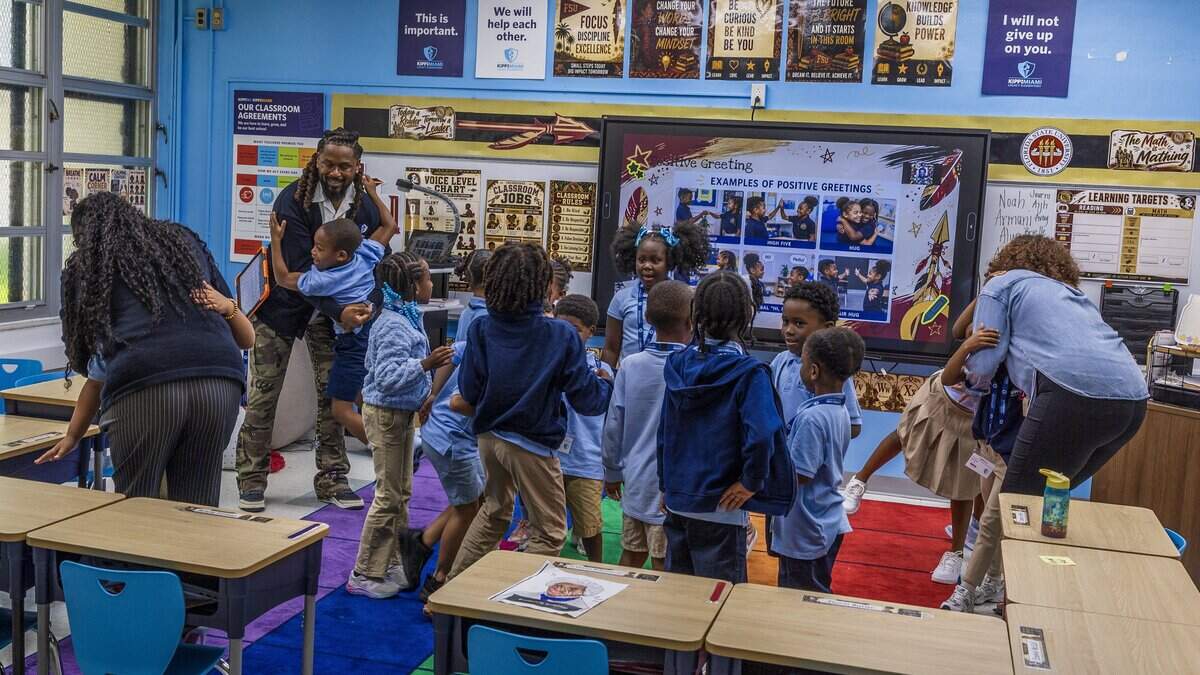
The 6-year-olds shot out of their seats, silently pushed their chairs under their desks, lined up single file and headed to their spots on the classroom’s play mat.
Read more Miami-Dade’s land-conservation program is facing a crippling budget cut
Moments after, Bill Withers’ “Lovely Day” marked the beginning of “positive greeting” time, where students hugged and high-fived each other, their instructors, administrators and even a reporter.
It’s a different approach than what once took place in the classrooms and halls of the old Poinciana Park Elementary building in Liberty City. That’s because it’s a completely new school.
KIPP Legacy School is Miami’s first charter school to operate in an old traditional public school building under Florida’s newly expanded “Schools of Hope” law. The law was recently expanded to allow certain charter school operators like KIPP – short for “Knowledge is Power Program” – to locate in vacant and underutilized school buildings at essentially no cost.
KIPP, the country’s largest charter operator, is leasing the space for 13 years from the district for a nominal $1 fee.
Ten days into operating, the K-6 school has 200 students, already more than Poinciana Park had in its last year of operation, when . The school has capacity for almost 800 kids, so there’s room to grow.
“It’s not lost on us that this was a school that was shuttered, and now we’re a charter operator and we’re reopening it. We want to reopen it in a way where it’s what the community wants here,” KIPP Miami Executive Director Charlie Schmidt said.
What does the community want?
Amid the shifting tides of Florida’s school choice landscape, they want school that will partner with the community and stay in the community, KIPP Legacy principal Stacie Alvarez said.
“To come here, to partner and to stay – that has been our commitment. That’s why the name is Legacy. We are going to be a school that stays,” Alvarez said.
The timeline to start the “school that stays” was tight.
Miami-Dade County Public Schools closed Poinciana Park last summer. KIPP put in its notice of intent to operate in the school in November. In April, the school board approved the lease beginning July 1, when KIPP began $2.4 million in renovations — namely fixing the roof and improving the cafeteria space. School started six weeks later.
Several students used to attend Poinciana Park before it closed, and are glad “to be home,” Alvarez said.
For now, the old school’s sign still looms over the building.
Poinciana Park was far from the only recent school closure. This summer, the school board approved plans to close or consolidate nine more campuses – the most ever in one year – as enrollment declines and ensuing financial pressures stretch the district thin.
KIPP is just one beneficiary of the legislature’s expanded Schools of Hope law, with New York charter operator Success Academy set to co-locate in five Miami-Dade schools starting next year. That venture has the strong backing of Ken Griffin, a local billionaire hedge fund manager and philanthropist.
Schools of Hope are intended to operate in areas served by “persistently low-performing schools,” a designation determined by low performance on state exams or the state school grading system. A School of Hope can also operate in a Florida Opportunity Zone, which are areas with high poverty or low median household incomes. Miami-Dade County has about 67 Opportunity Zones. Schools of Hope contracts state that the school should absorb a certain amount of students from the school zone where they open.
Proponents say Schools of Hope offer parents who live in districts with low-performing schools more options, while critics say Schools of Hope are going to siphon off resources from district-run public schools.
Read more Jury convicts man of murdering woman found stuffed in Florida Keys resort closet
What is the school like?
KIPP is perhaps best known for its emphasis on behavior and structure. But KIPP officials described that emphasis as “culture” rather than discipline.
While the organization has moved away from its famed “no excuses” style, and some of the more harsh disciplinary practices associated with it, the flow of class remains more structured than your average public school. The still-high level of accountability applied to students, Alvarez said, is part of the appeal for parents.
“We merge culture with academics… We don’t believe those two things are separate. It’s not like when you come in here, it’s all about academic instruction and we divorce your own identity, who you are and how it lives and breathes in the space. So, we try every opportunity to build really joyful spaces for kids that they can feel like learning is fun because if they’re invested in the learning that we do, we know it’s going to open tons of doors for them,” Alvarez said.
Plus, students “owning” their behavior gives them another area to succeed beyond pure academics, she said.
“[It’s] being the first to congratulate, but also the first to correct and hold kids accountable to high expectations and what they’re capable of. I think a lot of parents, when we talk with them, are like,’Thank you for creating a safe, loving environment where my kid is both held accountable, but also not seen differently when they make mistakes,’” Alvarez said.
Students undergo guided “restorative conversations” with each other when a conflict arises, she said.
In Ny’Asiah Gordon’s third grade class the class was singing a hip hop-style song about reading, writing and passing Florida’s state test Friday morning. They repeated the chorus line “read that book,” motioning with their hands as if they were cradling one themselves, eight times before sitting down for the bulk of the lesson.
Gordon used the evidence-backed “science of reading” approach, where children are taught to sound out words phonetically rather than guess, also stressing that all the students “track” when one of their peers is about to answer a question. When one student is called upon, all students repeat their peer’s name and turn their heads toward them.
Other protocols include “building” rather than correcting when peers are off the mark in their answers and the sign language sign for “I love you,” when a peer is working through a concept.
It’s too early in the year for KIPP Legacy to have tested its students, but its Miami Dade College campus’s academic track record bests most of its area peers, though it lags behind the rest of the district.
Third- and fourth-graders there outperformed Poinciana Park in both reading and math in 2025, with far fewer students scoring a “1” on a scale of 1-5 and a much higher rate of 3s or above. Still, the school has received a “C” grade from the state in the last three years, showing room for improvement.
In Miami-Dade, Black students make up a smaller share of charter school enrollment than of enrollment in district-run schools; same with students eligible for free or reduced lunch. Not so at KIPP, where a majority of students at both campuses are Black, and last year 99.8% of the student body at the Miami Dade College campus got free or reduced lunch.
Schmidt credited, in part, the Schools of Hope law for allowing the operator to open up shop in one of Miami’s historic Black neighborhoods.
“I think that if this legislation allows for families to get what they’re looking for and produces great outcomes for children, then that is a benefit to the entire community,” Schmidt said.
Read more Miami-Dade’s land-conservation program is facing a crippling budget cut








Post Comment