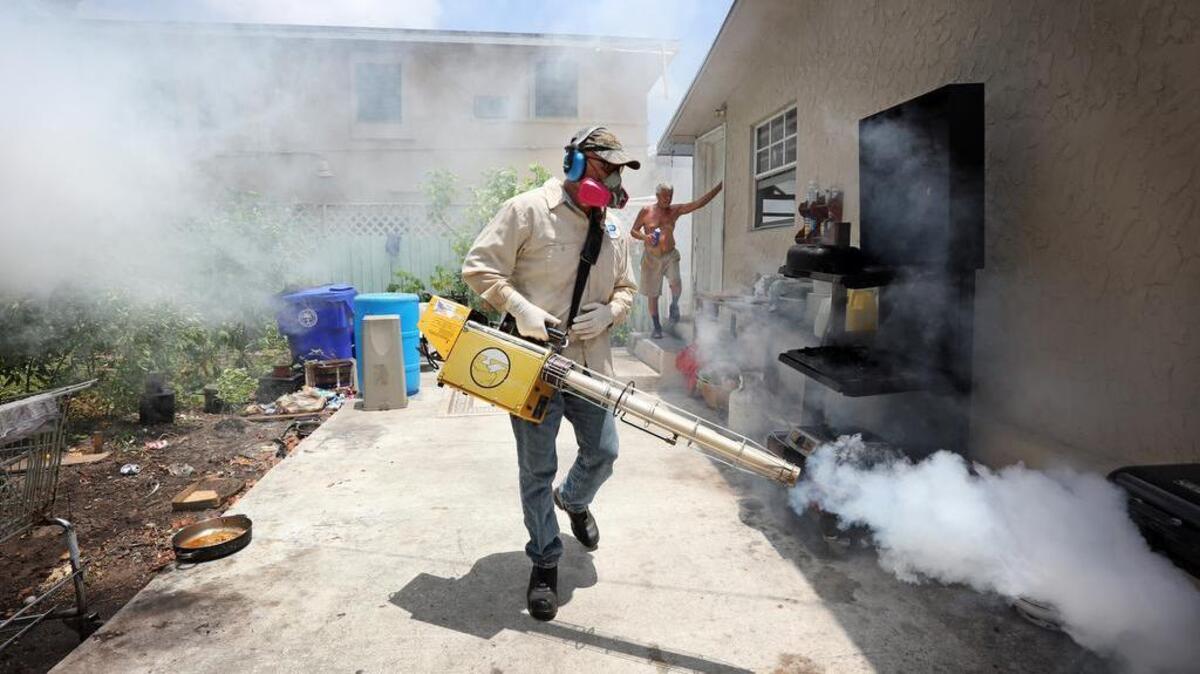
GMOs, drones and radiation: Florida’s war on mosquitoes goes high-tech
Life in Florida was unbearable before the widespread adoption of two life-changing pieces of technology: air conditioning and mosquito control.
Read more GMOs, drones and radiation: Florida’s war on mosquitoes goes high-tech
And while screen doors and a healthy (or, in hindsight, not-so-healthy) dose of DDT might have done the trick in the 1950s, nowadays, the war on skeeters has entered a new front. Here, the Geneva Convention does not apply.
The looming threat of killer diseases — Tampa Bay saw its first locally-acquired dengue death in a century last week — has pushed mosquito control districts to get creative, turning to increasingly unconventional tools, like radiation, biological warfare, drones and genetically modified mosquitoes. Some of the technology is already being used in Florida. Other methods are still experimental or awaiting federal approval.
Mosquitoes have climate change on their side. Researchers have found that a warmer and wetter world is a happier place for mosquitoes year-round. Some studies even suggest that higher temperatures may make it easier for mosquitoes to spread diseases.
More mosquitoes isn’t just an annoyance, it can be deadly. Miami is only a decade away from its Zika outbreak, and Florida appears to be on track to break a record for locally-acquired dengue infections this year.
But the new methods often bring fear, suspicion and pushback from the public, said Jenifer McBride, communications director for Lee County’s mosquito control district. Residents have raised concerns about releasing modified insects into the environment, while mosquito-control officials say they have few alternatives as their existing arsenal loses effectiveness.
“The problem is people think we have all these new chemicals coming out and all these chemicals we can use,” she said. “That is just very far from the truth.”
Plus, she added, “they are becoming less effective.”
Big Tech tries mosquito control
That fear was on full display this spring when headlines trumpeted that Google planned to release millions of mosquitoes in Florida infected with a naturally occurring bacteria that makes them sterile. Those Wolbachia-infected male mosquitoes mate with females (the only gender of mosquito that bites) and produce eggs that don’t hatch.
McBride said she was inundated with calls from freaked out residents — including some politicians — worried that this would unleash something terrible and permanent into the ecosystem. The comments on the federal permit request from Google-owned Project Debug were filled with similar concerns. Project Debug did not respond to requests for comment.
“Their reaction was whatever Google was doing had to be terrible,” she said.
But she had a simple response to anyone who asked her about the Big Tech incursion. They’re not doing anything new, she told concerned callers. This exact technology has been around for a long time. Lee County has been releasing Wolbachia-infected mosquitoes since 2017, and the Florida Keys Mosquito Control District is currently partnered with the company Mosquito Mate to do the same. South Miami tried it in 2018; it was a success.
Research shows that releasing these sterilizing bugs leads to fewer numbers of disease-carrying mosquitoes and no harmful impacts to the ecosystem around them.
“It’s interesting to me all of a sudden there’s this ‘oh no, what are we doing’ when it’s been used for a decade and a lot of these trials have been completed,” said Andrea Leal, executive director of the Florida Keys Mosquito Control District.
Leal said the Keys are wrapping up a 2-year trial with the bacteria-infested mosquitoes, which she called “a great tool” for keeping the winged menaces at bay.
If the results are as good as she expects them to be, the Keys will likely keep buying the Wolbachia mosquitoes to tamp down the local population. But what they’re really waiting for the opportunity to purchase, she said, is the other new mosquito tech that stirred up controversy in recent years — genetically modified mosquitoes.
Jurassic Park
In 2021, the Florida Keys became the first U.S. testing site for male mosquitoes modified to carry a “lethal female gene.”
“When they’re out and mating with the wild females, her female offspring do not survive. The males survive and a half of them have that gene,” Leal said.
The company behind it, initially called Oxitec and now rebranded to Flyttr, did annual releases in the Keys from 2021 to 2023 and a year of monitoring in 2024. Now, they’re waiting on the Environmental Protection Agency to review the data and give them the all-clear to start selling the mosquitoes.
Flyttr did not respond to multiple requests for comment, but Leal said initial results shared with the district were very promising. The population dipped, only male mosquitoes survived and the gene died out in just two to three months after releases stopped, about three generations of mosquitoes.
“It worked exactly as designed,” Leal said.
And while Leal first heard of the concept of genetically modified mosquitoes in 2010 at a mosquito conference, it took more than a decade to actually let the first insect out of the box, thanks to clunky government permitting bureaucracy and tremendous public outcry in the Keys.
Read more Report: Saints OT Kelvin Banks Jr. (ankle) could go on IR
Key West’s city commission passed a resolution objecting to it, even though the release was planned for a mile away in Key Haven. More than 250,000 people signed a petition against it. The Florida Keys Mosquito Control District received thousands of angry emails and held packed webinars and meetings to hear resident feedback.
A 2016 non-binding resolution had split results. Most of Key Haven residents said no way, but the majority of residents in Monroe County voted to allow the trial to proceed. The Mosquito Control Board OK’d it in 2020 in a 4 to 1 vote.
If the EPA allows Flyttr to start selling their mosquitoes in the future, Leal said her district would “definitely consider” purchasing them.
“Our biggest issue in mosquito control is we have very limited tools in the toolbox,” she said. “That’s why it’s so important that we look into novel tech.”
Very few new products hit the market for tightly-regulated mosquito control districts, despite the flurry of products on the shelves at home improvement stores for homeowners. So GMO mosquitoes would be a welcome addition, experts said.
“The reality is we’re probably going to have to go to genetically modified. It does work,” said Lee County’s McBride. “People automatically jump to Jurassic Park, but it’s very safe. It’s going to be necessary as we see these diseases increasing.”
X-rays to the rescue
While GMO mosquitoes may not be shelf-ready for a while, Lee County’s mosquito control district is experimenting with something else: fluorescent, irradiated mosquitoes.
It’s an old technology, born in Lee County’s Sanibel Island in 1951, pioneered with a new insect. Back then, researchers were focused on eradicating the New World screwworm, a nasty pest that lays its eggs in wounds on living creatures. The larvae burrow in and eat warm, live flesh. It’s as painful as you’d expect.
Scientists raised hundreds of the flies and then zapped them with an X-ray, sterilizing them but not killing them. They released paper cups of the irradiated flies by dropping them from a plane. It worked, and led to widespread use of the technology that helped drive the screwworms out of Florida.
In 2022, Lee County’s Mosquito Control District decided to try aiming radiation at mosquitoes instead, specifically the biting, disease-carrying kind — Aedes aegypti. The initial pilot project was wiped out after Hurricane Ian slammed the region, but they started again in 2024.
In a lab in Lee County, the largest mosquito control district in the nation, scientists raise a million mosquitoes a week. At the pupae stage, they can be easily sorted into piles of males and females. Once they hatch, scientists shutter the cloud of male mosquitoes in a cold room, where they get slow and drowsy.
That makes it easier to cram about 1,000 into a 1-by-1-inch box and hit them with radiation. After some quality control checks, including researchers who examine mosquito sperm under a microscope to ensure those swimmers are dead in the water, they get packed into containers for release. As a finishing touch, they’re sprinkled with fluorescent powder that glows under a black light, so scientists can track the ones they release.
“You can’t release mosquitos without knowing who did it,” McBride said. “We have different colors for different areas.”
Lee County is spreading these sterile male mosquitoes all kinds of ways: low flying small planes, by hand and piloted drones. Staffers are also working on designing an automatic feeder that could be used in a van.
Right now, the experiment is focused on the Edison Park neighborhood of Fort Myers. Getting the community on board with this new technology was really important, so McBride said they went door-to-door and spoke to the local news. They even invited students from local schools to witness releases of the sterile, non-biting mosquitoes.
“I want our citizens to know what we’re doing. We’re really transparent,” McBride said.
And while it’s too soon to know the official numbers on this trial, so far, so good.
Read more A history of Warner Bros – from old Hollywood to streaming era
“We’ve seen really amazing results,” she said.










Post Comment