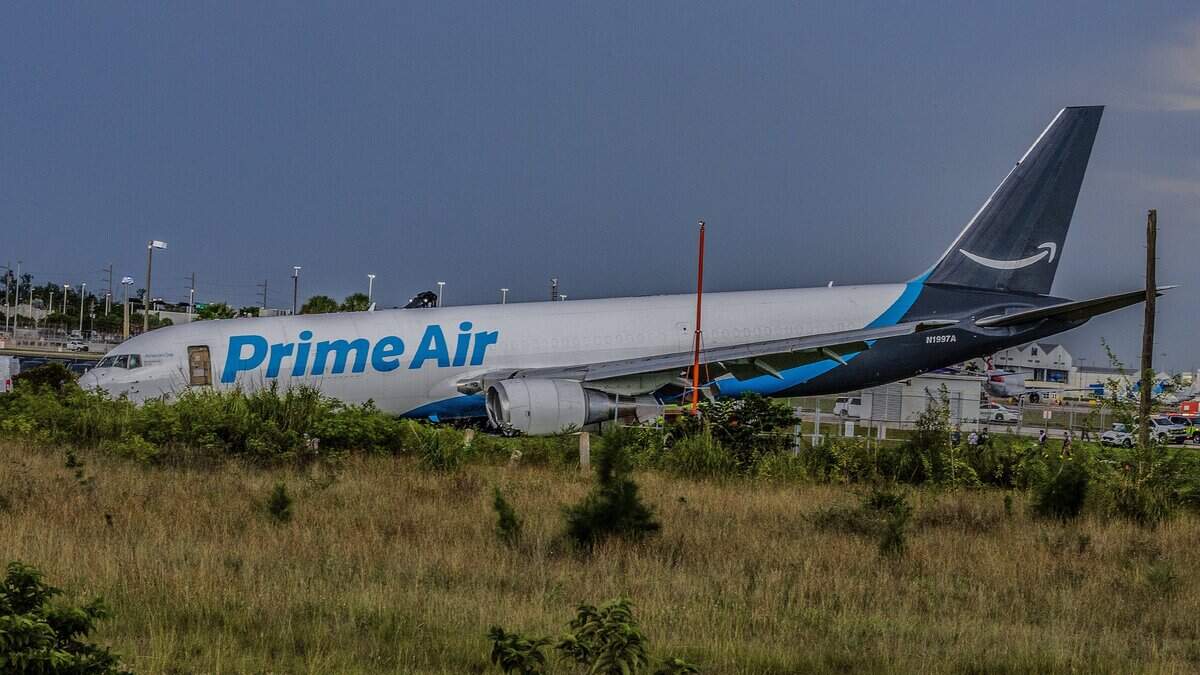
Former pilots weigh in on what may have caused cargo jet to overshoot MIA runway
Federal investigators are just beginning their probe into the crash of an Amazon plane that overran the runway at Miami International Airport on Sunday, killing five people and injuring five more, but those with years in the cockpits of big jets have their theories on what went wrong.
Read more Nearly 24 hours after cargo plane crash, cancellations, delays plague MIA
Bob Thomas, who had a 43-year career flying planes for airlines like Eastern, American Eagle and Southwest, told the Miami Herald the first thing he noticed from videos circulating online was that the Boeing 767-300 was coming in “way too fast,” saying the pilots should have aborted the landing, went back up in the air and tried again.
“They were halfway down the runway at about 180 knots,” Thomas said, referring to a speed of about 207 mph. “That’s when it’s time to go around. You go around.”
Steve Scheibner, a retired American Airlines captain who hosts a popular YouTube channel on all things flying, theorized that the crash could have been caused by several missteps as the jet came in for a landing over the 8,000-foot runway.
On an episode he posted Monday, Scheiber showed a video of the plane coming in above the runway and, judging from the footage, he said the plane was approaching too fast. Scheibner said the plane was still traveling at 172 knots, which is about 30 to 35 knots too fast. That’s about 197 mph, and about 35 mph to 40 mph too fast, in his estimation.
Then, when the nose landing gear touched down first, the landing gear on the left side of the plane —the wheels on the plane’s left side — never seemed to set down on the runway, which was running out as the plane continued to travel at a high rate of speed, said Scheibner, who was also a U.S. Navy aviator.
“They burned down so much runway at this point, it’s not funny,” he said.
Most importantly, Scheibner said he never saw the “spoilers” pop up on the top of the wings. Spoilers are the flaps most airplane passengers have likely noticed that come up as the plane touches down on the runway. They force the aircraft down so the wheels get traction, which makes the brakes more effective, Scheibner said.
Read more Nearly 24 hours after cargo plane crash, cancellations, delays plague MIA
For the spoilers to deploy, three things have to happen. First, the pilot must physically arm them from the cockpit with a lever. The pilot then has to pull the throttle all the way back to idle the engines. Finally, the main tilt sensors on the landing gear have to activate. Then, the spoilers will go up, Scheibner said.
From the footage Scheibner referenced, he said it appears the pilot forced the nose of the plane down first to try slowing it down.
“It’s a really poor way to land this jet,” he said.
And, by the time it appears the left landing gear touched all the way down, the plane only had about 2,600 feet of runway left, and it was still going “screaming fast.”
Thomas also said it looked like spoilers, or lack of them, were an issue. He said there were manual ways to get the sequence going to deploy them, but as the crew was running out of runway, they were probably frantically trying to stop the plane.
“They’re busier than a one-armed paper hanger at that point,” Thomas said.
There were thunderstorms in the area at the time of the crash, but Thomas said pilots are used to flying in stormy weather. “That’s going to happen. That’s no reason to overrun a runway.”
Read more A Publix and Miami gas station sold 2 of Sunday’s 3 lottery draw big winners









Post Comment