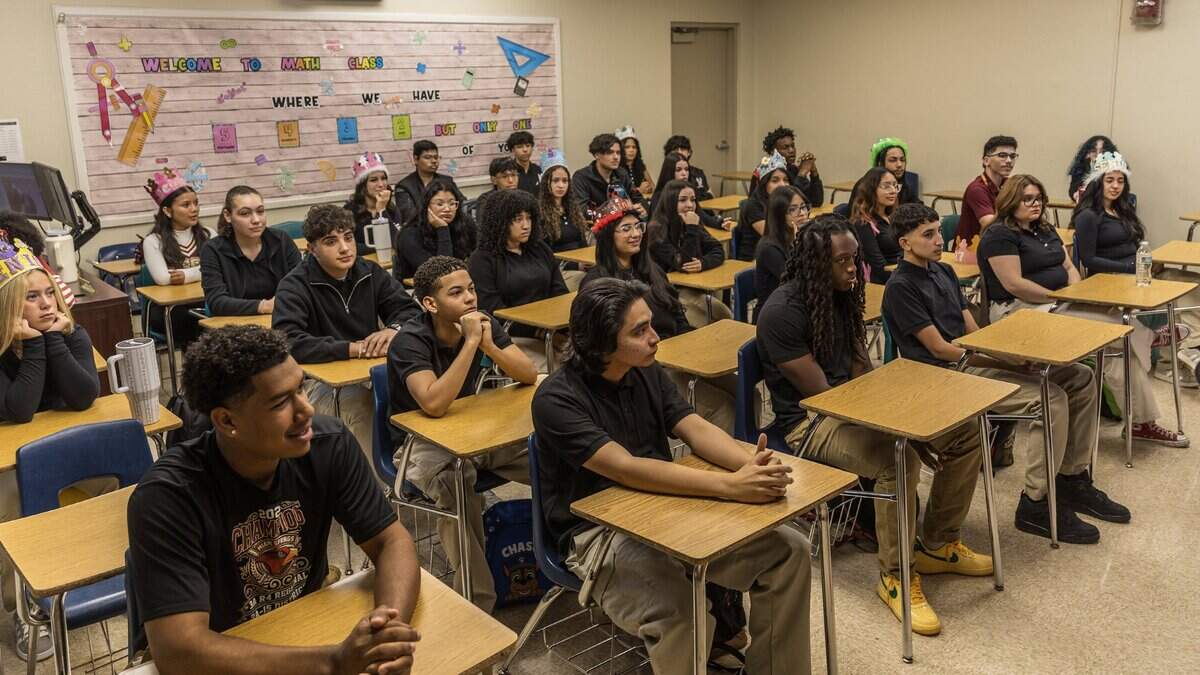
Florida schools are at a tipping point. Donalds and Jolly have different visions
Three decades of Republican rule in Florida have brought the state’s education system to the precipice of a new era — one in which privately run institutions play an unprecedented role in teaching the next generation.
Read more Record rain swamped Key West streets, and Miami got soaked. What’s next?
Exactly 30 years after the first Florida charter school opened in Miami, more than one in four students now attends one or subsidizes a private-school education with a taxpayer-funded voucher. In Miami-Dade, one of the largest school systems in the country, that number is more than 44% of all preK-12 students.
With vouchers alone topping $4.5 billion this year in Florida, and hundreds of charter schools in operation, the school-choice explosion has granted parents a whole new level of control over where their children attend school. But it has also disrupted the flow of taxpayer money to Florida’s traditional public schools, which are contracting and in some cases closing altogether as students leave.
Into the moment steps the Florida governor’s race, featuring a Republican nominee who wants to keep charging ahead and a Democratic candidate who thinks the school-choice system is broken — even though he uses it for his own kids’ education.
“My position has always been: I’m not here to pick which school is going to be funded,” said Republican nominee Byron Donalds, husband to a former Collier County School Board member and charter-school operator. “I’m here to make sure that parents have the purchasing power to make those decisions.”
He sees himself carrying on the work of past Republican governors: Jeb Bush, the architect of Florida’s school choice movement, and Ron DeSantis, who signed the universal voucher into law.
Democrat David Jolly sees something else: A model of education that increasingly looks like a caste system, where families with fewer resources settle into underfunded public schools taught by underpaid teachers.
Donalds “is okay with public education becoming a platform for a permanent underclass,” said Jolly, who wants to rein in — but not unravel — the flow of public money to private and charter schools.
The candidates’ different views reflect the disparate perspectives among Florida families about the state’s push to have public education money “follow the student.”
While the number of students attending traditional public schools has stayed stagnant at around 2.38 million since 2000, the number of students attending Florida charter schools — which are privately run but free of charge and considered public — has ballooned from about 27,000 to more than 408,000 today. The private school population has also expanded from 349,000 to nearly 497,000 as of the latest count, from two years ago.
“While a free society has a real interest in an educated citizenry, that interest does not require the state to run the schools. It does not justify a monopoly on how it is delivered,” state Education Commissioner Henry Mack wrote in a recent social media post. “Why not give the money to the family? Let parents choose among approved providers.”
But as more families choose to attend class outside their government-assigned boundaries, once-mighty schools like Miami Killian Senior High, which has seen its enrollment drop from 3,000-plus to 430, are shrinking. Dozens of other schools in Miami-Dade are below 50% capacity. The district this summer closed or consolidated nine public schools — many of them anchors in underserved communities — and has cut its operating budget.
A similar contraction is taking place in Broward County.
Holly Bullard, chief strategy and development officer of the left-leaning Florida Policy Institute, says Florida’s policies have left traditional schools to rot.
“You cannot fund two school systems … with the same general pot of money and not expect profound pain and upheaval — and that’s what we’re starting to see now,” Bullard said.
For supporters of school choice like the Foundation for Florida’s Future, an education advocacy group founded by former Gov. Bush that pushes for choice and accountability, the disruption is the consequence of competition, where families’ extra options incentivize better results across the board, even if some schools don’t make it.
“There are numerous improved outcomes for the kids who participate and for the kids who choose to stay,” said Patricia Levesque, the foundation’s executive director.
The Numbers
So, has Florida’s school-choice push led to better-educated students?
Comprehensive test results are difficult to track. Little consistent data exists. Florida has replaced its statewide reading and math tests three times since 1999 and has made changes to scoring rules, subjects and more during that time.
The National Assessment of Educational Progress (NAEP), the lone test administered country-wide to public and charter school students by the U.S. Department of Education, offers some data. For Florida, the results are mixed.
In the 1990s, Florida’s fourth graders were testing well below the national average. By the mid-2000s, they had caught up, and come 2019 they’d leapt far ahead of the rest of the country. That lead has sustained in math, but in reading, Florida’s scores dropped precipitously from 2022 to 2024.
The eighth-grade numbers are less rosy. In math, Florida kicked off the ‘90s below the national average and has stayed there. Reading scores started below the average, too, but reached parity in the mid-2000s. In both subjects, however, Florida’s scores declined more steeply from 2022 to 2024 than the rest of the country.
State-level NAEP data does not include private school student scores, though shows students at those schools performing significantly higher in reading and math.
NAEP also , including Miami-Dade. The district’s scores roughly track with the rest of the state and usually rank high among 26 other large, urban districts in the nation.
Florida’s dip from 2022 to 2024 is concerning for all in the state’s education space, pro-school choice or not.
“I think the big picture for whoever is the next governor is we’ve got to turn around Florida’s declining performance in reading and math. Florida used to be the state that everyone talked about,” Levesque said.
Choice ideas
Donalds and Jolly have different visions for steering the state’s system of education.
Choice is king for Donalds and his wife, Erika. That shapes their perspective on technology in the classroom, what will help improve outcomes and how they address enrollment.
Read more This upscale mall restaurant in Kendall just reopened after a big makeover
Asked if the declining enrollment in traditional public schools is a problem to fix, Donalds responded quickly.
“I think this is what parents are choosing, and districts are going to have to respond in kind,” Donalds said.
The bigger question on enrollment, he said, is what districts choose to do with the property left behind. Many districts, including Miami-Dade, have leased their buildings out to private schools or other education or childcare enterprises. Some have been forced by the state’s new Schools of Hope law to share their space with charter schools.
Five traditional public high schools are slated to begin sharing their buildings with charter operators next school year. One such charter school opened over the summer in a closed Liberty City elementary school site.
Choice advocates like Levesque argue the state needs to make permitting easier for private schools, even proposing a state-backed revolving loan fund to spur construction and meet the spiking demand. Donalds says he would support easing permitting restrictions, but framed it under his overall agenda on decreasing permitting timelines for multiple types of development.
In the classroom, Donalds’ campaign message has focused on his plan to provide every Florida student with a personalized “student success plan” meant to shepherd them into a college or career that fits them best. His platform also features an evidence-based “science of reading” emphasis.
Though it’s less an emphasis of the gubernatorial campaign, Erika Donalds has advocated for a certain amount of technology, including artificial intelligence, in schools. In addition to her Collier County School Board background, she has established charter school nonprofits, for-profit management companies and a company that develops virtual reality teaching tools.
Teacher pay is another hot issue in the state. Florida’s $56,663 per teacher ranks next-to-last nationally in average teacher salary, leading only Mississippi, according to a report from the National Education Association. Nationally, the average teacher is paid $74,495, according to the NEA.
Donalds supports raising pay for all teachers.
“Do we want to be able to pay teachers more? Absolutely, we do. We want to also make sure that that’s ubiquitous, whether a teacher is in the traditional system or whether they’re in a private school or a charter school,” Donalds said.
Donalds has also suggested reforms for the school grading system. Levesque said it’s in need of major change.
Initially ushered in by Bush, the grading scale has grown too lax, awarding “A” and “B” grades to too many schools that don’t teach enough of their students to read and understand math, she said.
What is Jolly proposing?
Jolly promises to bring about a “10-year renaissance in public education,” headlined by a 30% increase in teacher pay and a promise to keep neighborhood public schools intact. He also wants to rein in voucher spending.
“We’re the third-largest state with the fourth-largest GDP, and we’ve chosen to pay our teachers dead last in the nation. It’s a moral wrong, and from a business perspective it’s just stupid,” Jolly said.
His big proposed limitation on the choice system would be to force schools that accept vouchers to cap tuition at the rate of the voucher. That’s around $8,000, making it essentially free for the family.
With a Republican Legislature, Jolly might face some roadblocks to getting that done. That’s something he recognizes, saying he’d end-run lawmakers and push for a ballot initiative that asks voters to divert money that currently goes to support tourism initiatives like convention centers.
“We don’t have a crisis of convention centers. We have a crisis in teacher pay. We have a crisis in public education funding,” Jolly said.
Donalds hears something else when he hears Jolly talk about his “renaissance” for public education.
“What I hear is school choice is going to be rolled back. What I hear is that parents are going to lose the choices that they have been afforded, and I find that to be interesting because Mr. Jolly right now uses school choice,” Donalds said, making note of Jolly’s use of the universal private school voucher for two of his children.
Miami-Dade School Board Member Joe Geller doesn’t see it that way.
He said a potential Jolly administration would bring “vast and ubiquitous” change to the GOP-dominated state, but wouldn’t erase school choice.
Instead, Geller, a former Democratic state representative, said Jolly would bring back needed attention to the state’s public schools.
“Literally everything in the state changes after 25 years of being the same, relentless attack on traditional public schools. You can’t overestimate what a significant change this would be, top to bottom, of 25 years of consistent philosophy based on attacking public schools and the people who work in them,” Geller said.
Florida parents are, by and large, still choosing to send their children to public schools. Among public school students, about 85% still go to traditional public schools. More than four times as many students attend traditional public school than go to private schools.
But the numbers show that vouchers and charters schools are attracting a larger share of students each year, reflecting the popularity of school choice with Florida families.
On Election Day, voters will help decide how much further they want to push the school-choice movement.
Read more In heated Gables election, scrutiny over Castro’s Tallahassee trip, Lago’s UM ties






Post Comment