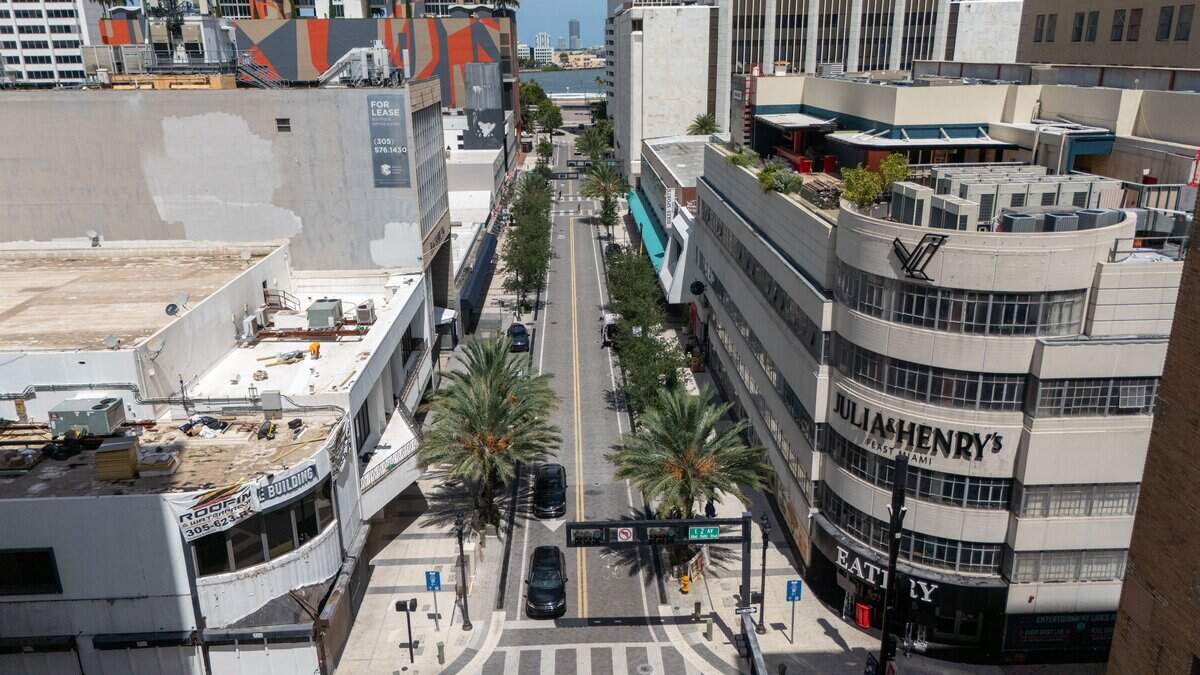
Construction is finally, finally over. Can historic Flagler Street reinvent itself?
Ten years ago, on the heels of a flubbed sidewalk beautification project, the city of Miami broke ground on what was to be a total makeover of historic, bedraggled Flagler Street in the heart of downtown.
Read more What Haitians need to know about TPS, ICE after legal status in U.S. ends
To bring new life to Miami’s original Main Street, there would be wider, nicer, more durable sidewalks for outdoor cafes and improved walkability. New shade trees and historically appropriate lighting. A design that allows the street to be closed to cars for markets and festivals. Better drainage to end persistent street flooding.
It was just the start of what one longtime downtown advocate has dubbed “the fiasco on Flagler” — a decade-long nightmare of stop-and-go-and-stop-again construction, fired contractors and legal battles, design changes, and endless traffic detours and street closures leading, inevitably, to a string of business closings and ballooning costs that climbed from $13 million to $32 million.
But it’s all over now. Mostly.
Earlier this year, months after work on the project stopped entirely amid a fresh city-contractor dispute, newly installed Miami Mayor Eileen Higgins and City Manager James Reyes stepped in, hiring subcontractors directly to wrap up enough of the work to fully reopen Flagler for the first time in six years.
The job’s not yet completely done, but there are early signs of a rebound along the five long downtown blocks covered by the Flagler streetscape revamp, which runs from Biscayne Boulevard to the corner of West First Avenue, where the Dade County Courthouse stands. Construction fences and barriers are mostly gone, traffic is flowing, pedestrians are strolling and a dozen new businesses have opened along the corridor, with several more on the way.
”Fortunately, the fiasco on Flagler is no more,” said Terrell Fritz, veteran director of the Flagler Business Improvement District, a nonprofit funded by a special tax on local property owners. “The economic damage was significant. But the energy is very different, and now you can really start to see it. It’s time to stop talking about the streetscape project and focus on what’s next.”
What’s left to do?
What’s next remains to be seen. An experiment earlier in the year to use a completed section of the new street as intended — closing it to traffic for outdoor events on weekends — was a success, especially during the FIFA Fan Festival in Bayfront Park in June and July, when a pop-up party clubhouse on Flagler drew throngs of people to local bars and restaurants.
But it also posed an unexpected challenge that the city and agencies will have to grapple with. Closing the street was so expensive, mainly because of required police and security, that organizers say it’s unfeasible to try again without a reduction in cost.
Another lingering uncertainty is the fate of the historic Olympia Theater, a Flagler Street cornerstone that’s been effectively shuttered. The City Commission in September controversially opted to sell the landmark for $10 to a public charter school that has pledged to renovate it and provide unspecified programming in the future, though precise plans have not been announced.
Work on portions of the reconstruction project, meanwhile, is still to be finished, including some sidewalk sections, as well as repair of construction damage done to previously completed blocks of the revamped street.
The city also has to decide what to do about having ended up with mismatched street surfaces on Flagler, part of which is paved with luxurious cement brick and part with plain asphalt — the result of a midstream redesign and the decision by Higgins and Reyes to reopen the street quickly.
The city still has $1 million more, in the form of an appropriation from the Florida Legislature this last session, to apply to the Flagler streetscape, according to staff for Miami Commissioner Ralph Rosado, who also serves as chairman of the Downtown Development Authority, which applied for the state money. That could go to completing the repaving of the street with the brick paving, applied so far only east of Miami Avenue, or to create a formal entrance for Flagler. But the city’s required to raise matching funds, and no final decision has been made.
But there’s another inconstant element on Flagler that neither the city nor its agencies have any control over.
The street’s ultimate fortunes rest to a significant degree on the slow-baking plans of entrepreneur Moishe Mana, who after more than a decade of amassing some 80 downtown Miami properties now owns much of Flagler Street. In March, Mana acquired his largest piece of the street when he bought the former SunTrust Bank tower, on the south corner of Flagler and Biscayne, for $110 million.
Mana has spent years renovating an old office building just off Flagler into what he calls the Nikola Tesla Innovation Hub while refining ambitious plans to renovate and redevelop rows of century-old shops and other buildings he owns along the street, many of which have long been sitting vacant.
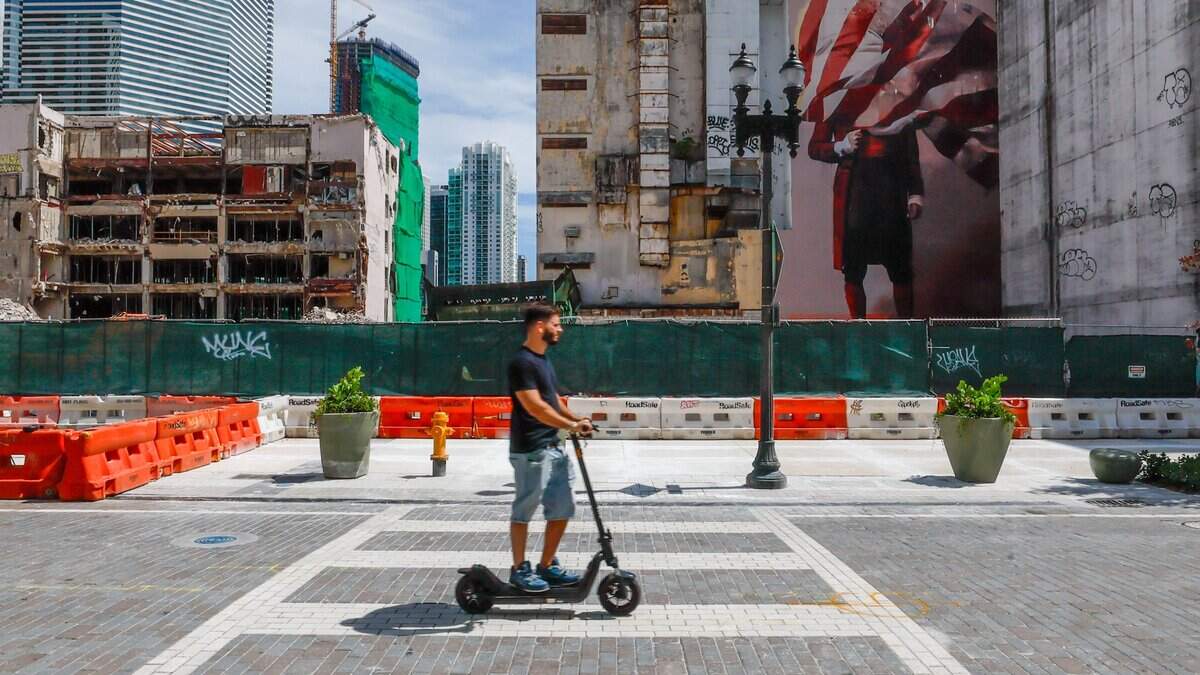
Mana has also been engaged for the better part of a year in the snail-paced demolition of a half-block’s worth of his buildings on Flagler that were condemned as structurally unsound and unsalvageable. Because the properties directly abut the Metromover line, work can take place only overnight when the mover cars are not running and must proceed under extreme precautions.
That’s meant that a new section of sidewalk along the properties undergoing demolition remains fenced off.
Once the teardown is finished, however, Mana and the DDA say they are teaming up to build a temporary soccer park on the site, including one regulation field and some mini pitches.
What caused the delays?
Mana has also been a key player in the Flagler streetscape plan, which the city and the DDA launched after brick-paver sidewalks installed under a previous beautification scheme in 2004 began to prematurely crack and fade.
Construction work on the new plan began in 2016 and was supposed to take two years but stalled after one year when the contractor, locked into running disputes with the city over cost overruns and persistent delays, was fired. The contractor in part blamed a series of surprises uncovered below ground — tangles of jerry-rigged utility lines no one could account for, including wooden water lines, dating back to the city’s earliest days and apparently still in use, that needed to be moved or replaced.
At that point, only the westernmost block, in front of the county courthouse, had been completed.
As the city geared up the slow process of selecting a new contractor, Mana urged officials to consider a more ambitious plan that would markedly upgrade materials and design, including brick pavers on the street and a curbless layout to provide a flat surface all across for festivals and other events.
Read more Traffic alert: Major crash in Broward shuts down a stretch of I-95
Mana paid for a conceptual plan, and the city embraced it. Work on an enhanced plan was supposed to restart in 2019 but was again delayed, this time by the COVID-19 pandemic. The project, now with a $27 million budget, finally kicked off in 2021 and was supposed to proceed in phases over two and a half years.
By the middle of 2025, though, project general contractor Lanzo Construction had finished only the easternmost two blocks of Flagler and had started on the next two-block section that would connect to the long-finished section at the county courthouse. Work was once more suspended by a disagreement between the city and Lanzo.
Because that newest phase of work required the closing of the intersection of Flagler and East First Avenue, traffic and a busy bus route had to be rerouted along adjacent one-way streets, spreading congestion through a stretch of downtown and significantly prolonging bus riders’ trips.
When Higgins took over the mayor’s seat, she made clearing up what she termed the Flagler Street “disaster” a priority. By March, the long-closed East First intersection was formally open again.
“They did it so fast we couldn’t believe it was happening,” the Flagler BID’s Fritz said.
How businesses have been faring
By then, Fritz said, property and business owners along the street had given up on waiting for the project to be finished and had hatched plans to begin promoting a new Flagler Street anyway, Fritz said. Although sidewalks remained open throughout construction, he said, visitors were discouraged by a forbidding maze of high construction fences and barriers obstructing views of businesses.
Loss of foot traffic, coming after pandemic shutdowns, meant that surviving businesses folded one after another. Some did manage to hang on, especially on the two blocks that were done first, in particular the bars Lost Boy Dry Goods and Over Under, longtime street stalwarts.
“Last year it was literally at a standstill,” Fritz recalled. “We didn’t know when it was going to go forward.”
Starting in February, the BID and the DDA teamed up to organize a series of Flagler Weekends, with live music, Saturday green markets and Sunday vintage markets, leading up to the FIFA fan fest. One April weekend, selected to coincide with the opening of the Miami Film Festival at the historic Olympia Theater and dubbed Heritage Days on Flagler, was dedicated to one of the city’s founders, industrialist and railroad magnate Henry Flagler, after whom the street is named.
The unexpected opening of the street in March provided a further, welcome boost in the runup to the FIFA event, which saw the DDA set up a soccer pitch in the middle of Flagler and Lost Boy raise an air-conditioned pop-up tent to lure visitors.
“That was wildly successful,” Fritz said. “All the bars and restaurants saw an enormous influx.”
But it was also wildly expensive, he added. The 14 weekend closures cost more than $130,000, about 70% of that for Miami police to secure intersections. Doing a full winter season would cost $415,000, an amount Fritz said his agency and the DDA can’t justify.
The DDA is now paying for traffic analysis to find out how to make it more manageable in terms of security, money and personnel, and the agencies are raising sponsorship money and still hope to restart weekend closings in October, he said.
But the street improvements, especially the wider sidewalks, are starting to pay off in other ways. An accompanying zoning change means that places serving alcohol on Flagler are not subject to spacing restrictions and can now have sidewalk seating all along the street.
The agencies have also turned their focus to promoting leasing and improving the look of buildings along the street, where low-scale, one- or two-story retail buildings, some of them in sad shape, are mixed in with office towers, including historic gems like the Alfred I. duPont building.
Mana commissioned, at his own expense, a massive brooding Mona Lisa mural on the side of his headquarters’ office tower at East First Avenue and used colors from the painting to handsomely refashion his storefronts on the 100 block of Flagler with fresh paint and smoky new glass fronts, though most remain vacant.
The DDA provided cash grants to support the opening of several new businesses along the street.
The result is that 13 new businesses have either opened this year or are about to open on Flagler and on abutting side streets, including a pizza restaurant, a cigar club, a wine shop, and a French bakery and cafe. Seven more have signed leases, including a contemporary art gallery and a Vietnamese pho spot.
With the leasing emphasis clearly on food and beverage establishments, Flagler appears poised for a future as an entertainment district, in contrast to its past as a retail shopping street — though Fritz doesn’t rule out the return of at least some stores, and Mana has said his aim is to attract tech, fashion and other creative businesses.
The task remains tall, Fritz said, but things are looking up for the first time in years.
”What our retail mix will be is going to evolve,” Fritz said. “Now we need to get to work and start filling the empty storefronts that remain.”
Read more Couple accused of having sex at a South Florida mall in front of customers








Post Comment