Can President Donald Trump promise $5,000 to voters? What the law says
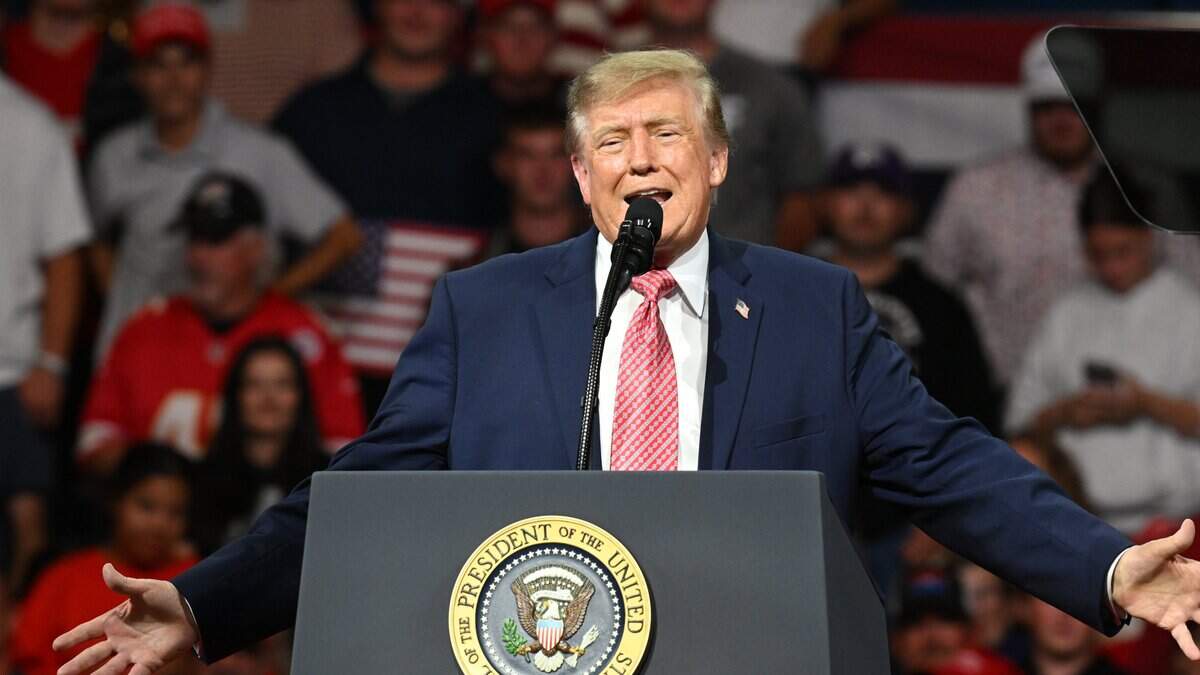
“If you elect a Republican House and a Republican Senate on November 3, you get $5,000,” President Donald Trump said Monday, Oct. 19 at a rally supporting U.S. Sen. Roger Marshall in Park City, Kansas. “And if you lose, you get nothing.”
Read more Hialeah paid Calvo’s political consultant thousands to text about mayor’s events
Trump once again mentioned his promise to pay every American adult $5,000 if Republicans kept control of both chambers of Congress after the Nov. 3 midterm election. It’s an idea he first shared in September during the GOP’s midterm convention in Dallas.
He said at the convention in Dallas that the reasoning for the proposal was the country’s “tremendous economic success,” also saying that the United States “is making so much money.”
The promise follows another Trump promise, when he said he’d give Americans $2,000 tariff dividend checks last November. Trump also called a $5,000 DOGE dividend, based on savings from the now-shuttered initiative headed by Elon Musk, a “great idea.”
Those checks never went out to citizens.
Is paying $5,000 to U.S. residents for keeping Republicans in control of Congress something Trump can do? Is it legal? Here’s what the facts say.
Can Trump pay $5,000 to U.S. citizens?
Under U.S. federal law, it is illegal to give or accept payments that are intended to influence the way a person is voting. The penalty is not more than a year, and two if “willful.”
“Whoever makes or offers to make an expenditure to any person, either to vote or withhold his vote, or to vote for or against any candidate; and
“Whoever solicits, accepts, or receives any such expenditure in consideration of his vote or the withholding of his vote—
“Shall be fined under this title or imprisoned not more than one year, or both; and if the violation was willful, shall be fined under this title or imprisoned not more than two years, or both.”
Reading this, it appears that Trump’s willful promise to give $5,000 to U.S. citizens (and the acceptance of the money) could land Trump and voters in jail.
But experts say he’s not violating any laws. And if it is legal for Trump to make this promise, he would need congressional approval to make the promise a reality.
Rick Hasen, an election law professor at UCLA, said in a blog post that “Trump would have a strong First Amendment defense” for his promise.
Read more A Florida airport is solving its ‘biggest issue.’ What to know about parking
Hasen cited the 1982 Supreme Court decision, , in which the court “rejected a Kentucky attempt to remove a successful county candidate from office after he had promised not to take a salary in apparent violation of a Kentucky anticorruption law barring promises of things of value to voters.”
“Even if one could take Trump at his word that he would secure legislation to give these payments (ha!), I believe they are constitutionally protected,” Hasen said. “How is this different from a candidate pledging if elected to secure ‘medicare for all’ or to cut everyone’s taxes?”
Another blog post from Mohamed ‘Arafa, who is joining the Indiana University Maurer School of Law, Bloomington as a visiting scholar in 2027, said that because Trump was acting as a public official, the proposed benefit can be linked to a standard campaign promise.
‘Arafa said that Trump’s promise offers a financial perk for voting a certain way, but that the promise alone doesn’t make it bribery.
Richard Painter, a government ethics expert and corporate law professor at the University of Minnesota, told PBS that he agreed with Hasen, saying that Trump’s claims are protected by the first amendment.
Although Trump is not a candidate, Painter said candidates are otherwise allowed to make campaign promises, such as raising or lowering taxes or funding social programs.
The latest U.S. Census Bureau estimates say that there are around 245 million adult citizens in the country. Giving each person a $5,000 check would cost around $1.2 trillion. It’s unknown how they would make the payments if approved, but Vice President JD Vance claimed the payouts would draw from tariff revenue.
National polling shows that most Americans are skeptical of Trump’s promise. A recent NBC News Decision Desk poll taken with Survey Monkey reported that 14% of U.S. adults expect the $5,000 check, and that 47% of self-identified Republicans say they don’t expect to receive one.
42% of respondents “definitely” don’t think they will receive the check and 29% say they “probably” won’t get it, according to the NBC News poll.
This story was originally published October 21, 2026 at 3:30 PM with the headline “Can President Donald Trump promise $5,000 to voters? What the law says.”
Read more Photos: Sacramento picket lines for largest state worker strike in California history








Post Comment