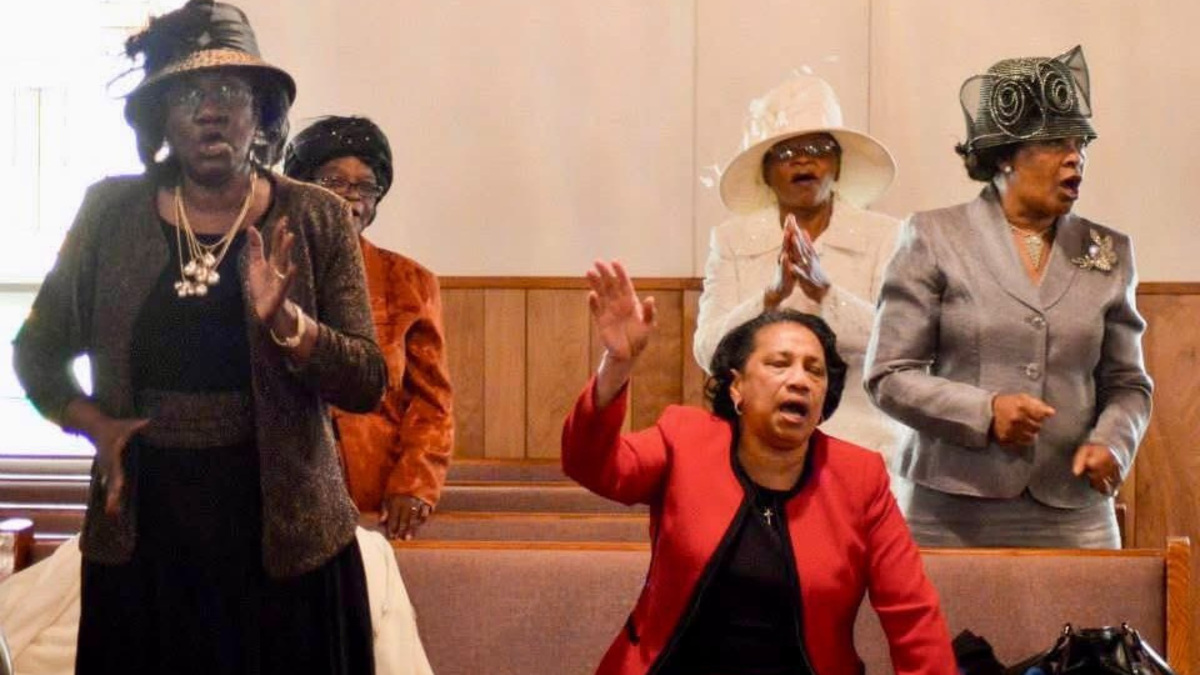
‘Black joy personified’: Project explores spirituality in Florida
Every so often, little Isis Jones would spend her summers worshipping with the church mothers and praisers at Mount Trial Primitive Baptist Church in the rural area of Sopchoppy, a small, historic town in Wakulla County, Florida, located about 45 minutes southwest of Tallahassee in the Florida Panhandle.
Read more Saturday’s two lottery winners, one worth $10 million, sold at Publix stores
Growing up in the Baptist church, it isn’t hard to remember the fancy hats, getting up extra early to put on your Sunday best and the sounds of hymns radiating through the church pews as worshippers pour out their hearts.
As for Jones, what she remembers most about the church is that it was the first place she learned who God is and who she was called to be.
Faith has long been a central part of Black identity and community, shaping generations of traditions, relationships and resilience. Churches have served as safe havens where generations of believers with shared backgrounds, struggles and cultures could gather, worship and uplift one another, creating a sense of community rooted in faith.
But the influence of those institutions doesn’t necessarily end when worshippers walk out the church doors. That’s what the REVIVAL research team is taking a closer look at.
With the help of Florida Humanities, the statewide nonprofit affiliate of the National Endowment for the Humanities, the research team was granted a Public Humanities Program Grant to support ongoing research in Wakulla County. Their discoveries take a closer look at the impact of long-standing institutions like Mount Trial Primitive Baptist Church, whose roots date back nearly 200 years.
According to the researchers, the church was established by formerly enslaved Africans and Black Indians after emancipation. It is also the owner and operator of Buckhorn Cemetery, 10 acres of memorial burial grounds.
Researchers and interviewees iterate that the local church is an anchor for its community where traditional practices like the washing of feet, baptisms and devotions continue to be pivotal in sister churches established by its members.
Now, the team includes Jones, the director of “REVIVAL: Where Black American Spirituality Lives, Breathes and Moves,” Neal Lester, a foundation professor of English at Arizona State University and independent scholar Randy Nelson.
They hope to document and share the complex diversity of Black American spirituality, starting closer to home but making it a national initiative because “Black spirituality is not singular in expression,” a release shared with the Tallahassee Democrat said.
Faith as a way of life
For this exploration, the investigators partnered with scholars, artists, faith leaders and community members to “document stories of Black American spirituality as a living system of faith, memory, resilience and community building,” it continued.
“Some of the lessons that we’ve learned about Wakulla is that there is a true sense of self that is understood through the connection to others. In Wakulla, your identity is very much tied to your relationship with God, and your relationship with God is exercised through your love and service of others, and also in your excellence of that service,” Jones said in an interview with the Democrat.
“For me, coming from there and having spent time as a child there, I know that everywhere I go, I must present my best self first. But there’s also a space for me to be embraced and to be loved in that space when I’m not perfect, but also it’s never about just myself.”
Read more Iman Shumpert called out media overexaggeration of Caitlin Clark and Angel Reese’s rivalry
Jones said being grounded in these teachings from an early age helped her find her purpose: carrying those same lessons and seeds into the world and showing who God is through her own life. She’s found that same calling among others connected to the Baptist church in Wakulla, where faith is not only something practiced in worship, but something carried into how people serve, love and show up for one another.
Nelson reiterates the same sentiments.
“Showing the world the essence of rural country living and the spiritual aspect of it,” Nelson said, was his goal with the project. “I’ve had the opportunity to go around the world, but there’s no place like Wakulla to me and people don’t understand that. I think that this particular project allows folks to see that. Spirituality is one thing, but the ability and strength of a people to rise in spite of.”
Conducting research
Early this year, the team began their documentation.
Story circles, one-on-one interviews and virtual chats with groups ranging from five years old to 90 years old have been the central point of the team’s research.
“When we go in, we’re not doing traditional research,” Jones said. “We went in and said, ‘Hey, we want to talk about Black American spirituality. We might ask a few questions, but if you don’t have a word answer, you can give us a poem,’ which some people did.”
To get specific, their findings examine over 300 oral histories, storytelling, music, worship traditions and community archiving collectively; the project aims to document how “spiritual practices continue to shape identity, belonging and cultural memory as a historical anchor in Black communities across generations.”
“We just buried a member of the Wakulla community of Mount Trial, actually a longtime deacon there, who passed at 90 years of age. But we went to go visit him. He was dealing with some bouts of memory loss due to dementia, but when we began to ask him questions about the mourners’ bench, questions about what his role was as a deacon, he might not necessarily always remember things… but when we began to talk about the mourners’ bench, he went somewhere in his mind… that’s what I mean by the stories that we’re encountering with people outlive whatever circumstance they’re going through. So that’s kind of been a very wonderful experience too.”
A living museum of Black joy
By the end of the year, they plan to bring all of their findings together in a living museum where songs, dances, testimonies, art and performance pieces will come to life in a space that guests will be able to interact with.
“Here is Black joy personified, and too often our stories of Black folks are about trauma and hard times and struggle, and it can be about both of those,” humanities scholar Lester said. “That’s what I’ve gotten most out of this, and what I hope that our final project display exhibition shows is Black Joy, that can emerge and does emerge from all the things that’s happening in the world.”
Lester said Wakulla has a grounding that creates a kind of protective distance from the turmoil happening beyond the community’s borders. In that space, he said, residents have been able to hold onto a sense of focus, faith and connection even as the world around them changes.
“I think that’s also what makes it more joyful is that you’ve got people here who are saying, no matter what’s happening in the world, I know where my focus is and my eye is on a prize that’s bigger than that.”
This solutions‑focused article is supported by a grant from Press Forward North Florida, an initiative of the Community Foundation of North Florida. To learn more and to support local journalism like this, visit cfnf.org/press-forward.
This article originally appeared on Fort Myers News-Press: ‘Black joy personified’: Project explores spirituality in Florida
Read more Jonathan Taylor Among the Best Underdog Fantasy Football Props for NFL Sunday Night Football
Reporting by Kyla A Sanford, USA TODAY NETWORK – Florida / Fort Myers News-Press
USA TODAY Network via Reuters Connect
Copyright Reuters or USA Today Network via Reuters Connect
This story was originally published September 20, 2026 at 8:52 AM.







Post Comment