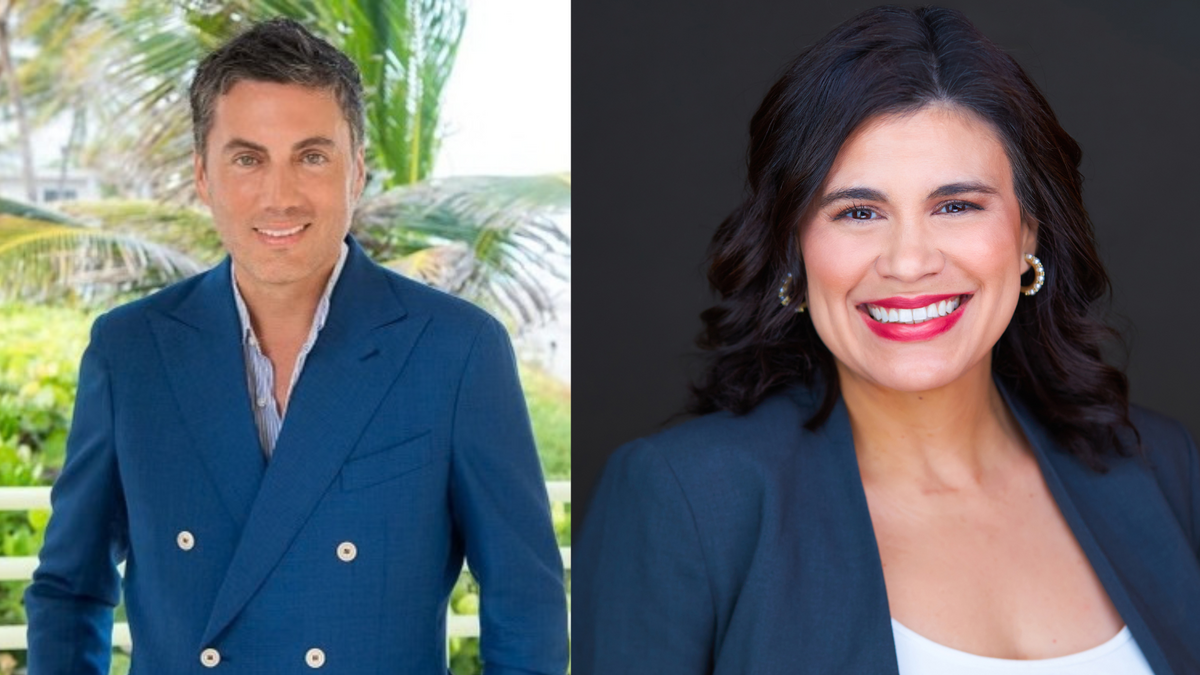
Báez-Geller denounces political ads accusing her of connections to terrorist groups
A former Miami-Dade school board member running for a state district seat said she’s the subject of a “hateful” new political ad wrongly accusing her husband’s law partner of being a terrorist sympathizer and questioning her support for Israel and the Jewish community.
Read more Báez-Geller denounces political ads accusing her of connections to terrorist groups
In a video posted to X.com last week, Lucia Báez-Geller, the Democratic candidate for Florida House District 106, says her opponent, Republican incumbent Fabián Basabe, is responsible for spreading “disgusting lies” about her and her husband, David Geller, ahead of the race to represent the coastal district that stretches from Miami Beach north through Surfside, Bal Harbour, Sunny Isles Beach and Aventura.
A political ad originally posted by a MAGA blogger on X.com made the internet rounds last week and was picked up by conservative Miami influencers and later amplified by Basabe himself. The ads speculate that a personal donation of $250,000 — which Báez-Geller loaned to herself, according to campaign finance records — was bankrolled by “Islamic blood money,” drawing connections between Báez-Geller and foreign terrorist groups.
State Rep. Basabe, said while he didn’t “finance or create the ads,” he believes the videos circulating “are completely fact-based.” Basabe told the Miami Herald that he supports the issues and questions the videos raise about Báez-Geller’s campaign finances, the organizations that have endorsed her and her support for Israel — which he echoed in his own video posted to X.com yesterday.
“If a bill comes to the Florida House floor aimed at divesting state funds from companies supplying the IDF, will Lucia Baez-Geller vote with the progressive organizers and unions who funded her campaign, or will she vote with the pro-Israel constituents of her district?” Basabe said.
Báez-Geller said she doesn’t buy it. She believes the ads are coming from Basabe and are meant to be a distraction from his recent legal troubles. Basabe was found liable for sexual harassment in July; he owes $450,000 in damages in a civil trial that accused him of sexual harassment, battery and defamation.
“Fabian Basabe has been proven in a court of law to be a serial liar and was just found liable for defamation of one of his own sexual harassment victims,” Báez-Geller told the Miami Herald. “As a school board member I was proud to fight back against antisemitism.”
The political ad accuses Báez-Geller of being connected to terrorist groups through her husband’s law partner, Khurrum Wahid — a well-known criminal defense attorney in Miami who is also a founding member of Emgage Florida, a civic engagement group which started over 20 years ago. The ad also calls into question Wahid’s connection to the Council on American-Islamic Relations or CAIR, a nonprofit organization that has been in a legal battle with the state after DeSantis declared it a terrorist organization last year. CAIR has denied alleged ties to terrorist groups and has been described as the “Muslim ACLU” by members of the community.
Báez-Geller said in her own video posted to social media that her “family’s commitment to Israel and the Jewish community speak for themselves.” She pointed out her personal ties to the Jewish community through her family’s long time membership at Temple Beth Sholom in Miami Beach, and said as a school board member she helped pass the International Holocaust Remembrance Alliance (IHRA) definition of antisemitism.
“Let me be clear: anyone challenging my family’s commitment to the Jewish community is lying. Period,” she said. “I am and always will be a strong supporter of the Israel and Jewish community.”
While Báez-Geller focused her response on her track record with the Jewish and Israeli community, the ad itself is inherently focused on connecting Báez-Geller to a prominent South Florida Muslim attorney who sits on the board of Muslim organizations. The anti-Muslim rhetoric is not novel in the political world of attack ads, but seems to be more normalized in Florida, according to experts who spoke with the Miami Herald.
Islamophobia in the political world
Wahid, Geller’s law partner who was the subject of the ad, told the Miami Herald that as a high-profile Muslim attorney who is active in his community he is no stranger to attacks like the one in the ad, which perpetuates a type of “racism” that’s becoming more normalized by Florida elected officials, he said.
Read more California X-ray technician gets 120 days in jail for fondling patient
“This isn’t new stuff for me. I feel terribly bad for all the candidates who are getting smeared in this way, because the racism against me will turn into an opportunity for their opponents to use that racism against the candidate in a slightly different way,” Wahid said.
Geller and Wahid are law partners at Wahid Vizcaino Geller LLP, a trial-focused firm that offers a range of legal services. Wahid is a criminal defense attorney who has worked on some of the country’s most high-profile and controversial cases, including the Hafiz Khan Taliban financing case in 2013, in which Wahid defended Hafiz Khan, a man who was convicted of being part of a global conspiracy to funnel money to the Pakistani Taliban. Recently, Wahid was the lead defense attorney in the death penalty case of a Miami man who pleaded guilty to the horrific triple homicide of his estranged wife and her two young daughters.
The ads also call into question Báez-Geller’s connection to Emgage Florida, a civic organization that focuses on building political literacy, civic equity, and mobilizing Muslim-American voters and other minority groups. The group, which is heavily active in the Miami-Dade and Broward County area, runs voter registration drives, hosts candidate forums, and lobbies local governments. The group successfully advocated for public schools to recognize the Muslim holiday Eid ul-Fitr as an official school planning day so that students could have the day off.
Wahid’s involvement in political and civic engagement groups, coupled with the fact that he’s defended a lot of people who many would think of as “the bad guys,” makes him “low-hanging fruit” for attack ads, he said.
“That is, I believe, my job as a criminal defense lawyer, to stand up for the Constitution, and everyone deserves a zealous defense, regardless of who they are and what they’re charged with,” said Wahid, who reiterated that he does not adopt the same views as his clients just because he represents them in a court of law.
The political ad against Baez-Geller is an example of larger trend in U.S. politics where anti-Muslim rhetoric is becoming more commonplace, seemingly as more Muslim-Americans become elected in positions of power.
In a closely-watched Senate race in Michigan, for example, Democratic nominee Abdul El-Sayed could become the first Muslim U.S. senator in American history if elected. El-Sayed’s religion has been the subject of much debate, sparking online discussion about the double standard among those who fights for freedom of religion and whether mainstream religious groups, like Christians, are treated more favorably than those from minority religions.
Many Muslim-Americans feel as though their faith is being used as a cudgel against them in a political world that sometimes treats Muslim candidates as outsiders, rather than citizens. Muslims in Florida are feeling the impact too, according to Omar Saleh, an attorney for CAIR Florida who often represents individuals in religious discrimination cases. Some feel less welcomed in Florida in recent years, as politicians continue to promote anti-Muslim rhetoric and create legislation targeting Muslims.
As for the political ads and online influencers connecting everyday Muslims to foreign terrorism, “The goal is to inject as much fear as possible,” said Wahid.
This story was produced with financial support from Trish and Dan Bell and donors in South Florida’s Jewish and Muslim communities, including Khalid and Diana Mirza and the Mohsin and Fauzia Jaffer Foundation, in partnership with Journalism Funding Partners. The Miami Herald maintains full editorial control of this work.
Read more NASCAR Hall of Famer diagnosed with CTE, first known case in racecar driver









Post Comment