As deportation flight lands in Haiti, U.S. says two planeloads a week will start soon
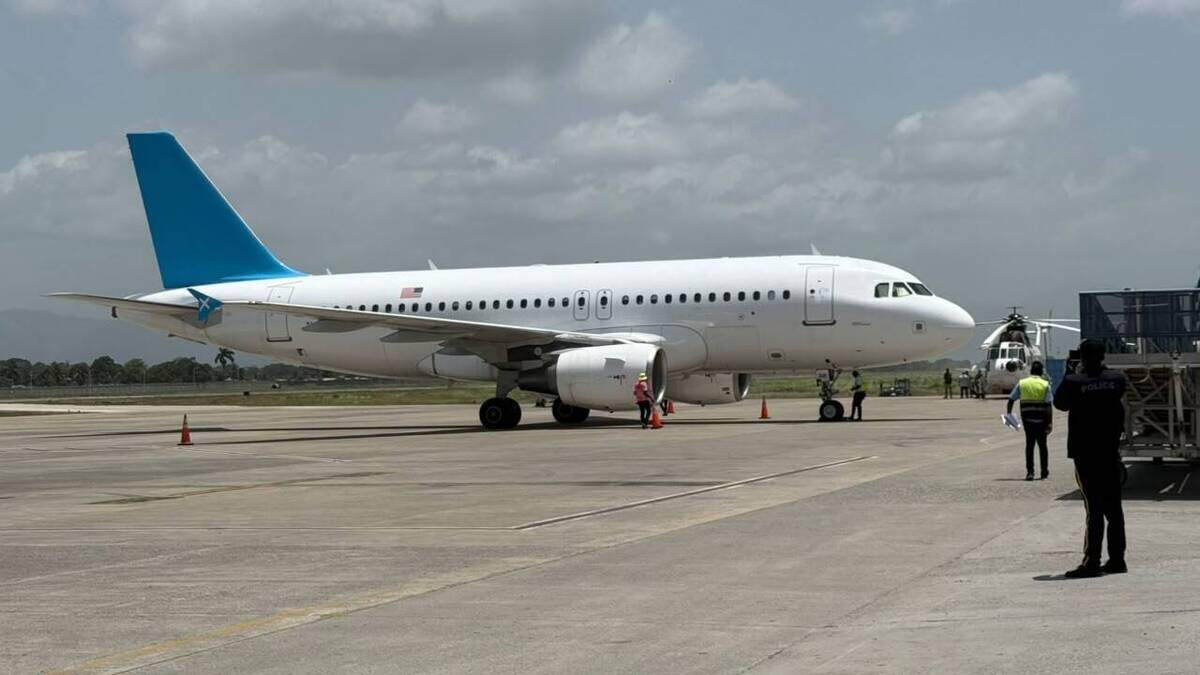
Days before hundreds of thousands of Haitians in the U.S. are set to lose deportation protections, the Trump administration on Thursday flew more than 100 Haitian nationals back to the Caribbean country, signaling the start of what Haiti officials and immigration advocates expect to be a surge in removals beginning next week.
Read more Under 40 in Miami? The homebuying math keeps getting worse
More than 300,000 Haitians in the U.S. will lose Temporary Protected Status on July 24, leaving them vulnerable to detention and deportation.
The plane carrying the deportees arrived on the same day the United Nations confirmed that a deadly gang rampage in the hills above Port-au-Prince had left at least 61 people dead, including 14 children.
“Escalating deportation flights to a country engulfed in violence and instability, and deporting people with Temporary Protected Status who have built their lives, families, and communities in the United States, is an abomination,” said Savi Arvey, policy director for refugee and immigrant rights at Human Rights First, which monitors deportation flights.
“These deportations blatantly ignore the reality on the ground and knowingly put lives at risk,” she added.
Thursday’s Immigration and Customs Enforcement charter flight originated from Miami, and departed shortly after 11:30 a.m. It arrived at Cap-Haïtien’s small international airport in the afternoon.
Two deportation flights a week
U.S. officials have warned the Haitian government that after TPS protections end next week they should expect at least two weekly flights carrying around 200 people. The deportees return in shackles with nothing more than the clothing on their backs even after years or decades in the United States.
The prospect of mass deportations to a country reeling from deadly gang warfare, a deepening humanitarian emergency and record numbers of people who have fled their homes has alarmed Haitians at home and abroad.
“Haiti is truly not prepared to receive these people,” said Katia Bonté, coordinator of Groupe d’Appui aux Rapatriés et Refugiés, GARR, a Haitian nonprofit that has worked since 1991 to protect the rights of migrants, refugees and deportees, particularly those expelled from the neighboring Dominican Republic.
READ MORE: Supreme Court TPS ruling could deepen Haiti’s worsening crisis, experts say
The organization is already struggling to assist an estimated 20,000 Haitians who are deported each month from the Dominican Republic, often in miserable conditions.
Most of Haiti’s West region, home to Port-au-Prince and the gateway to the country’s other nine geographic areas, is under the control of armed gangs, which have torched police stations, hospitals and schools. Buildings that haven’t been destroyed have become makeshift encampments where displaced families live with no toilets, electricity or security.
Bontés group, which has managed to keep its officers in the Christ-Roi neighborhood of the capital despite attacks, is now sandwiched between three camps and private homes occupied by some of the displaced, she said.
Deadly gang attack in Kenscoff
On Thursday, as Haiti’s Office of National Migration prepared to receive the latest group of deportees in Cap-Haïtien, Stéphane Dujarric, the spokesman for U.N. Secretary-General António Guterres, told reporters in New York that following a documented attack on July 9 in the town of Kenscoff, human rights colleagues had reported more attacks.
The 5 Segond gang, led by one of the country’s most notorious gang leaders, Johnson Andre, aka “Izo,” had carried out a series of attacks in Kenscoff and Pétion-Ville in the Port-au-Prince metropolitan area.
“Residents were killed while attempting to flee inside their homes or after encountering gang members on roads and footpaths,” Dujarric said. The violence was concentrated in the community of Robin and at least 5,840 people were displaced, he added, “while homes and telecommunications infrastructure were just outright destroyed.”
In northern Haiti, where deportation flights are landing in the city of Cap-Haïtien because U.S. commercial flights are still barred from flying into Port-au-Prince, life isn’t much better. The port city, which served as the capital of the pre-independence Haiti, is struggling to absorb people displaced by armed gangs in the West, Central Plateau and Artibonite regions, as well as Haitians deported from other countries.
The city has expanded more than fifteenfold compared to its size in the 1970s, said Michèle Oriol, the former head of a Haitian government agency responsible for land-use planning and territorial development. Oriol recently told Magik 9 radio station that in addition to the risk presented by a major earthquake fault that runs near the city, the overcrowding is “a public health disaster waiting.”
READ ME: Haitians are set to lose TPS benefits on July 24. Here is what they need to know
Read more Miami-Dade now leads Florida in cases of people sick with diarrhea parasite
Beyond the rampant gang violence, Haitians are facing widespread hunger. More than half of the population is unable to find enough to eat.
That hasn’t stopped the Trump administration’s deportation efforts. Even before the end of TPS on July 24, the administration notified Haitian authorities that it will start increasing the number of flights.
Haitian officials were told that those onboard Thursday’s flight were TPS beneficiaries but were given no information to verify that. A spot check of the manifest showed that at least two were not born in Haiti while several deportees have criminal histories. They include registered child sex offenders and convicted drug traffickers. One passenger was identified by U.S. authorities as a gang member at the time of his arrest.
‘Now is not the time’
Haiti’s security and humanitarian situation remains extremely fragile, with essential public services under severe strain and the country’s ability to receive an influx of returnees already overwhelmed by the tens of thousands who have been sent back from the Dominican Republic.
At this current rate, the country has told U.S. officials, any sharp increase in the number of returnees would exceed their ability to provide humanitarian assistance or help with reintegration. There is also another problem: Haiti’s prisons are already severely crowded, and two of the largest prisons have not been rebuilt following 2024’s massive prison break by gangs launching coordinated attacks.
“We understand it’s temporary,” Haiti Prime Minister Alix Didier Fils-Aimé said about TPS policy in the United States. “But T also stands for timing. This is not the time to send those people back.”
Under U.S. law, the Department of Homeland Security must review conditions when deciding whether to renew or end protections for a country. Internal documents filed as part of the U.S. Supreme Court case that paved the way for Trump to end TPS show that former DHS Secretary Kristi Noem did not carry out the required consultations with other agencies about conditions in Haiti.
READ MORE: ‘Noem lied’: Emails suggest DHS ignored federal law to end TPS for 350k Haitians
In June, the U.N.’s International Office for Migration reported that recent gang attacks had driven the number of people forced to flee their homes to a record 1.47 million as of May. That number has since gone up with the fresh attacks in Kenscoff.
“For the first time, the metropolitan area of Port-au-Prince alone counted more than 300,000 displaced persons,” the immigration office said. “At the same time, more than 25,000 Haitian migrants were forcibly returned from neighboring countries, many arriving with urgent humanitarian needs.”
Bonté said her colleagues working along the Haitian-Dominican border see those needs on a daily basis.
“It’s a catastrophic situation where all you see is misery,” she said. “These are areas where services were already nonexistent or weak, like schools, hospitals.”
In arguments in federal courts before the Supreme Court ruling, lawyers for Homeland Security argued that Haitians deported from the U.S. don’t have to live in gang-controlled territories and they could relocate elsewhere.
Bonté said the reality is more complicated. Even when public buses or motorcycles are able to travel along back roads or main roads controlled by gangs, the trip is “obsessively expensive and highly risky,” she said. “Yes, there are other regions without the gang problem, but they are saddled with a lot of other problems.”
Deportations will deepen crisis
Guerline Jozef, executive director of the U.S. advocacy group Haitian Bridge Alliance, said the deportations and the expected surge of people will only deepen Haiti’s crisis.
The latest gang attacks “highlight the growing humanitarian and security crisis facing communities that were once considered safe havens from the violence affecting much of Haiti,” said Jozef, renewing her calls for a halt to the deportations.
“These deportations are how the U.S. is literally adding gas to the fire and will create more chaos, instability and force more people to flee.”
Read more Hear from candidates vying to succeed Frederica Wilson at forum in Little Haiti
This story was originally published July 16, 2026 at 2:47 PM.










Post Comment