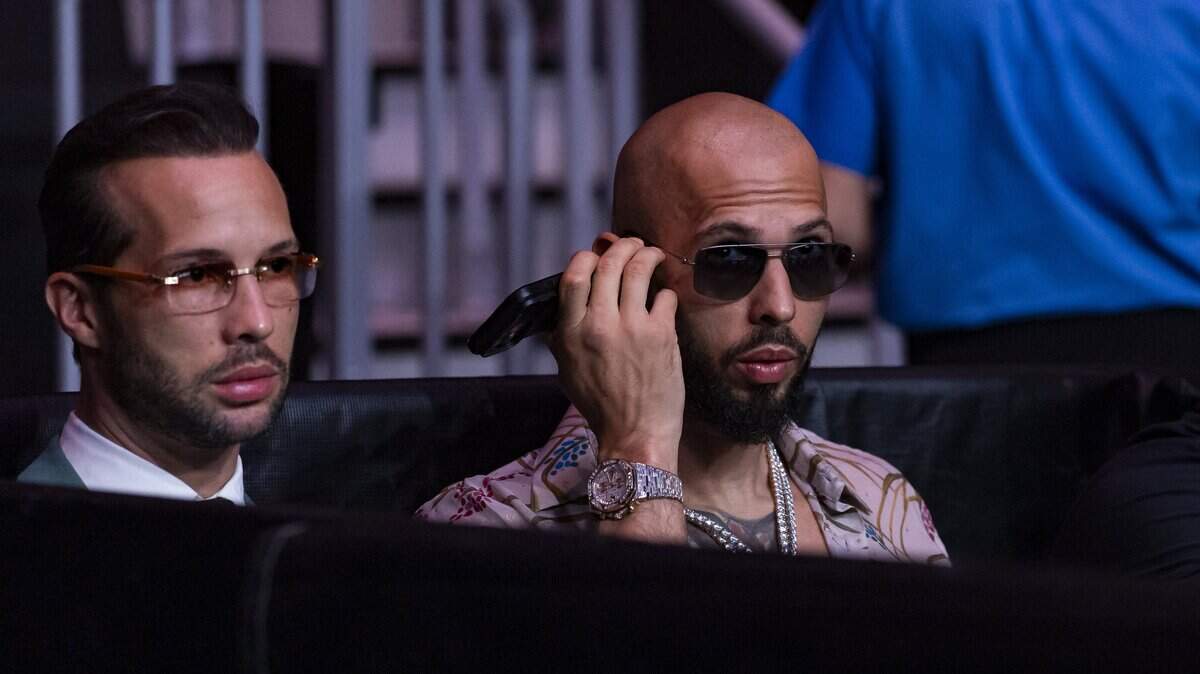
As Tate brothers fight to be freed, they say their personas are just for show
For years, Andrew and Tristan Tate sold millions of followers a fantasy of almost limitless freedom.
Read more Coral Gables to investigate claims of paid speakers at zoning hearings. What to know
Private jets. Exotic cars. Cryptocurrency. Mansions around the world. The ability to cross borders whenever they pleased.
Andrew Tate, the former kickboxer who transformed himself into one of the internet’s most recognizable and polarizing influencers, cultivated the persona of “Top G,” a man wealthy, connected and independent enough that ordinary rules seemed barely to apply.
On Thursday, that image followed the brothers into a Miami federal courtroom.
Andrew and Tristan Tate took the witness stand in shackles and tan jail jumpsuits and argued that they cannot adequately defend themselves from criminal sex charges in Europe if they remain locked up at the Federal Detention Center in Miami while fighting extradition to the United Kingdom.
During nearly two hours of testimony under oath, the brothers denied criminal accusations that they face across multiple countries, lashed out at critics and prosecutors, and tried to explain the extravagant public identities that they spent years constructing online.
The private jets, the luxury cars, the declarations of extraordinary wealth and freedom, they said, should not necessarily be taken at face value.
Some of those displays of luxury, they testified, involved things that they did not actually own — part of the carefully cultivated images surrounding their exaggerated online personas. Those personas, they repeatedly insisted during their testimony, were not entirely the men sitting before the judge.
The hearing stretched for roughly eight hours and ended without a decision from U.S. Magistrate Judge Lauren Louis. Afterward, the brothers were returned to jail while Louis considers whether they should remain detained or can be released under restrictions as the extradition case proceeds.
That distinction between persona and person has suddenly become extraordinarily important.
Andrew, 39, and Tristan, 38, are being held while the United Kingdom seeks their extradition to face dozens of criminal charges, including accusations of rape and sexual assault. They deny wrongdoing.
To win release while the extradition case moves forward, the brothers must overcome the strong presumption against bail in international extradition cases and persuade Louis that they are neither dangerous nor likely to flee, while also establishing the “special circumstances” that courts generally require to release someone awaiting extradition.
And during the unusually lengthy hearing, much of that argument came down to a question created partly by the brothers themselves:
How much of the Tate mythology should a federal judge believe?
Prosecutors argued that the brothers’ own public claims about wealth, passports, cryptocurrency and unrestricted international travel demonstrate precisely why ordinary bail conditions might not hold them.
Their lawyers offered the reverse interpretation. The swagger, they said, is marketing. The cars and private jets are part of an image. The offensive comments are comedy and hyperbole. And the brothers’ actual conduct — years of international travel while returning to face court proceedings in Romania — shows that they do not run.
For two men whose fortunes were partially built by blurring the boundary between personality and performance, the distinction could now help determine whether they remain behind bars.
‘Top G’ enters federal court
Perhaps the clearest attempt to separate the public Andrew Tate from the private one came from Natasha Sesay, his longtime romantic partner who traveled from Dubai to testify.
Sesay described a man almost unrecognizable from the aggressive online personality familiar to millions of followers.
She said Tate was calm at home, rarely argued, did not raise his voice and had never been violent toward her. She described him as a loving and attentive father. She said they have an 8-month-old child and are expecting another through surrogacy.
“Top G,” she explained, was something else.
Sesay characterized the persona as an alter ego — a provocative internet character that Andrew uses to attract attention, entertain an audience and make money. She compared Andrew’s online character to Batman and Tristan’s to James Bond.
“Top G is like Andrew’s alter ego,” she testified. “It’s a character” that says provocative things, she said, but “it’s really … how he makes money.”
“A lot of it is comedy,” she added. “It’s a very different character to the one that I know personally.”
Tristan Tate later offered an even more elaborate explanation.
Asked by the judge who Top G was, Tristan said the persona was essentially “5%” of his brother’s personality amplified for the internet.
Its underlying message, Tristan said, was conventional: work hard, exercise, stay away from drugs and crime. But those messages alone would never attract hundreds of millions of viewers.
So Andrew exaggerated.
Tristan compared the strategy to Sacha Baron Cohen’s Borat — an outlandish character capable of attracting an audience that a conventional motivational speaker could never reach.
“Top G is a hilarious character,” Tristan told the court. “I couldn’t live with Top G, and I couldn’t spend any time in a secure housing unit with Top G. I think he’d get on my nerves.”
“Luckily,” he added, “Top G is not a real person.”
Andrew himself acknowledged making what he called “stupid” and controversial statements about women and other subjects. He described Top G as an exaggerated, gangster-like caricature influenced by Baron Cohen’s Ali G character and said many of the videos now being used against him were made years ago.
The government’s position is essentially that the court should not dismiss all of that material as theater.
Prosecutors played clips and cited social-media posts that they said were relevant both to dangerousness and flight risk. In one recording cited during argument, Andrew says: “Slap, slap, grab, choke, savage, sex.” Prosecutors argued that the online content provided some indication of the men behind the personas, especially when considered alongside the violent sexual-assault allegations that they face.
The defense countered that no accusers appeared at the Miami bail hearing to testify against either brother and argued that disputed foreign allegations should not be converted into proof of dangerousness before an extradition hearing has even tested the government’s case.
The court is not deciding whether the Tates committed the crimes alleged in Britain or Romania at this stage.
But their public images have nevertheless become evidence.
When wealth becomes a liability
Few social-media figures have advertised wealth as aggressively as the Tate brothers.
Prosecutors seized on those claims.
They pointed to public portrayals involving private aircraft, cryptocurrency, watches, luxury automobiles and plans for a custom, $50 million superyacht. They cited a $2.1 million Aston Martin and Bugattis that the Tates had presented as being worth $5 million and $7 million.
The message that prosecutors drew from that lifestyle was straightforward: these are not ordinary defendants whose movements can be controlled by taking away passports and placing ankle monitors on them.
The brothers, prosecutors argued, have portrayed themselves as people with enough money, international connections and access to private transportation to move between countries with ease.
Defense lawyers responded that prosecutors were treating advertising as an audited financial statement.
Andrew denied being a billionaire. He denied owning a jet or yacht and said he did not own a Bugatti. He characterized much of the luxury imagery surrounding him as “social-media hyperbole.”
Both brothers also said Romanian authorities had seized much of what they actually owned.
Tristan testified that the Romanian government had taken approximately $15 million in property, including gold bars, cash, cars, real estate and even savings accounts established for his children.
“They took everything that I’d ever made in my life,” he told the court.
Andrew similarly said the asset seizures left him with so much financial pressure that he returned to fighting to generate income, taking a heavyweight boxing match against American reality star Chase DeMoor in Dubai in December 2025. DeMoor, whom Tate described as younger and substantially heavier, defeated him by majority decision.
The argument about finances produced one of the hearing’s central paradoxes.
If the brothers’ online presentation is accurate, prosecutors argue, their enormous resources make them a formidable flight risk.
If it is exaggerated, as the defense now says, then one of the foundations of the Tate brand was an intentionally constructed illusion.
Seven passports — and ‘Vladimir Scorpius’
Nothing captured that collision quite like the debate over passports.
Prosecutors pointed to social-media material that is associated with Andrew and that they said contained boasts about having seven passports, access to cryptocurrency and few ties to any particular location. One post, according to the government, effectively challenged authorities: “If you wanna come get me, then come get me.”
Then came “Vladimir Scorpius.”
The government introduced material involving what appeared to be a Mexican passport carrying Tristan Tate’s photograph and biographical information — but bearing the name Vladimir Scorpius.
Tristan did not deny knowing about the passport.
Instead, he gave an explanation entirely consistent with the strange world surrounding the Tate brand.
Vladimir Scorpius, he testified, is a fictional supervillain from one of his favorite books. The passport, he said, was a fake printed by an assistant around 2021.
He denied ever traveling on it.
He also pointed out that he had never even been to Mexico.
“I would certainly never do anything so stupid as to try to travel on it,” Tristan told the court.
Read more Traffic Alert: Both directions closing on the Dolphin Expressway
Prosecutors were not satisfied.
They said the purported passport contained an identification number. A prosecutor told Judge Louis she entered that number into a Mexican government website and obtained a record associating it with the name Vladimir Scorpius and Tristan Tate’s photograph.
Louis pressed the government.
Had Mexican authorities actually authenticated the passport? When had it been issued? What did the identification number establish?
The prosecutor said the number appeared valid but acknowledged the material did not establish an issuance date. The judge also noted that the government’s supporting document was in Spanish and lacked a certified English translation, which she requested.
The exchange left the court with an almost uniquely Tate-like problem: an apparently official identification number attached to a purported passport bearing an internet celebrity’s face and the name of a fictional supervillain, while prosecutors and defense lawyers fought over how much of it was real.
The family men
The defense tried to replace the image of borderless influencers with another identity: fathers with powerful reasons to stay put.
Sesay said Andrew was involved with his children and made them a priority. She described Tristan similarly.
Asked whether the brothers would abandon their children to flee prosecution, her answer was immediate.
“Never.”
She said she had “zero concerns” that either would disappear. Andrew, she testified, had told her that fleeing would make no sense because he considers himself innocent and would then spend the rest of his life looking over his shoulder.
Prosecutors challenged Sesay’s independence.
She acknowledged under cross-examination that Andrew provides housing, food and medical support for her family and sometimes gives her luxury items, including handbags, shoes, jewelry and cars.
Tristan, who took the witness stand despite saying his lawyer had advised against it, spoke at length about his own children.
He said he has eight.
One, a 6-year-old daughter with autism, lives in Dubai. Tristan said that whenever he is there he makes a point of putting her to bed personally and, when traveling, calls her every day.
Asked if he loved his children, Tristan replied: “With all my heart.”
Then, when asked whether he loved them all, he injected the sort of humor that has always been part of the brothers’ public personas.
“Some more than others.”
He later said that clearing his name had become more urgent because his children were becoming old enough to see news about the allegations against him.
“My children are getting old enough to watch the news,” he testified. “I need to clear my name.”
From private jets to splitting a Twix
The hearing also displayed a striking reversal in lifestyle.
Tristan described life at the Federal Detention Center as physically and psychologically punishing.
He said the brothers were confined for long stretches in a small secure-housing cell with a toilet visible from outside, excessive heat, ants and roaches. He complained of little sunlight and limited exercise.
He also said the food was inadequate for two men accustomed to maintaining large, athletic physiques.
Tristan testified that he had fallen from at least 245 pounds to 231 pounds after being jailed. He said commissary access was initially so limited that they rationed snacks.
At one point, the brothers split a Twix bar.
For men whose internet image revolves around extreme abundance, the detail offered an almost cinematic contrast.
But the government cited detention-center records showing the brothers had been permitted to buy beef jerky, Snickers bars, noodle soups, toiletries, vitamins and headphones.
And prosecutors said medical records directly contradicted claims of significant weight loss: Andrew, according to the records cited in court, went from 209 pounds when arrested to 212 pounds, while Tristan went from 232 pounds to 233.8.
Tristan also testified that a chemical spray used against inmates in a nearby cell traveled through the ventilation system into the brothers’ cell, leaving him coughing and suffering eye and throat irritation. He said the effects lasted at least 24 hours and that he received no medical treatment.
Defense attorneys described their confinement as effectively punitive segregation even though the brothers had not committed disciplinary violations. Prosecutors disputed that characterization.
Every trip was another chance to run
The brothers’ international mobility created another battle over interpretation.
Prosecutors challenged the travel history supplied by the defense and cited social-media posts suggesting additional trips were made to Bulgaria, Dubai, Romania and the Bahamas. The government argued that private aircraft and potentially multiple passports could make their movements difficult to track.
The defense turned the same travel history into perhaps its most powerful argument for release.
Every trip, their lawyers said, was another opportunity to disappear.
And they returned.
The brothers had been allowed to travel while under Romanian judicial supervision. Their lawyers argued that they repeatedly went abroad and complied with requirements to return when ordered.
A government attorney noted that a defense travel exhibit listed 43 trips between February 2025 and July 2026, only nine of them to Bucharest.
The defense answer was that the brothers had appeared in Romania every time they were required to do so.
That disagreement encapsulates the bail fight.
Prosecutors look at 43 international trips and see men extraordinarily capable of movement.
Defense lawyers look at the same 43 trips and see 43 opportunities to flee that were not taken.
‘This is my last chance’
For all the theater surrounding the Tates, portions of the hearing were decidedly less performative.
Both brothers said being jailed in Miami was interfering with their ability to participate in criminal proceedings in Romania.
They argue that this matters not merely because assets are at stake but because they potentially face lengthy prison sentences there.
Andrew became emotional while describing what he believed could happen if he could not participate.
He told the court he had fought the Romanian case for years and said a Romanian court had previously sent the case back to prosecutors rather than allowing it to proceed to trial. Now, he said, incarceration in Miami had left him unable to communicate adequately with his lawyers or attend proceedings.
“I don’t wanna get stabbed in the back,” Andrew said. “I can beat the Romanians. I beat them, and I’m innocent.”
The possibility that he could lose his Romanian case because he was stuck in U.S. detention, he said, “breaks my heart.”
“That’s a special circumstance, sir,” he told the court. “All I want is a fair day in court.”
Tristan similarly offered to accept strict house arrest in Miami if it would allow him to communicate with his daughter, Romanian lawyers and attorneys pursuing a Palm Beach County defamation lawsuit that he and Andrew filed against a woman who accused them of wrongdoing in Romania and others they say helped spread those allegations.
Prosecutors dismissed the idea that the brothers’ other litigation amounted to an exceptional reason for release.
They argued that compliance with prior Romanian restrictions is what courts should expect from anyone granted release — not a “special circumstance.” They also noted that the brothers’ lawyers remain able to litigate the Palm Beach case while their clients are detained and questioned how essential the brothers’ physical presence actually was to the Romanian proceedings.
After hours of testimony, arguments, videos, travel records, social-media posts and discussion of jail food, Louis did not immediately decide whether the brothers would be released.
The judge requested additional written information about the Romanian proceedings, an issue that the defense had cited as an important reason for bail. Defense lawyers were given until Monday, Aug. 31, to supplement the record, and the government was given time afterward to determine whether it would respond.
Louis said she intended to rule promptly once briefing was complete and did not expect another hearing unless the parties believed additional testimony or argument was necessary.
Read more An Uber driver vanished with 400 cinnamon rolls. Border Patrol was involved





Post Comment