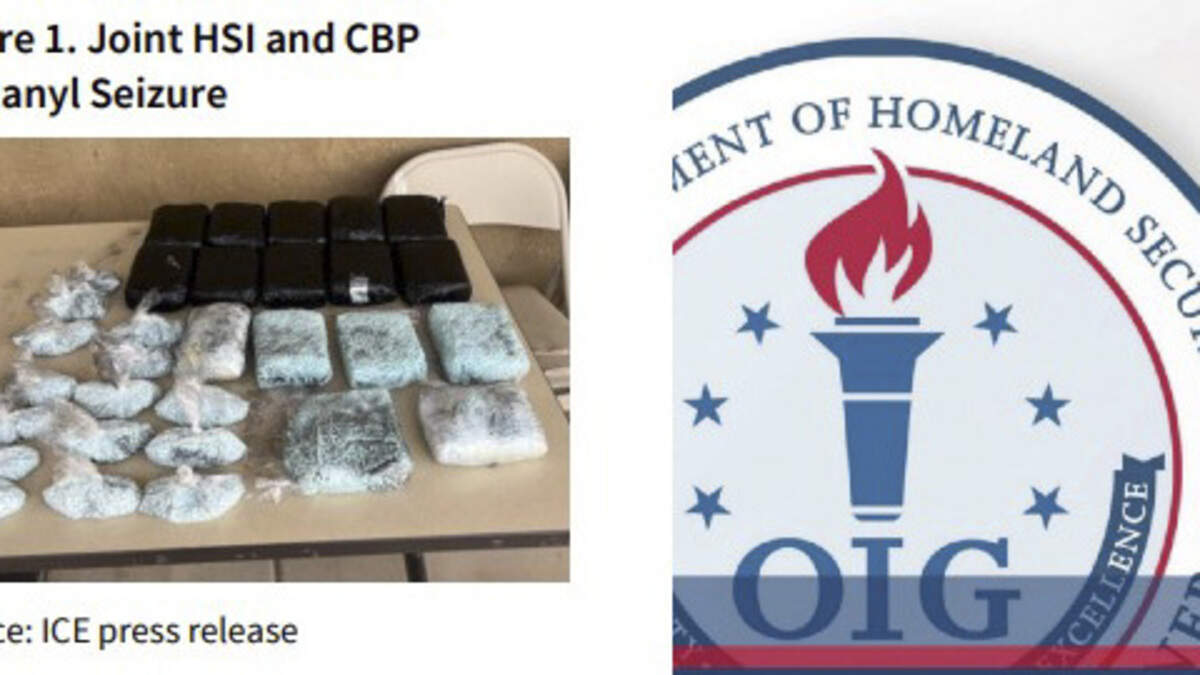
ICE’s immigration focus held back fentanyl investigations, DHS watchdog report finds
A new federal watchdog report revealed that the Trump administration’s emphasis on prioritizing immigration enforcement for U.S. Immigration and Customs Enforcement reduced the agency’s capacity to prevent fentanyl from crossing into the United States. The report found that investigators dedicated less time to fentanyl-related cases, initiated fewer investigations and seized considerably less of the dangerous synthetic opioid over the last year.
Read more Wife of arrested DeSantis ally stands by him, calls child abuse allegations ‘false’
The Department of Homeland Security’s Inspector General, in its , said that from fiscal year 2024 to 2025, Homeland Security Investigations, ICE’s investigative arm, allocated about 30% fewer hours to combating and seizing fentanyl. Additionally, HSI’s fentanyl seizures dropped by 39%.
The federal watchdog found that the time agents spent investigating fentanyl-related cases declined by 250,000 hours in 2025; meanwhile, the time spent by the agents on immigration investigations increased by 1.7 million hours.
“With ICE dedicating more staff hours to immigration investigations, staffing hours for fentanyl investigations declined,” the inspector general wrote.
That caused the amount of fentanyl seized by the federal agency to drop from 33,316 pounds in fiscal year 2024 to 20,292 pounds in 2025.
A Department of Homeland Security spokesperson in a statement Monday acknowledged that the federal agency had received the audit results from the inspector general and that in May the attorney general had granted Homeland Security Investigations full statutory power to “increase the United States efforts to enforce the Controlled Substance Act.”
“ICE-HSI is working closely with the Department to track metrics and execute goals to assess how well ICE-HSI is combating fentanyl. In FY26, an action plan was launched as an Agency Priority Goal, which set key milestones for combating fentanyl. These goals are ongoing and will conclude in FY27,” the DHS spokesperson said.
The DHS spokesperson also provided the Herald with examples of HSI fentanyl seizures and said the department had continued to carry out its action plan despite funding issues due to multiple government shutdowns.
The federal watchdog investigators interviewed more than 100 ICE agents and officials and said that during interviews with 11 HSI field offices, agents in nine offices “reported that the shift in priorities toward immigration enforcement reduced capacity on fentanyl investigations.”
In the audit, which was conducted from March 2025 through May 2026, HSI agents described the issue to the watchdog investigators as an “all-hands-on-deck” environment in which the office focused primarily on immigration priorities. At one office, the watchdog investigators found that 99% of the agents’ time was dedicated to immigration investigations.
The watchdog investigator found that a drug investigation team of seven agents was reduced to two or three because the agents were assigned to immigration cases.
“HSI prioritized immigration enforcement over fentanyl-related criminal investigations,” the watchdog report said.
In December 2025, President Donald Trump signed an executive order “designating fentanyl as a weapon of mass destruction.” The order described the synthetic opioid as being “closer to a chemical weapon than a narcotic.”
Read more Scooter crash leads to a deadly shooting, Miami-Dade Sheriff’s Office says
Trump directed the secretary of Homeland Security to work with other executive agencies to identify fentanyl smuggling networks and for the attorney general to pursue prosecutions for fentanyl trafficking.
DHS’s role extends beyond immigration enforcement. The department, which oversees agencies such ICE and Border Patrol, is also responsible for combating criminal organizations like cartels and for stopping drugs like fentanyl from entering the country through its agencies.
ICE’s Homeland Security Investigations office is responsible for partnering with Border Patrol and other federal agencies to investigate and uncover drug routes and networks, and to apprehend those trying to smuggle fentanyl into the U.S.
The DHS inspector general’s findings show that Trump’s immigration crackdown has not only upended the lives of many families in South Florida, including hundreds of thousands of Haitian immigrants who have now been stripped of Temporary Protected Status — and therefore their work authorization and legal status — but has also prevented the president from fulfilling a campaign promise to stop the influx of drugs into the U.S.
The Centers for Disease Control estimated that approximately 48,000 deaths in the United States in 2024 were related to synthetic opioids like fentanyl.
During the 2024 presidential campaign, Trump promised to impose tariffs on Mexico and China over fentanyl and to designate cartel organizations as terrorist groups for smuggling the deadly substance — which has claimed many American lives- across the southern border.
On the first day of his second term as president, Trump signed an executive order “declaring a national emergency at the Southern Border of the United States.” The order attributed the drug-related deaths of hundreds of Americans to “the illicit narcotics that have flowed across the southern border” and fulfilled his campaign promise to treat the cartels as a terrorist organization.
Last summer, surrounded by lawmakers and families who had lost loved ones to fentanyl, Trump signed the HALT Fentanyl Act into law, which classified the substance as a Schedule I drug under the Controlled Substances Act.
The OIG report raises questions about whether the Trump administration can pursue two main priorities —immigration enforcement and intercepting fentanyl smuggling — when one appears to undermine the other.
The report also found the HSI had spent more than $150 million to develop an analytics platform for investigating fentanyl, but it was not adopted by the agents because it “did not assist with their efforts.” They also found that the agency did not provide agents with funds in a timely manner to assist with their investigations or to purchase necessary evidence.
In other cases, the watchdog investigator found Border Patrol did not always refer fentanyl seizures to HSI for an investigation.
Read more ICE’s immigration focus held back fentanyl investigations, DHS watchdog report finds











Post Comment