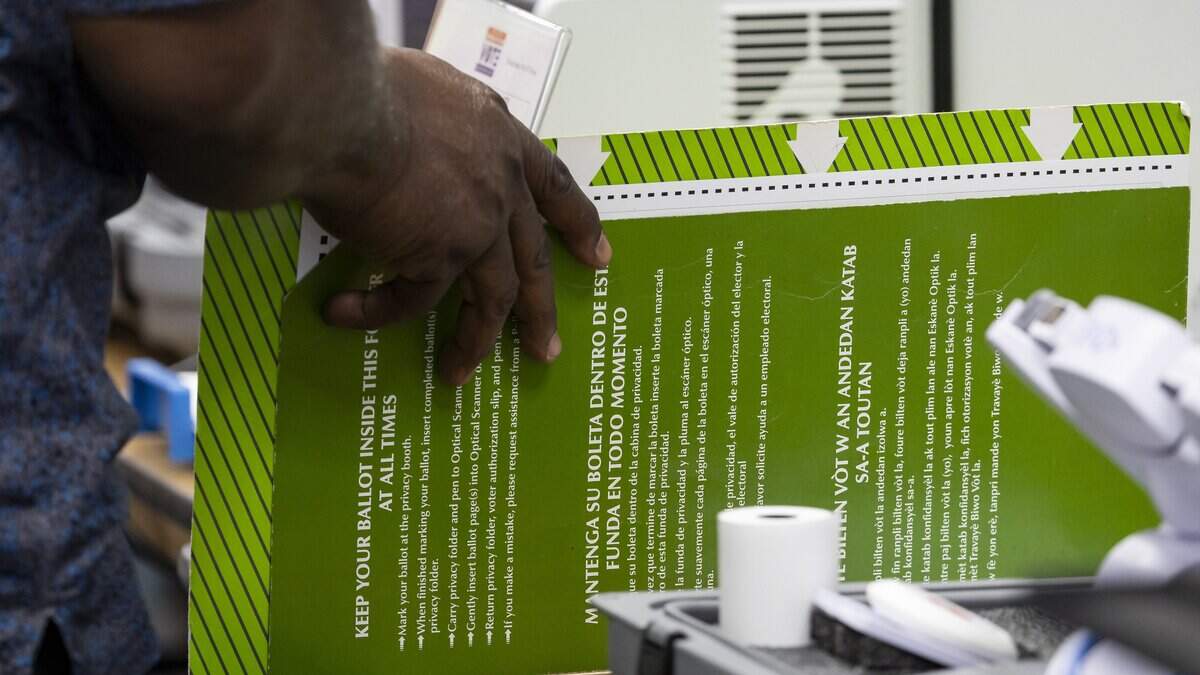
Republican gov. brawl, democratic socialism in FL: What to watch on Election Day
After a wave of Democratic momentum in other states’ primary elections, all eyes will be on Florida Tuesday night to gauge where voters stand in one of Donald Trump’s bastions of support — and determine what the head-to-head matchups will be in November.
Read more Key West officer arrested for driving under the influence, police say
Republican gubernatorial candidate Byron Donalds has held a commanding lead in polling and funding throughout the election cycle, but significant margins from any of his competitors could spell trouble for him against a Democrat in November, and drive more national investment in the race than Florida Democrats have seen in years.
On the Democratic ballot, a Senate primary will test whether the progressive momentum evident elsewhere in the country is resonating enough in Florida to help Angie Nixon overtake a better-funded, moderate Democrat, Alexander Vindman.
And Gov. Ron DeSantis led a mid-decade redistricting effort that shrunk the number of Democratic-leaning congressional seats in the state from eight to four, raising the stakes of key South Florida congressional primaries in determining how likely it is that Republicans will be able to keep control of the U.S. House the rest of Trump’s second term.
Close watchers are also looking at how many voters turn out, and in what cities, to gauge what campaign messages are working to fire up voters and drive them to the polls.
Here’s what to watch for as the results roll in Tuesday night:
A test of Donalds’ weaknesses
Since he got Trump’s endorsement more than a year ago, Donalds, a congressman from Naples campaigning to become Florida’s first Black governor, has held a commanding lead in the Republican primary and built an almost $100 million campaign war chest.
But as the frontrunner, he’s been the primary target of attack ads from his three opponents: former Speaker of the House Paul Renner, Lt. Gov. Jay Collins and debate league founder James Fishback. Tuesday’s results could signal how effective the messaging against him has been among the Republican base — and how big of an opening there is for a Democratic opponent in November.
The biggest question after Tuesday is whether voters who don’t support Donalds are likely to come back to his side by the general election if he lands the nomination, according to University of North Florida pollster Sean Freeder.
“Depending on which of his opponents ends up with the highest percentage, there could be some cause for concern for what that would mean for Donalds going into the November general election,” Freeder said.
Fishback has been aggressively attacking Donalds over his politics and his race while holding rallies across the state drawing crowds of young men motivated by his hard-right campaign promises.
“The best-case scenario for him, which won’t happen, is the second-place person is someone like maybe Paul Renner because I think his voters would have no problem just switching allegiances and coming back into the Donalds camp fold for November,” Freeder said. “If, on the other hand, it’s maybe Collins, but particularly if Fishback ends up with strong numbers, I could see that as very dangerous for Donalds.”
Democrats haven’t won a statewide election since 2018, but they have their sights set on 2026 being the year the tide turns in their favor thanks to an expected national Democratic wave in November — as is typical for the party out of power during midterm election year.
After Jerry Demings dropped out of the Democratic primary for health reasons just before the candidate qualifying deadline, Democratic frontrunner David Jolly has faced little opposition. South Florida state Rep. Dotie Joseph is running against him, but entered the race at the final moment and has had just weeks to campaign.
If Joseph garners significant support from voters Tuesday, despite her short campaign, it could signify the vulnerability of Jolly’s background among the party’s essential Democratic base. Jolly is a former Republican congressman who opposed Trump and has since switched parties. Skeptical Democrats say his candidacy mirrors that of Charlie Crist, also a former Republican, who lost to DeSantis by almost 20 points in 2022.
Miami-Dade Republican Party Chairman Kevin Cooper said the competition in the Republican primary between party leaders like Donalds, Collins and Renner has resulted in “iron sharpening iron,” whereas the lack of significant competition on the Democratic side is likely to leave the party with a largely untested nominee.
“I’m excited to see who our nominee is going to be, but theirs is like, where did they find this guy?” Cooper said.
Miami-Dade Democratic Party Chairwoman Laura Kelley said she’s motivated by the fact that despite Republicans’ more competitive gubernatorial primary, Democrats have a larger share of registered voters who’ve cast a ballot so far, both in Miami-Dade County and statewide.
“It’s interesting to me that, despite that very contested primary, they’re not showing up to vote in the primary. At least not in the numbers that the Democrats are,” she said.
Progressive momentum in the Senate race?
Freeder, the pollster, attributes Democrats’ turnout lead by percentage of registered voters, in large part, to what he sees as the most interesting race on the ballot Tuesday: the Democratic Senate primary between Vindman, a former National Security Council staffer and Trump whistleblower, and Nixon, a progressive Jacksonville state representative.
The Democratic primary, where the party’s left flank has more power than during a general election, could signal the strength of a progressive message in Florida. Nixon has been an outspoken voice against DeSantis’ agenda in the House, and is the former leader of the progressive organizing coalition Florida for All.
She’s been campaigning with Democratic Socialists of America congressional candidate Oliver Larkin, including at a South Florida rally headlined by Michigan Congresswoman Rashida Tlaib this week, and is running after a string of other progressive wins against moderate candidates elsewhere in the country this summer.
If she manages to pull out a win, or a close race with Vindman, it could signal a rejection of the party’s centrist message and recent focus on winning over Republican voters ahead of November.
Read more Are gas prices up or down in your area? Check the cost in Florida cities
“It probably doesn’t tell us too much about the state of Florida as a whole, whether or not they could accept Nixon as a true competitive Senate candidate, but I think it does provide some interesting hints to where Democrats are in the state,” Freeder said.
DeSantis’ new maps create complicated questions
Kelley, the Democratic Party chair, attributed Democrats’ overperformance in early voting turnout in Miami-Dade County largely to the high number of voters weighing in on who they want to succeed Rep. Frederica Wilson in Florida’s 24th District after she announced her retirement.
The local party’s highest rates of turnout are in that district, she said.
A crowded field of Democratic hopefuls have been duking it out in heated public forums and secretive attack ads against each other. It’s one of the shrinking number of Black-majority congressional seats in the South after a wave of Republican-led redistricting efforts this year, and a rare shot at a safe Democratic South Florida congressional seat.
The race to claim another safe Democratic seat, representing Florida’s 20th District, is a test of the future of Black representation from Florida after U.S. Rep. Debbie Wasserman Schultz decided to run there instead of in the new, competitive DeSantis-drawn district she now lives in.
Other candidates in the race condemned her candidacy, and briefly considered consolidating around a single Black candidate to defeat her, but that effort failed. If she wins, it could leave South Florida with only one Black representative — from Florida’s 24th District — for the first time in three decades.
DeSantis’ mid-decade redistricting effort also shrunk the number of Democratic-leaning congressional seats in the state from eight to four, setting the stage for other heated congressional battles in South Florida in November.
Florida’s 22nd District is the highest-funded congressional race in the state — with more than $18 million raised, according to campaign finance reports, primarily from self-funded millionaires vying for the nomination.
All that money in the district has resulted in a slew of ads to Republican voters, and the general election race is poised to continue drawing massive investment, after both the Republican and Democratic congressional fundraising committees added the district to their target list for gaining control of the U.S. House in November.
A newly drawn 25th District stretching from Palm Beach to Miami Beach is also in both parties’ crosshairs in November. Larkin, the Democratic Socialist of America candidate, is trying to oust incumbent Congressman Jared Moskowitz for the Democratic nomination.
While he faces a steep uphill battle in the primary, Larkin’s vote share could indicate more momentum for the progressive left in Florida — even as the local party is trying to differentiate itself from democratic socialism.
“Miami-Dade County is not New York. It’s not, and we have a different culture, a different history,” Kelley said. “Oliver Larkin appears, at least to me, to be the only candidate that is aligned with the DSA so for us at least, it’s not a huge issue.”
And, in Florida’s 27th District, Tuesday’s primary will determine who will face off against María Elvira Salazar in a district Democrats see as particularly vulnerable to flip in their favor in November.
The Trump effect on voter turnout
If Democrats stand a chance at finally winning a statewide race, chipping away at the state’s legislative supermajority or flipping congressional seats, it will all come down to voter turnout in November.
For both parties, the Trump effect looms large over Tuesday’s election as a test of how much the backlash against him will drive out voters — or whether he’ll manage to maintain his hold on Florida.
For the Republican side, the party is planning a clear Trump-oriented message if Vindman and Jolly take the top of the ticket Tuesday: “They’re not really running on a platform so much as they’re running against Donald Trump,” Cooper said.
Freeder said his recent polling showed Jolly trailing Donalds in a potential head-to-head matchup — if Republicans turn out to vote at the same margin as their voter registration lead.
If that doesn’t happen, “I think you have a really competitive race there. So I think turnout is really the name of the game going into November,” he said.
Statewide, about 19% of registered Democratic voters have already cast a ballot in Tuesday’s election, whereas only about 15% of Republicans have. And in Miami-Dade County, more Democrats have voted early than Republicans, even though Democrats have fewer registered voters: about 16% of registered Democrats have voted in Miami-Dade, compared to just 11% of the county’s Republicans.
It’s hard to draw conclusions from those numbers because the party’s ballots look so different, and it could be attributed to the congressional Democratic races like Florida’s 24th District or Democratic Senate race.
But it’s still giving Democrats hope that their early voting turnout advantage will translate into the general election, Kelley said.
“We’re already seeing an incredible voter turnout in the primary,” Kelley said. “If we can keep that going into Tuesday I’m really excited because typically a lot of people don’t vote in the primary and seeing that enthusiasm is really indicative that things will go well in November as well.”
Read more Weather alert: It could feel like 112 in South Florida as heat advisory issued








Post Comment