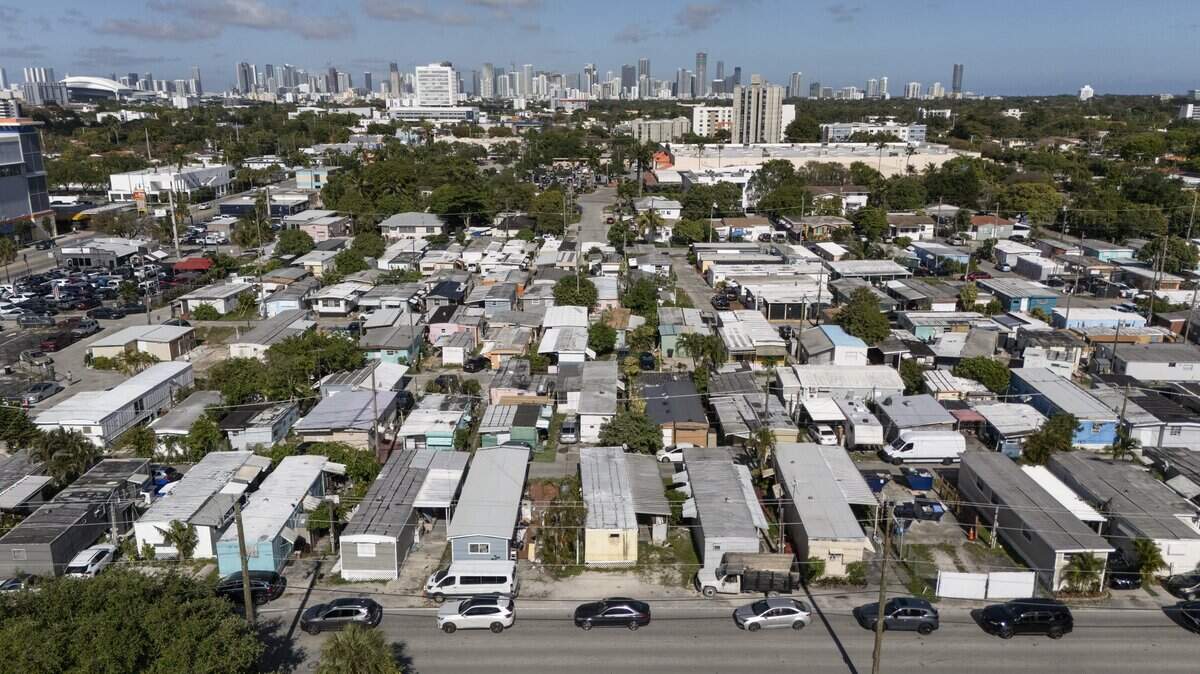
The Miami metro area is now more expensive than NYC and LA. Here’s why
It finally happened. After years of wealthy out-of-staters flocking to South Florida and ceaseless luxury development, Miami has dethroned New York and Los Angeles as the most expensive of the United States’ 10 most populous metropolitan areas.
Read more St. Thomas University president on leave amid investigation into policy violations
A recent Bureau of Economic Analysis data drop shows that the cost of living in the greater Miami area has surpassed that of the nation’s most infamously expensive cities
Though largely driven by surging housing prices, increases in food, transportation and childcare costs combined with stagnant local wages to propel Miami into cost-of-living notoriety.
“When wages cannot keep pace with the cost of basic necessities, workers may be forced to live farther from their jobs, take on multiple jobs or leave the community altogether,” said Symeria Hudson, president and CEO of United Way Miami.
“Young people may begin to question whether they can realistically remain in the place where they grew up. That puts Miami-Dade at risk of losing the talent, energy and essential workers our economy and quality of life depend on,” she added.
How the analysis works
Based on 2024 numbers, the most recent available, the Bureau of Economic Analysis uses something called price parities to measure differences in price levels between U.S. cities. The national average score is 100.
New York City, per the federal statistics bureau, scored a 112 in 2024, meaning the Big Apple is roughly 12% more expensive than the average US metropolitan area. And while LA logged a 113, Miami notched an eye-watering 114, making it the costliest of the country’s largest cities and the most expensive of all U.S. metro areas barring San Francisco, which outscored Vice City by one point.
Miami’s high cost-of-living score marks a six-point rise relative to what it clocked in 2019 and an almost 10-point rise from a decade prior, in 2014, BEA data shows.
Housing led the way
While everything in Miami has gotten more expensive, the spike in housing costs is unmatched.
Miami households spent roughly 35% of their income on housing in 2019, according to Bureau of Labor Statistics data. That was a lot, but it was less than the 40% they spent on housing in 2024.
The surge in housing prices came partly from the influx of high-earning out-of-staters during and after the COVID-19 pandemic. The federal government’s fair-market rent estimate for a two-bedroom in metro Miami rose nearly 60% between 2019 and 2024, from $1,454 to $2,324 a month, according to Department of Housing and Urban Development data, while median household income grew only 34% over the same period.
Read more Man dies in hospital after being stabbed at Miramar gas station, police say
Now, roughly six in 10 Miami renters are considered cost-burdened, meaning they spend more than 30% of their income on housing, the threshold for what HUD considers affordable. Nearly three in 10 spend at least half their paycheck on rent.
Many homeowners are struggling with affordability as well. Property values increased by 60% in Miami-Dade in the half decade since 2019, and property taxes ballooned by almost 50% over the same period, according to real estate analytics firm Cotality.
Meanwhile, the 2021 Surfside condo collapse upended economic life for many South Florida condo owners. Miami-Dade homeowners association fees are up more than 70% since 2016, according to Florida International University’s Metropolitan Center, a spike that can be at least partially attributed to the condo safety legislation passed in the disaster’s wake.
Miami now has the highest homeowners association fees in the country, a median $617 a month. Condo association insurance premiums rose to $462,000 by the end of 2024, up from $175,000 three years earlier, while individual homeowners’ premiums climbed 44% over the same span.
Wages are stagnant
Transportation adds another squeeze. Miami ties Houston for the highest transportation spending of the 10 largest U.S. metro areas. Roughly 20% of greater Miami household spending, or about $14,400 a year, goes toward getting around.
Car insurance is part of the story. In Florida, it averages more than $3,200 a year, the second-highest figure in the nation. And with few public transport alternatives, Miamians need cars, which, when purchased new, average close to $50,000.
Food tells a similar story. Restaurant food costs are up roughly 30% since 2020, and grocery prices have climbed about 25%, according to data from the U.S. Department of Agriculture.
Essential costs — housing, food, transportation and basic technology — have risen 5.6% a year nationally since 2021, faster than inflation. And in Florida, the price of those essentials has risen even faster — 7.3% a year, according to United Way.
But local incomes haven’t risen as fast as prices.
A single adult in Miami-Dade now needs to make at least $47,784 a year just to cover the basics. A family of four needs $114,480. Neither figure includes savings. As a result, more than half of Miami-Dade households — 56% — are now living paycheck to paycheck.
This story was produced with financial support from supporters including The Green Family Foundation Trust and Ken O’Keefe, in partnership with Journalism Funding Partners. The Miami Herald maintains full editorial control of this work.
Read more Man dies in hospital after being stabbed at Miramar gas station, police say












Post Comment