Do you feel unsafe walking in Miami? It takes millions to reduce pedestrian risk
Walking in Miami shouldn’t feel like an extreme sport, but the numbers tell a different story.
Read more Brazil’s rout, Scotland’s march, Haiti’s history and other top World Cup news
According to a new report that tracks pedestrian deaths across the nation, the Miami metro area, which includes Fort Lauderdale and West Palm Beach, ranked as the 17th most dangerous metropolitan area for pedestrians. The region had a yearly pedestrian fatality rate of 3.4 per 100,000 people, according to the report.
Florida ranks as the fifth most dangerous state in the country for pedestrians, with over 3,700 deaths from 2020 to 2024, an increase of over 370 deaths from the previous four-year period, according to Smart Growth America, a nonprofit group that researches and ranks pedestrian fatalities across the country.
What makes walking such a deadly risk here?
Dense traffic. Distracted drivers. Speed. And roads designed for cars and not for people.
But millions of dollars are flowing into Miami-Dade County and its municipalities aimed at improving sidewalks, crosswalks and even trees. All of those improvements could cut the risk for pedestrians.
From 2020 to 2024, over 1,000 pedestrians died in South Florida, up 117 deaths from the previous four-year period, according to Smart Growth America.
In Miami-Dade County, over 1,000 pedestrians have been hit by vehicles in 2026, and nearly 30 died, according to data from the Florida Highway Safety and Motor Vehicles department.
‘She was the radiant essence of love’
Deahni Kipnis, a 66-year-old from Gainesville, had her sense of joy “ripped” from her on May 30 last year when her niece, Katie Kipnis, was killed at age 41 while walking home in Miami.
“She was a radiant essence of love,” Kipnis said. “And that was stolen from a couple of hundred people who knew her and really loved her and cherished her.”
The Little Havana tragedy involved a hit-and-run by a drunk driver going 110 miles per hour, according to Kipnis.
“There is the ability for her to have picked up 110 miles an hour, without there being stop signs, I believe, or traffic lights,” Kipnis said. “Being able to look at any street where people pick up high speed, is there a way to limit that in some way to make it safer for pedestrians?”
Gabriella Serrado, the chief of infrastructure planning at the Miami-Dade Department of Transportation and Public Works, said Miami-area roads are so dangerous for pedestrians because of how they’ve been built.
“We basically prioritize trying to get somewhere faster, rather than … the people that are walking or living in our neighborhoods,” Serrado said.
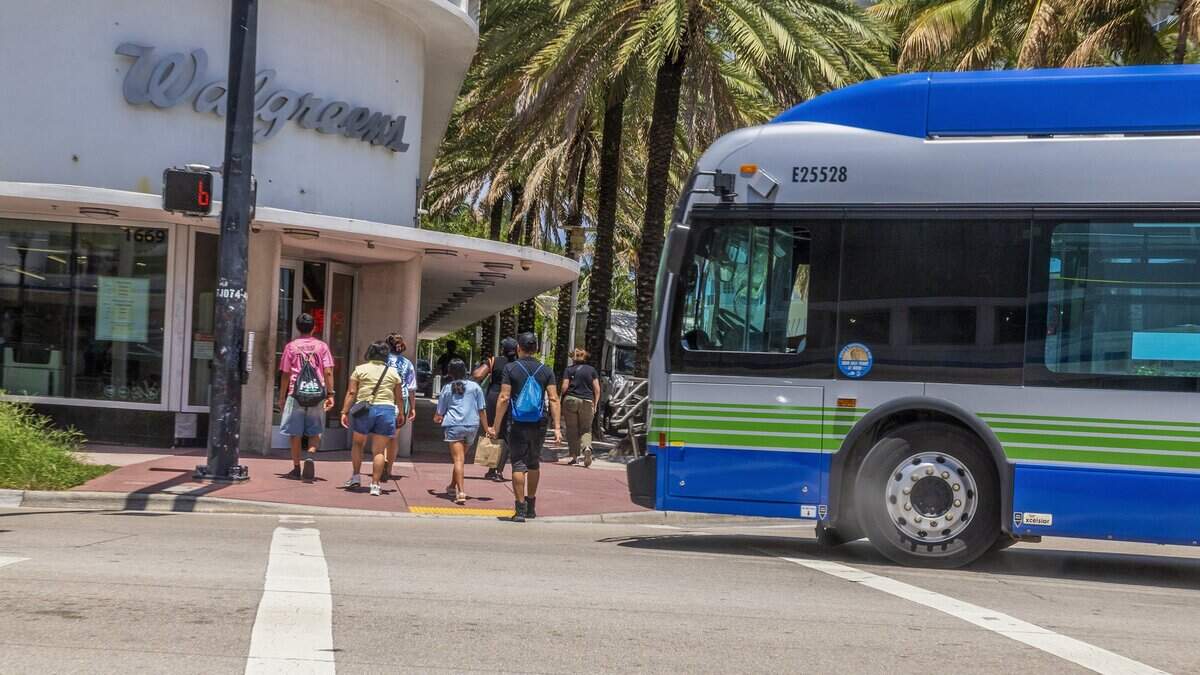
Nowhere is that more apparent that bus stops alongside busy streets and Tri-Rail stations surrounded by highways and high-speed arterial roads. The pedestrians heading to mass transit stops have to first navigate the traffic just to get to their rides.
“South Florida, in general, is still a very car-centric community,” said Jose Gonzalez, the director of transportation and mobility for Miami Beach. “It’s just the culture that we have here, and over time, hopefully, that will change.”
And this design flaw is changing the way those who live here use public transit.
“The reality is that most people in Miami don’t feel safe crossing a lot of streets, and it really hinders how they move,” said Cathy Dos Santos, the executive director of the Transit Alliance, a nonprofit that advocates for walkable streets. “Because if you can’t even walk to your bus stop, you’re not going to take that bus. If you can’t walk to the metro station, you’re not going to take the metro.”
Leaders want to do something about that.
Millions pour in to fix Miami’s roads
The county’s Vision Zero plan is an initiative that aims to eliminate all traffic fatalities by 2040 through mapping and publicly posting crash data. It also looks to install crosswalks and mark streets for pedestrian right of ways, and do street safety audits, during which a group of professionals walk high-risk roads and report back what improvements are needed.
Serrado says that to meet the county’s goal, it will need both funding and community involvement.
The county received over $20 million in funding through the Safe Streets for All Program, a federal grant program that provides money to prevent roadway fatalities, to deliver 27 projects improving various streets and intersections by adding things like crosswalks and signs. It’s also funding five road safety audits countywide.
The improvements target intersections and roads with a high number of crash injuries. The projects include things like installing mid-block pedestrian crossings, new pavement markings and signs warning drivers to be on the lookout for pedestrians.
The Northwest Second Avenue corridor is also on the list for improvements, according to Natalia Neira, the county’s Vision Zero. program manager.
As for the actual construction projects, “they do cost a lot of money,” Serrado said, and the county will surely need more than the $20 million grant to achieve its goal of completely eliminating traffic fatalities.
“We certainly need a lot more,” Serrado said of the funding.
She continued to say that funding the research is important to identify areas where crashes are the most common so that the county is able to ask for specific grants.
Read more Are condo values down in your Miami-Dade area? Check the latest in 29 cities
Serrado and Neira said part of the county’s research involves monitoring hospitals for reports of injuries from crashes that weren’t reported to police.
Change coming to Miami Beach
Miami Beach adopted its own Vision Zero action plan last year through a $400,000 federal grant, and leaders also hope to end pedestrian deaths by 2040.
“Our mission was clear that we needed to take drastic steps to improve pedestrian safety for all our users and all people here in Miami Beach, whether it’s a resident, a visitor, a workforce employee, whoever,” Gonzalez said.
The city is also working on other pedestrian safety plans, such as the West Avenue Neighborhood Improvement Project aimed at decreasing the chances of flooded roads and improving landscaping, sidewalks and accessibility.
“Once we do the road raising, and we complete that and complete the construction of the pump station, we will be able to handle much larger rain events than we do today,” said David Gomez, the director of capital improvement projects with Miami Beach. “Today, on a regular rainy day, there are intersections that wash out and just are impassible, unless you’re wearing river boots or fishing boots.”
When intersections are flooded, pedestrians are more likely to cross in unsafe, unmarked areas, increasing the risk that they will be hit by a car.
Gomez said that this $100 million project was supposed to be completed by fall 2028, but drainage concerns have extended that date. He said he is unsure when it will be completed.
The city of Miami is also looking at key areas to improve pedestrian safety.
Little Havana is one of the most dangerous places to walk in Miami, and the threat pedestrians face worsens by the year.
From 2020 to 2025, 18 pedestrians died in Little Havana, 11 more deaths than from 2015 to 2019, according to the city.
In 2022, Miami began project designs for the area to improve safety after four Pedestrian Priority Zones were identified. These priority zones focus on pedestrian traffic by installing crosswalks at all intersections, banning right turns on red lights, increasing crossing time, shading sidewalks, lowering speed limits and reducing driving lane widths.
Phase one of the Little Havana project is expected to be completed in October. Improvements such as mid-block crosswalks and new trees are among the 20 pedestrian projects within the four priority zones. The cost is $5.5 million.
The presence of trees alongside sidewalks can greatly reduce the risk of pedestrian fatalities, Dos Santos said.
“When we’re talking about the solutions, oftentimes it really is trees that are going to change that experience. Trees are actually a huge safety mechanism, because if a street is designed well, they’re planted on the edge of the sidewalk with still plenty of sidewalk space,” Dos Santos said. “You’re providing an additional barrier between the pedestrian and the car. You are looking out for the health and safety of the pedestrian, because now they have a much kinder environment to walk through.”
Hialeah also adopted the county’s Vision Zero action plan in 2021. Also, a master plan aims to improve pedestrian safety by including enhanced crosswalks and traffic-calming measures, such as roundabouts and speed humps, as well as widened and shaded sidewalks around parks and schools.
The plan also proposes using the land underneath the Metrorail to create a protected walking and biking path.
The city just finished receiving public opinion on the plan. Next steps are funding and to put it into place.
‘A car is a lethal weapon’
Although the county and cities are working to eliminate dangers pedestrians face, Miami remains a dangerous place for walkers.
Kipnis, who lost her niece in the hit-and-run, said she believes part of the solution is making drivers understand the power of getting behind the wheel.
“People need to understand that a car is a lethal weapon. It’s not entertainment, it’s not just something that gets you from one place to another,” she said. “When you understand that you’re really in a lethal weapon, it makes you think of driving a little bit differently.”
Gonzalez said he thinks similarly, and that infrastructure improvements can only go so far.
“If we want to make a real change and truly ensure pedestrian safety,” he said, “it’s both about providing the facilities as well as changing the behavior of drivers.”
Read more How unsafe are Miami streets? It takes millions to reduce risk for pedestrians
This story was originally published June 25, 2026 at 5:00 AM.









Post Comment