Florida higher ed leaders strike deal after UF governance fight delayed president vote
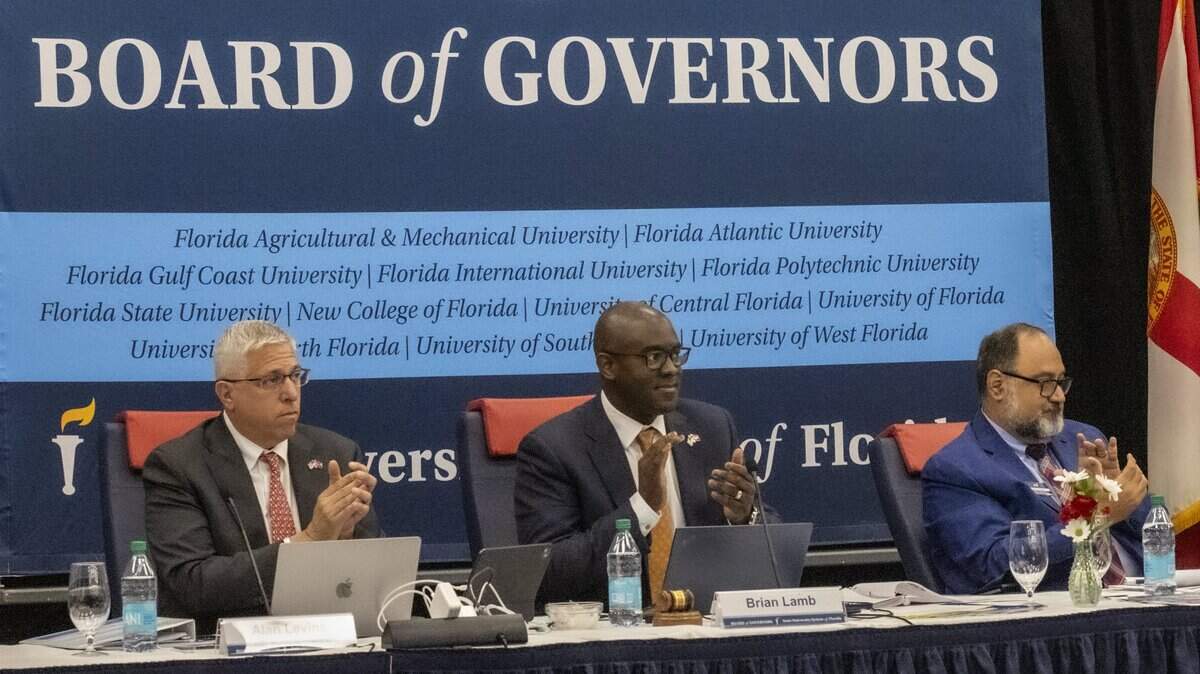
The leaders of Florida’s higher education system appeared to reach a truce Wednesday in their battle over who controls the University of Florida, after an explosive public meeting laid bare the personal and political tensions surrounding the state’s flagship university.
Read more Stepson uses knife, sword and axe to kill stepfather, Miami-Dade deputies say
The agreement, which calls for an independent review rules and governance of state university boards of trustees, capped a whirlwind week in UF’s turbulent search for a permanent president. The State University System’s Board of Governors had been scheduled to vote Wednesday on Stuart Bell, the former University of Alabama president selected unanimously by UF trustees.
But Board of Governors Chair Alan Levine pulled Bell’s nomination and other UF business from the agenda last week, saying in a letter to System Chancellor Ray Rodrigues that he first needed to address concerns about the power held by Mori Hosseini, the chairman of UF’s Board of Trustees.
Wednesday’s two-hour discussion at Florida Atlantic University boiled down to a central question: How much authority should a university board chair hold over a president and the full board?
Hosseini, a GOP megadonor and close ally of Gov. Ron DeSantis, has long dominated Florida’s higher-education system. A former Board of Governors chair, Hosseini helped engineer a performance-based funding system that incentivized state universities to climb the U.S. News & World Report college rankings.
He also holds tremendous sway over UF. In his eight years atop the university’s board, he has intervened in matters far below the scope of the typical chair. UF gives him wide latitude over university affairs, including authority over senior hires, compensation and outside contracts.
Those delegations were the center of Levine’s concerns. At Wednesday’s meeting he argued that Hosseini’s power could put Bell in what he called a “parallel reporting structure,” answering both to the full board and to one trustee with independent authority.
“Otherwise, he will end up in a parallel reporting structure where one board member is making board decisions while, at the same time, the president has to report to the full board,” Levine said.
Three presidents in three years
The meeting underscored a striking turn in Bell’s path to the presidency. A search that began with culture-war battles over diversity, equity and inclusion has become consumed by a power struggle between Republican heavyweights in Florida politics.
Bell was announced as UF’s sole finalist in May, nearly a year after the Board of Governors rejected Santa Ono, the former University of Michigan leader whom UF trustees had selected unanimously as president. Conservative activists and high-ranking Republican officials attacked Ono over his past support for diversity, equity and inclusion programs, and Board of Governors members questioned whether he had sufficiently disavowed those views.
Bell was widely viewed as a less ideologically combustible choice, but his nomination quickly attracted the same DEI backlash that doomed Ono. Now, his hiring has quickly become entangled in a different fight: whether Hosseini’s authority at UF has become so expansive that the next president could be constrained by a board chair operating alongside — and at times independently of — the full board.
That concern has particular weight after UF’s recent instability. Former President Ben Sasse’s resignation in 2024 was followed by intense bipartisan scrutiny of his spending and his hiring of former Senate staffers who worked remotely. Ono then won unanimous support from UF trustees before the Board of Governors rejected him last June. Bell would be UF’s third permanent president in a little more than three years.
Using presidential confirmation as leverage
At Wednesday’s meeting, Hosseini hinted that Levine was using Bell’s confirmation as leverage to undermine his authority, stemming from a long brewing feud between the two going back to Hosseini’s failed attempt to confirm Santa Ono a year ago and culminating in Hosseini’s decision last year to remove Levine from the board of UF’s hospital system.
Levine repeatedly said his governance concerns are not personal, nor were they a ploy to tank Bell’s candidacy. Rather, he said, they center on what he views as an unusually expansive delegation of authority to UF’s board chair.
One flashpoint during the debate was the contract of UF’s outgoing interim president, Donald Landry. Levine criticized UF for delegating negotiating power to Hosseini alone, arguing that the full campus board should participate in such deliberations during a public meeting. He also took issue with provisions in Landry’s contract requiring Hosseini’s signoff on hiring decisions.
Read more Doctor and others accused of $6.5 billion in fraud in South Florida and elsewhere
In Levine’s view, UF’s governance problem extends beyond presidential contracts. UF’s regulations grant the board chair wide latitude to approve or block certain executive decisions. Levine argued that when decisions ordinarily made by a university president or full board are concentrated in the chair’s hands, the university risks both internal conflict and legal questions about whether actions were properly authorized in public view.
Hosseini said the provisions Levine criticized were not a unilateral power grab. He said the authorities granted to him in presidential contracts measures — first introduced in Ono’s proposed employment agreement — were adopted at the urging of the governor’s office, including safeguards intended to give the chair oversight of a president’s handling of diversity, equity and inclusion and other state priorities.
The UF chairman also questioned the timing of Levine’s inquiry, noting that the Board of Governors was presented Landry’s contract in September when it approved his appointment.
“You had that contract for a year, and you read it, and you’re bringing your concerns now?” Hosseini asked Levine.
‘Move foward together’
Several members of the Board of Governors said they supported a review of governance rules but objected to linking it to Bell’s pending nomination.
The chair of the Board of Governors’ Nomination and Governance Committee, Charlie Lydecker, said Levine’s decision to hold UF items off the agenda before the full board had voted created troubling optics. Levine’s letter announcing the move, he said, “went nuclear” on the eve of a vote that could have put UF “on a steady path with a permanent president.”
Other members backed Levine’s underlying concern. Craig Mateer, a DeSantis appointee, said the sparring between the two chairmen had become “kind of ridiculous,” but added that university board chairs should not act as though they “own the university.”
The public clash came as Florida universities have faced broader skepticism from some academics over the DeSantis administration’s political interventions in higher education. Several governors warned that another public spectacle involving the state’s flagship university could make it harder to recruit presidents, faculty and other top talent.
Board member Nick Sinatra, a recent DeSantis appointee, called Levine’s delay of Bell’s confirmation vote “a bit of a kangaroo exercise.”
“If you’re an academic looking at this and saying, ‘Do I want to thrust myself into the political world of this confirmation process,’ it shouldn’t be that way,” Sinatra said.
Board member Ashley Bell Barnett said the dispute risked damaging “the reputation, the optics, the ability to attract good talent.”
“I really, truly hope that we can pass the baton, move forward together and not let these political throes and hot emotions and misinterpreted information derail all of us and what we’re doing,” Barnett said.
By the end of the discussion, however, the board found a path forward. Under the agreement approved by the board, Chancellor Rodrigues will work with Levine to identify an outside consultant to review governance documents, delegated authorities and university boards of trustees policies throughout the university system. The consultant will recommend changes for the board to consider.
When the meeting proceeded into discussions about audits, Levine approached Hosseini for a brief pull-aside conversation. When Levine left to return to his seat, the two chairmen smiled and shook hands.
Read more Murder suspect who is ex-Hurricanes player accused of smuggling drugs into jail









Post Comment