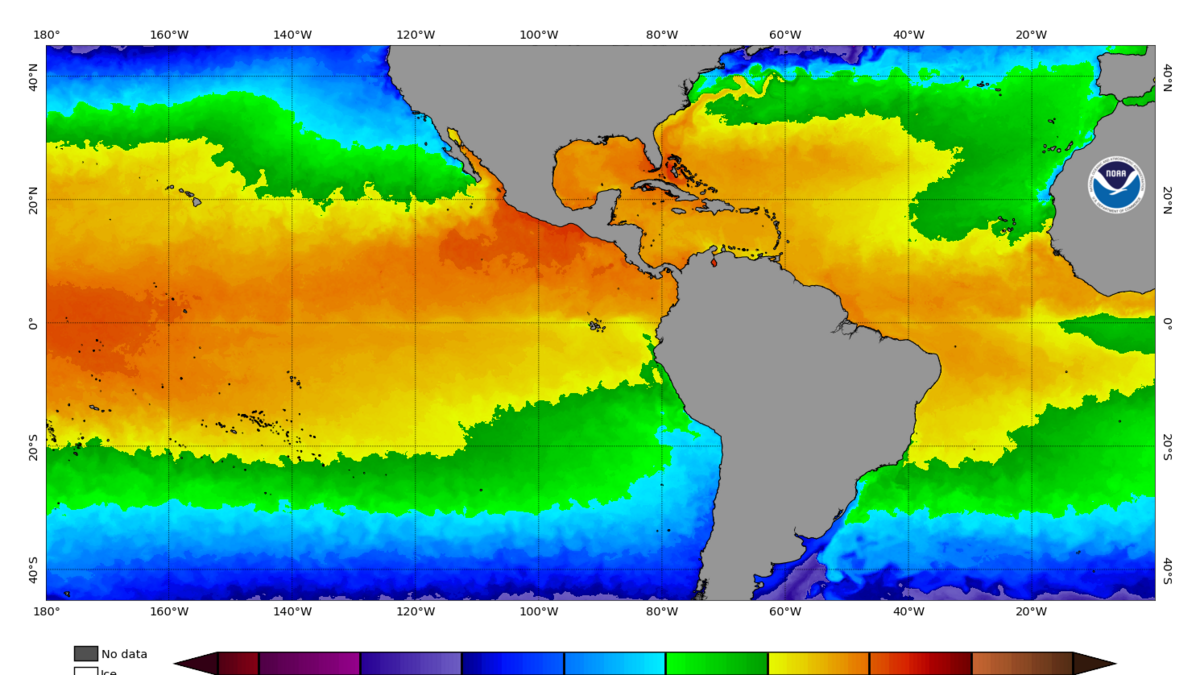
What’s warming (and cooling) the Atlantic? Study points to humans
The temperature of the Atlantic Ocean should matter to anyone living within striking distance of a hurricane.
Read more Man hospitalized after stabbing in Fort Lauderdale, police say
The warmer the sea surface temperatures get, the friendlier the waters become for storms to strengthen. It’s not the only factor that matters for individual storms to form — wind shear and dry air also play a role — but it’s pretty dang important.
And a new study from Florida State University researchers suggests that the biggest influence on those sea surface temperatures comes from people, not nature. The study, published in Geophysical Research Letters, found that unlike the Pacific Ocean, where temperature swings are more likely related to natural processes, the fingerprints on the Atlantic’s thermostat are distinctly human.
While scientists are confident that human-caused climate change is having an impact around the world, including in the warming Atlantic Ocean, there are also natural processes that play a role. Like the globe-spanning oceanic currents that ferry warm tropical water north to the Arctic, or global phenomena like El Niño and La Niña that are correlated with fewer and more Atlantic hurricanes, respectively.
Lead author Michael Diamond, assistant professor of meteorology at Florida State University, said his team’s research suggests that humans are the driving force behind the warming — and cooling — of the Atlantic. The warming comes from greenhouse gas pollution, which is spewed into the atmosphere whenever fossil fuels are burned.
Diamond said the study could be seen as good news. It suggests that humans have more of an impact than we initially realize, and therefore any changes we make could pay dividends.
“We shouldn’t expect to go into a hurricane drought just by chance,” he said. “The meteorological factors that drive the conditions for hurricanes and marine heat waves, we should expect them to go along with human emissions and not expect to get lucky and have them go away — or get unlucky and have them supercharged.”
But there’s cooling happening, too. All those cars and trucks and coal-burning power plants also emit particles that fill the atmosphere. Like the infamous Saharan Dust, chunks of stuff floating in the atmosphere can shade the Atlantic Ocean or form clouds, making it less likely that hurricanes will form or strengthen.
Then, a few decades ago, the world cleaned up its act and stopped letting so many of those particles into the atmosphere. It’s why cars have catalytic converters, to clean up some of those nasty bits that spew from tailpipes when we burn gasoline or diesel fuel.
A side effect of cleaning up the air meant, surprisingly, more hurricanes.
READ MORE: North America has cut air pollution, seen more storms. NOAA study suggests a connection
Read more Expect traffic madness for the big Scotland-Brazil World Cup match. Here’s help
When the researchers analyzed decades of global temperatures and ran dozens of simulations using high-tech global weather models, they found that the shifts from cooler to warmer Atlantic were not driven by natural processes.
“That might look like a swing, but it’s actually just two different human-caused changes lying on top of each other,” Diamond said.
That matters for hurricanes, because warm water acts as fuel for a hurricane’s engine. But sea surface temperatures are only part of the story.
“Sea surface temperatures are basically skin deep,” said Nick Shay, a professor of oceanography University of Miami’s Rosenstiel School of Marine, Atmospheric, and Earth Science. Shay studies ocean heat content, how hot the water gets when you plunge hundreds of meters down below the surface. “The idea here is the deeper the warm water goes, the more likely a storm is to form or intensify.”
Deeper pockets of warm water serve as much more intense fuel reserves for storms. It’s why we sometimes see storms in the Gulf suddenly intensify when they cross over one.
And while it’s clear that the ocean is absorbing more heat as human-caused climate change rages on, parsing what can be blamed on humans or natural variability in ocean heat content is a little more difficult, he said.
Regardless, there are clear trends to be found. Parts of the Atlantic are getting hotter, which is linked with stronger storms.
“We’ve seen a trend in the Gulf ocean heat content in the last couple years. The Gulf is definitely warming,” he said.
Read more Powerful Miami men are on roster of secret society run by Palantir’s Peter Thiel










Post Comment