Inside a new luxury Miami airport terminal: suites, caviar, privacy — for a price
What if you could fly without dealing with the airport?
You’d escape bumper-to-bumper traffic on arrival, jockeying for parking, long security lines, crowds everywhere, mediocre food options and frantic dashes up and down concourses looking for an available restroom, hopefully a clean one.
Read more Miami workers wanted a bigger space. They got it — and a ‘vibe check’ at door
What if that got replaced by a chauffeur, caviar, spa treatments and a more expeditious TSA service? Something more elite.
One company wants to make that happen, and it’s bringing its idea to Miami International Airport. PS, the company, has completed a new private luxury terminal, one of only four at U.S. airports. It’s already taking reservations and opens to the public on June 30.
The Miami Herald got an early look at the 34,000-square-foot space, slightly more than four major league baseball diamonds.
Luxury travel in Miami
Miami International Airport’s new private luxury terminal is at 4900 NW 36th St., the site of the original Pan American Regional Headquarters building. The private space is on airport grounds and near the airfield, but away from the main terminals.
The terminal is meant for travelers who still fly commercial but wish to do so without setting foot inside an airport. Membership isn’t required, but travelers need to sign up online and get approved 48 hours prior to a flight — and be willing to spend at least about $1,300 for a one-time privilege.
The private terminal isn’t cheap and may be viewed as yet another plaything for the wealthy in South Florida.
That’s partly intentional. In 2021, when the county opened competitive bidding for the project, documents identified the target demographic as “frequent affluent travelers who value status” and will pay to avoid the congestion facing “conventional passengers” at MIA.
But unlike the toys wealthy people like, this one has a real-world purpose, and could even benefit those who don’t use it.
The idea behind the terminal is that private charter aviation — even though growing — can be costly or unappealing for long distances. On the opposite end, airport frequent flier lounges in the regular terminals keep growing, too, but are becoming a little too popular, with long lines to enter.
MIA could be a test case for whether there’s demand for something in between.
A tour inside the private terminal
So, what’s this luxury private terminal like?
Away from the bumper-to-bumper highways, travelers enter the building from Northwest 36th Street. It’s a few blocks from the Miami Springs Golf & Country Club and an IHOP.
Traffic flowed smoothly and entering the terminal was easy on June 12, during a visit by a Herald reporter and photographer. There were still signs of final work as construction workers and tractors moved around. But visitors entered a spacious parking lot with lots of spots. A calming reflecting pool is one of the first things guests see.
Once the terminal opens to the public at the end of June, it’ll have valet parking, making arriving even less stressful. You’ll drop off their cars and luggage before even entering the building.
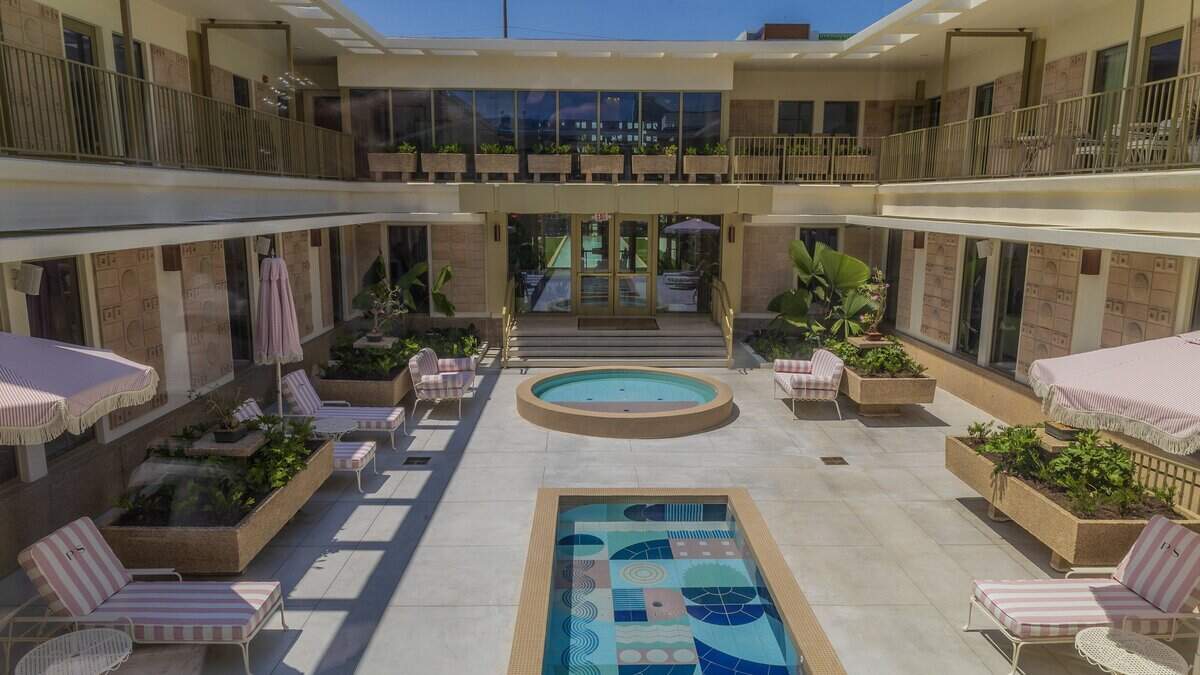
Before entering, you’ll see a building with mid-20th Century brutalist architecture with finishes from that period. The company preserved Pan Am logos and gold paneling, and restored the original reflecting pools.
Immediately after going through the doors, you’re in the lobby and a PS host or hostess checks you in. Notice the winding staircase with gold rails, also maintained from the original Pan Am building.
By now, PS staff has taken your luggage off of your hands, and you’re escorted to your suite or salon.
The new private terminal has lounges and five private suites in a two-story building, and an elevator if you want to head directly to your suite. The elevator will start operating at an undetermined date.
The main lounge is called The Salon and meant as a social lounge. The private suites are for travelers looking for more privacy or rest. Beds are provided. No matter which you choose, spa treatments will be available.
The Salon can seat as many as 50 travelers at one time, and the five suites can fit as many as 70. The company says it doesn’t expect to have capacity issues.
“We’re not anticipating to hit a limit” of guests, Amina Belouizdad Porter, CEO of PS, said in an interview with the Miami Herald in June. That’s in part because of a three-hour time limit to spend in the terminal.
At most points around the two-story building, you can see the open-air, square central courtyard. Here you can lie in pink lounge chairs with umbrellas. Beds of plants separate the chairs and provide cooling. While the pool is purely decorative, you can eat and drink by it.
The menu offers meals through the day. For breakfast, you can order Spanish Tortilla or Arepa Benedict. Later in the day, red snapper is available. Beverages include over a dozen types of tea including Malabar and Nepal White. During the June visit, dozens of staffers were behind the bar getting trained. It’s long and offers a wide selection of cocktails and fruit juice.
When your flight is ready to depart, you’ll go through the private terminal’s own TSA screening. On the other side of the scanner, rather than being left on your own to collect your belongings, getting rushed by other travelers behind you and having to recompose yourself for the long walk to your gate, a door opens up to a waiting BMW. You’ll take a ride to the air field, across the tarmac and get onto your plane.
Upon returning, the reverse happens. You can enjoy a shower back in the terminal while staff members retrieve your luggage. For international travelers, the PS terminal will have its own customs and immigration.
The cost of luxury at the airport
This isn’t for everyone, nor is it meant to be. The prices make that clear.
One-time use for non-members starts at $1,295 per person for the salon, a shared space, and $4,950 for up to a group of four for a private suite.
Read more If hurricane season is the reason, why build Alligator Alcatraz in July? | Opinion
The basic membership, called The Salon Membership, costs $1,250 a year. Then you have to pay $995 per person for each individual use of the salon, or $4,950 for one-time use by a group of up to four people for a private suite.
The higher level, the All Access Membership, sells for $4,850 annually. Then you pay $895 each time per individual for the salon and $3,650 for a group of up to four for a private suite.
The private terminal was led by R. J. Heisenbottle, Coral Gables-based founder and president of R. J. Heisenbottle Architects and interior designer Cliff Fong, who headed the PS private terminal in Los Angeles.
PS put in at least $12 million to renovate the building.
Does demand exist? What about airport lounges?
Can this venture be successful?
MIA is adding flights and undergoing an expansion and capital continues to flock to South Florida.
Bu tthere’s competition in the regular terminal, too. Lounges are expected to keep growing.
At MIA, American Airlines is doubling lounge space where free champagne will flow. Delta’s upgraded Sky Club offers Miami staple guava pastelitos and arroz con pollo. American Express’ Centurion Lounge has brought in James Beard-winning chefs. Air France is building a new lounge that will have an outdoor terrace.
PS doesn’t expect these lounges to disappear, nor is it trying to replicate them. It sees opportunity in the middle.
Porter, the PS CEO, estimated that a premium traveler may spend $3,000 for a round-trip first-class ticket between Los Angeles and Miami. The guest would use the airline lounge before departing, but not on arrival.
Meanwhile, those who fly the same route privately would need to shell out about $100,000, she estimated.
“That’s a big gap” in cost, Porter said. “There is a traveler that fits in between those two.”
The company behind the private Miami airport terminal
The Los Angeles-based company, previously known as The Private Suite, was founded in 2017 and acquired by airport operator Groupe ADP in 2024. It created its first private terminal at Los Angeles International Airport and second at Hartsfield-Jackson Atlanta International Airport.
The company opened its third location at Dallas Fort Worth International Airport on June 1. MIA is the fourth in the U.S.
Based on the Los Angeles and Atlanta terminals, travelers on domestic flights typically spend one hour lounging before going through security, and those on international flights take about 90 minutes, Porter said.
In Los Angeles, “we’ve never denied a reservation due to space,” she said
The executive declined to provide the maximum number of guests in one day that can pass through except to say it was “a few hundred” in Los Angeles, which is a smaller space than MIA’s.
Pre-billionaires
The MIA terminal has been years in the making. Even before the pandemic and prior to the more recent wealth migrations, PS started looking at Miami.
Later it won support from preservationists and Pan Am loyalists for maintaining parts of the past.
That includes the overhanging flat roof supported by thin gold metallic columns. All four sides of the building are covered by a pattern of interlocking trapezoidal pieces that serve as a sunscreen, cooling the interior. These are all features developed by the building’s original creators, the Miami firm of Steward-Skinner and Associates, prominent architects of the time also responsible for the design of the now-closed Miami Seaquarium and MIA’s first jet-age terminal.
It’s one of several Pan Am buildings still around, but is the only one designated for historical protection thanks to a vote in 2014 by the Miami-Dade County historic preservation board.
Pan Am was founded in 1927 as the first international airline in the U.S. In 1928, it opened a terminal and airfield on Northwest 36th Street on the site of the original Miami International Airport.
The building that houses the new private terminal also once served as Pan Am’s Flight Attendant Training School, which grew due to increased demand after World War II. Classes were offered in serving in-flight refreshments and putting on makeup.
The winding staircase near the front entrance was “used to help the students practice proper posture,” a 2014 report by the county said, “as they were made to walk down the stairs with books carefully balanced atop their heads.”
In 2023, the Miami-Dade County Commission approved the project.
According to documents from the vote, PS agreed to a 20-year contract with the county. The county-run Miami airport will receive a minimum of $600,000 annually in rent from the company, or 7.5% of gross revenues, whichever is higher.
Airport CEO Ralph Cutié estimated that over the life of the contract, $16 million in revenue would be generated for MIA without cost to the county.
Read more Miami home sales are on the rise, but what about prices? Check the trends









Post Comment