Wasserman Schultz debates Democratic opponents in contentious primary
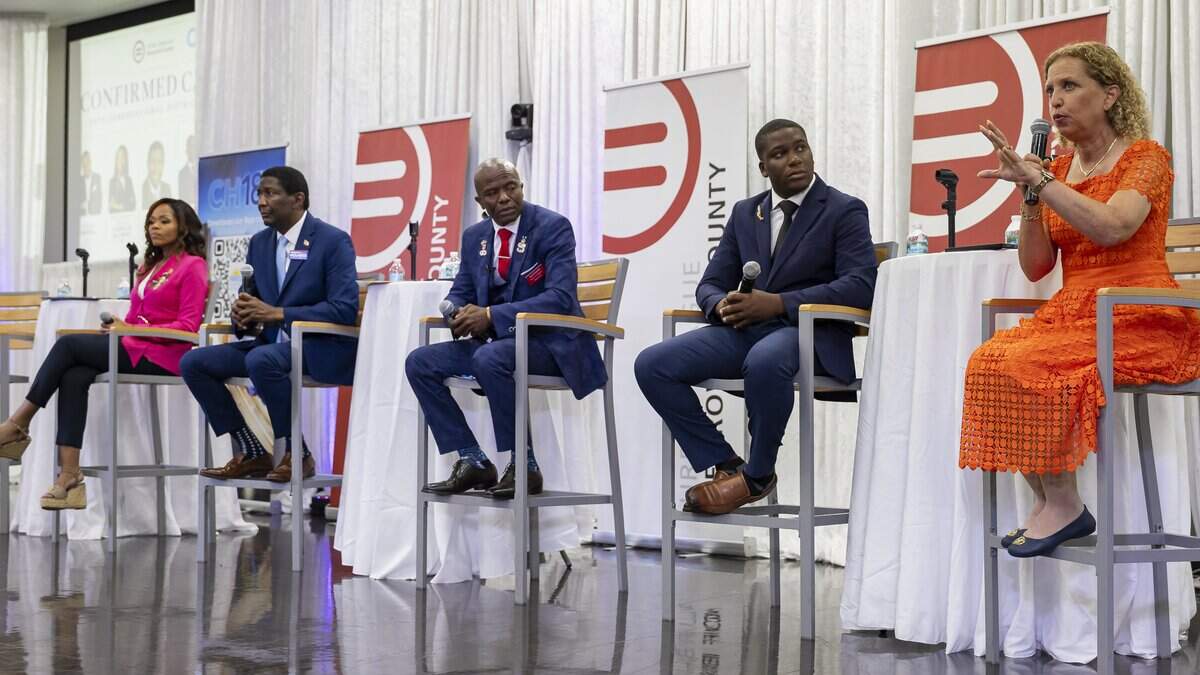
U.S. Rep. Debbie Wasserman Schultz defended her decision to run in a district drawn for decades to ensure Black voters’ representation in Congress during a debate at the Urban League of Broward County Wednesday — to a room of mostly Black voters and Black candidates who have spent weeks publicly condemning her run.
Read more Wasserman Schultz debates Democratic opponents in contentious primary
“This is a Black-access district and if we erase the remedy, we’re erasing the past,” said former Congresswoman Sheila Cherfilus-McCormick, who represented Florida’s 20th District until her resignation following a years-long ethics investigation. “Everybody must talk about what is wrong at this time, having someone come into our district forum shopping.”
Progressive candidate Elijah Manley echoed Cherfilus-McCormick’s sentiments to the room of about 150 people during a question about voting rights.
“While the Republicans are trying their hardest to silence Black voices, I don’t expect somebody in our own party, a white Democrat, to do the same,” Manley said, pointing at Wasserman Schultz. “We are not going back to a time when there were no Black people in Congress.”
Wasserman Schultz used almost every question during the nearly two-hour debate to tout her experience and political wins in Congress — and addressed the criticism of her decision to run in Florida’s 20th District the same way.
“It is absolutely certain that representation matters, and lived experience matters,” Wasserman Schultz said in response. “But experience and making sure that you have someone who has the seniority and seasoning, to be able to deliver for a district, it matters as well.”
Wasserman-Schultz’s appearance with the other primary candidates Wednesday comes after her Democratic opponents met to plot out how to defeat her in recent weeks, and Democratic leaders condemned her decision to run in Florida’s 20th District instead of the neighboring, now Republican-leaning 22nd District after Gov. Ron DeSantis’ redistricting effort.
Her campaign has more than $2.5 million on hand to blast into the district over the eight-week sprint to primary Election Day on Aug. 18, as some voters remain undecided about who can best represent them. Opponents largely focused on emphasizing their own plans, credentials and deep ties to district during Wednesday’s debate.
Democratic Party Chairwoman Nikki Fried has said she was “disappointed” in Wasserman Schultz for ignoring requests to discuss her decision with the state’s Democratic Black Caucus ahead of last week’s candidate qualifying deadline. When asked about that criticism Wednesday, Wasserman Schultz told the Miami Herald she was “very communicative and did a lot of outreach” before announcing her run, but did not directly address Fried’s statements about the party’s efforts after she jumped in the race.
One resident and undecided voter in the crowd, Darquita Johnson, said Wasserman Schultz’s decision to run in the district left her with unanswered questions, but that it wasn’t a deciding factor on how she’d vote in the primary.
“I would love to see a representation of me, but if it’s the best” candidate, Johnson said she’s still open to voting for Wasserman Schultz. “Like she said, she has a lot of pull, she’s very seasoned.”
But, Johnson said, if she were to vote for a Black candidate that she felt better represented the lived experience of people in the district, she’d opt for former Broward County Mayor Dale Holness: “He knows the community and he had a lot of plans that he was stating, what he would actually do.”
Read more Will the Miami World Cup match and a holiday weekend face extreme heat? See risk
After the debate, she said she hadn’t decided yet how she’d vote.
Candidates focus on the issues
The hits against Wasserman Schultz’s candidacy were a small part of a lengthy debate, as discussion spanned issues of affordability, housing, economic development, the environment and U.S. support for Israel.
A Republican in race, Rod Joseph, emphasized his experience in the military and said his campaign was about rejecting partisanship and the failures of the political system across both sides of the aisle. The district is heavily Democratic, and a Democrat is all but guaranteed to win. Former rapper, football coach and community activist Luther Campbell was not in attendance.
Wasserman Schultz focused heavily on her years of experience in Congress, pointing to bills she helped pass and programs she’s helped fund in South Florida for nearly every question. That includes efforts to support early childhood learning business owners, holding annual small-business workshops, cancer screening and prevention efforts.
“What I can promise you, because I have the receipts to prove it, is that I will show up and show out for the people of District 20, because that is what I have done through my whole career,” she said.
Cherfilus-McCormick — who is facing federal charges over an overpayment of federal covid relief funds to her family’s business, but denies wrongdoing — repeatedly called herself a “fighter” for the district. She highlighted the federal dollars she brought down to the district, her advocacy to protect temporary protected status for immigrants, and how she supported small businesses over her five years in Congress representing Florida’s 20th District.
She defended herself against the ethics charges by getting into the weeds of the allegations, insisting that she left the family business to start campaigning before the financial “mistake.”
Holness, the former Lauderhill commissioner and Broward County mayor, was the only attendee who avoided criticizing any other candidate in the race — focusing on his own deep ties in the community, and proposals to increase housing vouchers and low-income tax credits. He told the Herald after the debate that he “was focused on policies, and what I’ve done that people can see and know.”
“Let the others talk about the hype,” Holness said. “The policies at the end of the day is what’s most critical.”
Manley, a teacher and community organizer, emphasized his commitment to addressing unemployment, and pointed to his own experience relying on failing public transportation and experiencing youth homelessness after the 2008 financial crash.
He touted his youth — he’s 27 — as an asset and made clear he’d be an unapologetic progressive voice in the U.S. House, calling to abolish Immigration and Customs Enforcement and end U.S. military funding of “the genocide in Gaza.”
“Our community has been through so much — so much instability, so much career politicians, so much people shopping to continue their career. What we need is a reset,” Manley said. “We need something new, we need something different.”
Read more Is this tiny wine and tapas spot one of Broward’s best kept secrets?










Post Comment