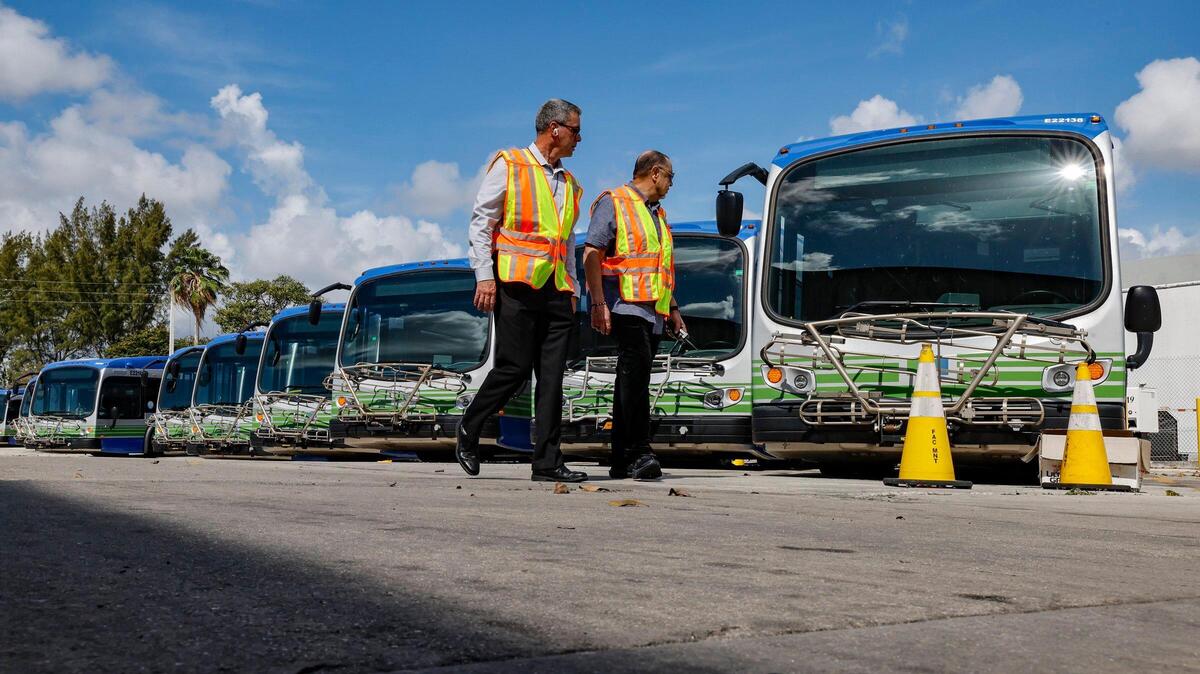
Miami-Dade transit officials weigh legal options over lemon electric buses
Three years after the company that sold Miami-Dade a fleet of electric buses went bankrupt, the county is still trying to figure out what to do about them – including taking legal action.
Read more Broward clears dozens of drug convictions from the ’80s and ’90s. Here’s why
Miami-Dade and Broward spent $126 million on a fleet of electric buses from a company called Proterra to cut climate-warming emissions and save residents money on fuel.
What they didn’t know at the time was that in less than a year most of the buses would be broken down and sidelined and that the company they bought them from would go bankrupt and be unable to provide service, maintenance or spare parts to keep the fleets on the street. Then, the company that took over for Proterra, Pheonix, also failed to replace essential parts on the buses – like batteries and gearboxes.
Miami-Dade spent more than $60 million on 69 Proterra electric buses and charging ports. Of that, nearly $24 million came from state and federal grants, and $37.5 million came from the half-penny tax added to retail purchases for transportation.
Proprietary technology in the buses posed a big complication. Not just any mechanic can fix them or debug software systems. Miami-Dade decided that enough was enough after a year of waiting for parts; they terminated the contract with Phoenix this April, according to Department of Transportation and Public Works (DTPW).
The county says its now going to assess all of their legal options. In a statement, Miami-Dade Department of Transportation and Public Works said that the County Attorney’s Office is actively pursuing all available legal and financial remedies to recover damages from Phoenix.
“We are unable to comment on specific claims or expected recovery at this time, but DTPW continues to advance parallel strategies to restore service capacity and protect Miami-Dade County’s long-term transit objectives,” said Maria Budet, Chief External Affairs Officer for the Department of Transportation and Public Works.
The county also plans to petition the Federal Transit Administration to allow them to retire and replace the buses before they reach the required 12-year lifespan, avoiding the need to repay federal funding tied to the vehicles. The federal government’s approval is needed in order to dispose or repurpose the buses, DTPW said.
A black mark on going green
Since the Proterra debacle, Miami-Dade purchased 100 electric buses from New Flyer, a more vetted company, and they say their efficiency on the Bus Rapid Transit Service has been successful. Only a few buses are off the streets getting maintenance work. Broward’s transit department, on the other hand, decided to cut its losses with electric and has a fleet of diesel buses on the way.
The millions of dollars worth of unused buses left a black mark on “going green.” Miami-Dade commissioners Natalie Orbis and Roberto Gonzalez passed a resolution in January directing the county mayor’s office to produce a report on whether the buses were actually a benefit for residents’ wallets and health – and the environment.
Read more: Are electric vehicles really saving Miami-Dade money? Commissioners want answers
The 24-page report sent to Commissioners in April evaluated all electric vehicles in the county.
Read more Kendrick Meek Jr. says he’s ready to build his own legacy with congressional run
The report touted positive results for the 405 electric cars and trucks the county has purchased, with more than $300,000 in savings on fuel, maintenance and the spillover cost of greenhouse gas and pollution emissions on health and the environment.
It said that electric vehicles saved $20,000 in environmental cost, which was found by using a tool from the Department of Energy’s “AFLEET” tool run by Argonne National Laboratory.
Unsurprisingly, the bus data was less substantial.
The New Flyer buses have been on the road for under a year, and the report says they haven’t been operating long enough to get a good measure. Only three of the 69 Proterra buses that Miami-Dade ordered were operational as of April. But the Proterra/Phoenix buses remained a “measurable financial risk,” because they were mostly unusable.
“Thanks to the report we requested from the administration, we confirmed that these buses did not provide value to Miami-Dade taxpayers and are sitting idle in a county lot,” Gonzalez said.
Broward decided to cut its losses with Proterra early on. The county withheld payment and rejected delivery of the final 11 buses. All 31 of the buses are parked now and retired from service, said Lucia Ross, Broward County Transportation Department director of communications.
Broward invested $31.4 million, and over 83% of that was covered by federal grants. So this limited the surtax exposure to $5.7 million.
Ross said this has made them pivot to “proven technology,” which, in Broward’s eyes, means diesel.
Broward County transportation department plans to purchase 65 diesel buses from Gillig and 65 diesel hybrid buses from New Flyer. They didn’t consider New Flyer for electric, despite the company’s more positive feedback from counties like Miami-Dade.
“Innovation carries risk, but we refuse to let that risk fall on our riders,” Ross said. “When customers stand at a bus stop, a bus should actually arrive.”
Ashley Miznazi is a climate change reporter for the Miami Herald funded by the Lynn and Louis Wolfson II Family Foundation and MSC Cruises in partnership with Journalism Funding Partners.
Read more Miami arts icon Marshall Davis to enter crowded race in congressional District 24










Post Comment