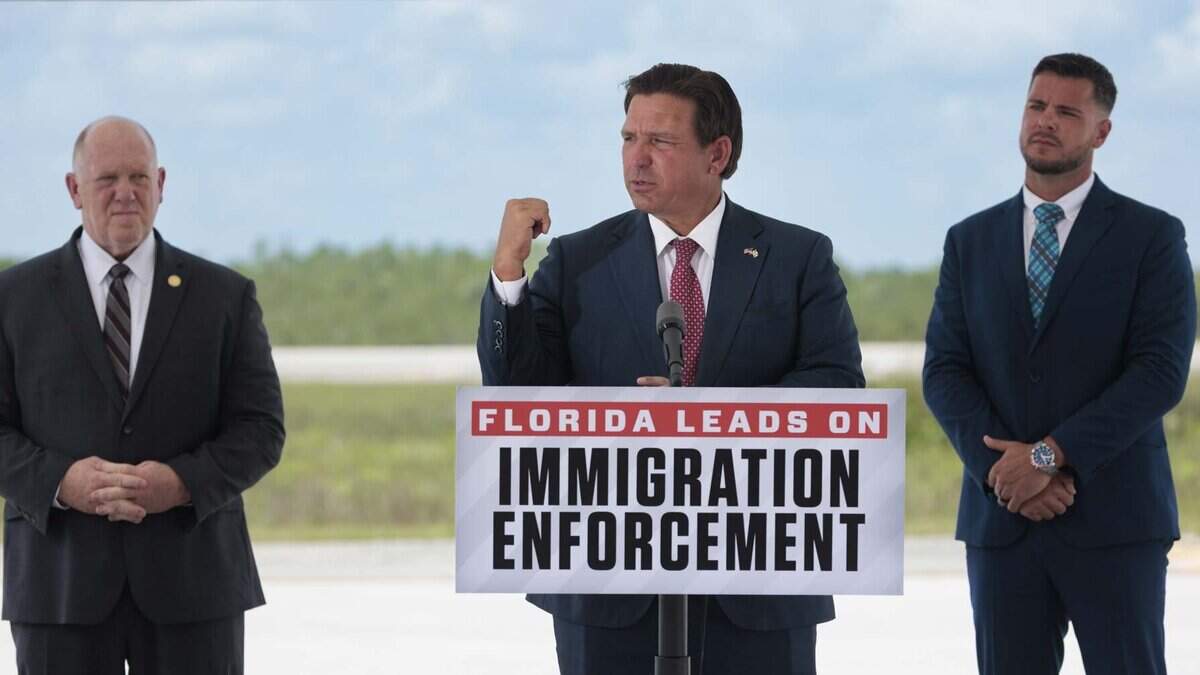
Payouts to FL immigration contractors surpass $1.2B, outstanding debts remain
The DeSantis administration in under two years has paid contractors more than $1.2 billion in emergency money for immigration enforcement — including to pull sheriff’s deputies to staff detention centers, to get gym equipment at Alligator Alcatraz’s staff village and to cover millions of dollars in overtime for security workers.
Read more Is South Florida experiencing a ‘rain bomb?’ Here’s what to know
Immigration enforcement efforts have accounted for 70% of the expenditures from the state’s emergency fund since summer 2025, when the DeSantis administration built the now-shuttered detention center in the Everglades named Alligator Alcatraz.
The fund, which the governor controls, allows Gov. Ron DeSantis to quickly respond to natural disasters and other emergencies without legislative approval. He’s tapped it for immigration enforcement under a nearly four-year state of emergency declaration that he re-upped earlier this week. The move pushed the declaration into 2027 and passed authority to incoming Gov. Byron Donalds.
Immigration contract totals had been ballooning for months, largely to help the state operate, build and later tear down the Alligator Alcatraz lockup. The center closed in June, about a year after opening.
But the number of outgoing checks to contractors has increased sharply over the past three months, a Herald/Times review of state spending shows, after the Legislature replenished the dwindling fund with hundreds of millions of taxpayer dollars.
The state still owes at least $263 million more to 32 separate vendors as DeSantis prepares to step down from office in January, according to spending records on Florida’s government accountability website.
The Florida Division of Emergency Management, which is overdue for a second time on providing a mandated quarterly report on how it’s been spending emergency money, did not respond to requests for comment.
The expenditures are among DeSantis’ steps to make Florida a leader in supporting President Donald Trump’s anti-immigration policies. In addition to opening detention centers and declaring a state of emergency, DeSantis also pushed the Legislature to pass laws that banned in-state tuition for undocumented college students and created a board to oversee immigration enforcement efforts.
The governor has maintained that the costs of immigration enforcement are necessary because they outweigh the unspecified expenses of immigrants living in the state without legal authorization.
Where did the money go?
Many of the original contract documents signed last year to staff Alligator Alcatraz were posted publicly for the first time in recent months.
They revealed hundreds of thousands of dollars to sheriff’s offices for temporary security and millions of dollars in overtime costs.
The Palm Beach County Sheriff’s Office charged the state $1.2 million across five contracts to provide staffing to Alligator Alcatraz — including for eight deputies and two supervisors to offer “fixed and roving security” for five different one-week periods throughout the 11 months the facility was open.
The Florida Department of Law Enforcement “requested regional support and assistance through the Florida Sheriffs Association. In response, [Palm Beach Sheriff’s Office] joined numerous other sheriff’s offices across Florida in providing assistance with five missions,” the sheriff’s office said in an emailed statement.
Read more Live updates: Broward swamped with a ‘rain bomb.’ Here’s the latest on crisis
“It did not impact our patrolling ability,” the office added.
Officers from faraway corners of the state were also pulled off their local duties and shipped to Alligator Alcatraz, contract documents show. St. Johns County Sheriff’s Office, near Jacksonville, sent 10 staffers at a time on various one-week security contracts.
Northeast Florida’s Nassau County, which borders Georgia, charged the state about half a million dollars to use its roving radio tower technology at Alligator Alcatraz in early July while the state was tearing down the facility.
Other contracts published last year show more than $10 million in overtime to GardaWorld — a security firm — for security and corrections contractors working at Alligator Alcatraz.
IRG Global, an emergency response company, listed a $102,000 cost for “Rec tent – gym equipment” under a $183 million contract to build Alligator Alcatraz’s staff village. IRG Global has received the most money so far of all contractors: roughly $257 million. The next-highest earner is sanitation and portable toilet company Doodie Calls, at $235 million.
Gothams, a disaster response company, was paid nearly $500,000 to print and procure credentialed badges and another $1 million in overtime for “credentialing agents.”
Specifics on these payments, and more recent ones, would be visible in a state-mandated quarterly report on the health of the emergency fund. It was due Oct. 15, although legislative leaders told the Herald/Times they have yet to receive it.
What is the emergency fund?
All of the spending came from Florida’s emergency fund, a trust created in 2022 for the governor to pay for declared disasters even without the blessing of lawmakers.
These emergencies range from hurricanes to floods to tornadoes to — most recently — immigration enforcement.
DeSantis renewed Florida’s state of emergency on immigration for the on Tuesday. The longstanding declaration, which DeSantis first signed in January 2023, attributes the ongoing need for the designation to the “failure” of former President Joe Biden’s administration. The emergency status is now set to expire Jan. 16.
Donalds, the incoming governor, has vowed a continuation of DeSantis’ stance on immigration and has threatened to remove local officials who don’t cooperate with U.S. Immigration and Customs Enforcement. His office did not respond to questions on whether he plans to re-up DeSantis’ immigration state of emergency.
State lawmakers earlier this month approved giving the emergency fund an additional $375 million to pay for the immigration efforts. It was the third — and largest — addition to the immigration portion of the emergency fund since the fiscal year began in July. The Legislature approved $187 million in September and $167 million in August.
The trust has $157 million left.
This story has been updated with additional information from Palm Beach County Sheriff’s Office.
Read more Roof collapses at Hollywood synagogue after Broward hit with heavy rain
This story was originally published November 18, 2026 at 12:44 PM.










Post Comment