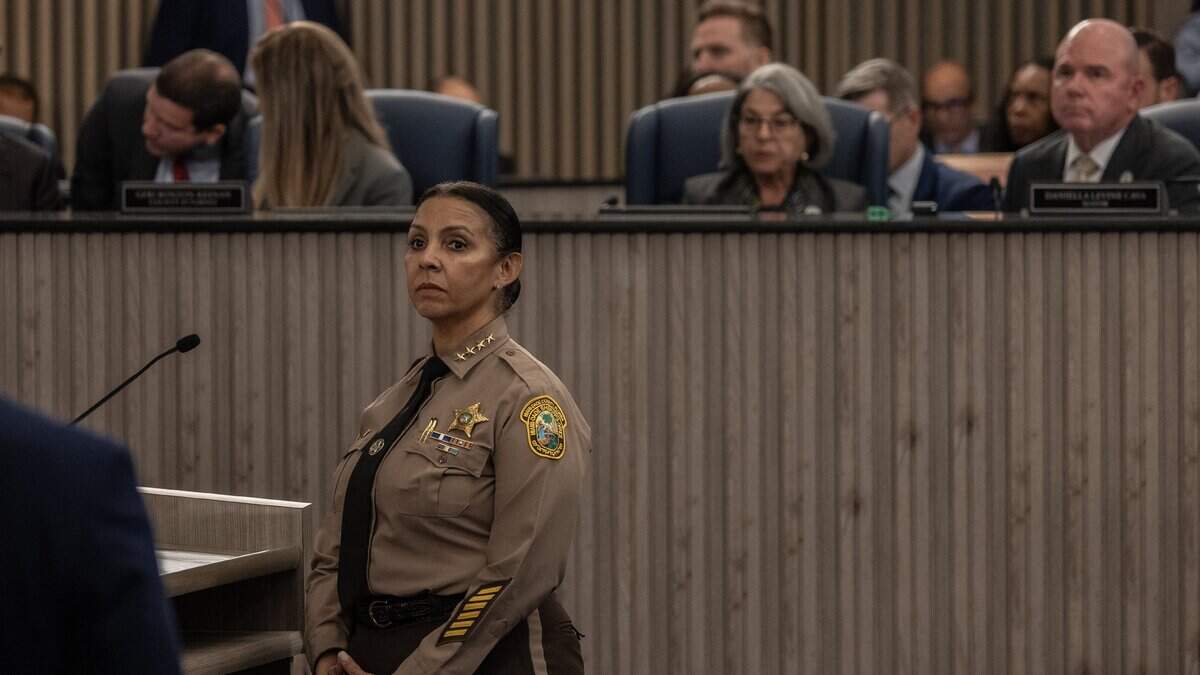
Sheriff defends pulling bodyguards from Miami-Dade mayor. ‘Not retaliation’
Days before she will pull deputies from a security detail for Miami-Dade’s mayor, Sheriff Rosie Cordero-Stutz says the move isn’t payback over a budget rift that left the law enforcement agency with millions less than it asked for.
Read more Legal challenges open Pandora’s Box in North Miami’s chaotic elections
“The decision to discontinue the program is not ‘retaliation’ for the County’s cuts to the Sheriff’s budget,” Cordero-Stutz wrote to Mayor Daniella Levine Cava in an Oct. 28 letter obtained by the Miami Herald. “It is based on a careful assessment of operational priorities and available resources.”
Miami-Dade’s Democratic mayor hadn’t used the word “retaliation” in her own letter protesting the decision by the county’s Republican sheriff to end a longstanding practice of plainclothes officers serving as drivers and bodyguards for elected officeholders.
But there’s no question the sheriff’s announced Nov. 6 end to the “sergeant-at-arms” program has sparked perhaps the most bitter dispute yet between the mayor and the sheriff since a 2025 change in Florida’s Constitution moved the county’s police force out from under Levine Cava’s control and into the hands of Miami-Dade’s first elected sheriff since the 1950s.
The controversy also means there’s extra attention on how the Sheriff’s Office will handle security for others as the mayor and commissioners lose their details.
A top aide to Cordero-Stutz, Rabbi Mark Rosenberg, has had a Sheriff’s Office squad car posted outside his house in a Miami suburb for multiple days, the Herald recently confirmed.
Rosenberg is a longtime police chaplain who now holds the title of senior adviser to the sheriff and who headed up an executive committee for Cordero-Stutz shortly after she took office in 2025. Despite taking on a high-profile role in Cordero-Stutz’s administration — the sheriff’s social media accounts include photographs of Rosenberg posing with her and Gov. Ron DeSantis on Oct. 23 and with her and Sen. Rick Scott in July — he does not take a salary.
In an interview, Rosenberg said his new role with the sheriff has brought with it threatening statements directed to him on social media. “The amount of threats I’ve gotten on myself only since the sheriff became sheriff is absolutely disgusting and disturbing,” he said.
Cordero-Stutz said the squad car was stationed as a response to those social media threats, which she described as tied to his religion and his role at the Sheriff’s Office. She said the same kind of security would be deployed if an elected official received a threat — along with anyone in Miami-Dade facing a credible security concern.
“If there is an active threat against anybody, I’m going to handle it, and I’m going to address it appropriately,” she told the Herald. “And that may mean that it’s a visible marked unit in front of that person’s residence or at their place of employment.” Her office said Rosenberg does not have a driver.
In her first interview on the sergeants-at-arms flap, Cordero-Stutz sought to differentiate between the Sheriff’s Office responsibility to respond to security needs versus the mission of the sergeant-at-arms program, which assigns deputies to preemptively protect and drive elected officials. She made the same point in her letter: “When a credible threat is identified, MDSO will take the necessary measures to address the concern for as long as the threat persists.”
Mayor and sheriff fight over budget and security details
In a letter to the sheriff released last week, Levine Cava portrayed the Cordero-Stutz decision as dangerous. Citing the 2025 shootings of state lawmakers in Minnesota, Levine Cava said elected officials face risks and that scrapping Sheriff’s Office sergeants-at-arms with three weeks’ notice presented “a significant security challenge.”
Read more Carol City beats Central in all three phases and on the scoreboard, 27-10
Levine Cava also referenced the ongoing budget fight. In September, commissioners passed a $1.2 billion budget for the Sheriff’s Office, which relies on county tax dollars for the bulk of its spending. Commissioners mostly sided with Levine Cava in rejecting Cordero-Stutz’s ask for about $42 million more in tax funding.
“Our residents expect their leaders to work together, and on matters of public safety, that expectation is non-negotiable,” Levine Cava wrote in the Oct. 22 letter.
The dispute has shone a spotlight on County Hall’s expanded use of officers as bodyguards and the drivers of black SUVs equipped with flashing lights that can allow an elected official to speed through traffic. In 2023, the county’s police department said it spent $1.3 million providing sergeants-at-arms to the commissioners and mayor. That amount has since tripled — before she axed the program, Cordero-Stutz’s 2027 budget had $3.9 million budgeted for sergeants-at-arms.
“I have to be fiscally responsible and look at my budget, and look at what has to stay and what must go,” Cordero-Stutz told the Herald. “That’s what this is about.”
Former Miami-Dade Commissioner Sally Heyman, who took office in 2002 and retired four years ago, told the Herald that when she was elected, there were just two sergeants who served the 13 commissioners and mayor. “And it sufficed.”
But current commissioners say enhanced protection is needed. Commissioner Oliver Gilbert, who is giving up his county seat in January after mounting a congressional campaign, said when he was mayor of Miami Gardens more than a decade ago, someone fired shots into his parents’ home — an address he said many people assumed was his. Now, social media, hate speech, Florida’s permissive gun laws and other factors “make security for elected officials necessary,” he told the Herald. “I wish sergeants-at-arms were not necessary.”
Sheriff’s Office security will continue at County Hall
Last week, Levine Cava privately shared a plan with county staff to redeploy some Corrections officers at the county jail system to serve as a new sergeant-at-arms squad, the Herald reported. Mike Roan, the mayor’s primary sergeant-at-arms before he retired from the Sheriff’s Office in August, is coming back to his old role to help set up the new program, sources told the Herald.
Cordero-Stutz said the Sheriff’s Office will continue to deploy deputies to serve as security during commission meetings and for overall security at the Stephen P. Clark Center, the government building that serves as County Hall.
The sheriff also said she’ll continue to have a deputy serve as her driver. Asked why she would do so if she’s taking away deputy drivers from commissioners and the mayor, Cordero-Stutz noted that county government and the Sheriff’s Office have separate budgets and said the county should absorb its own costs for security if elected leaders decide they need those services.
“Those are options open to them,” she said. “There’s a cost. It doesn’t have to be a deputy sheriff.”
Read more Ex-mayor admits stealing about $390K from California church where she did the books







Post Comment