Florida’s education chief warns against AI in schools. Is he using it himself?
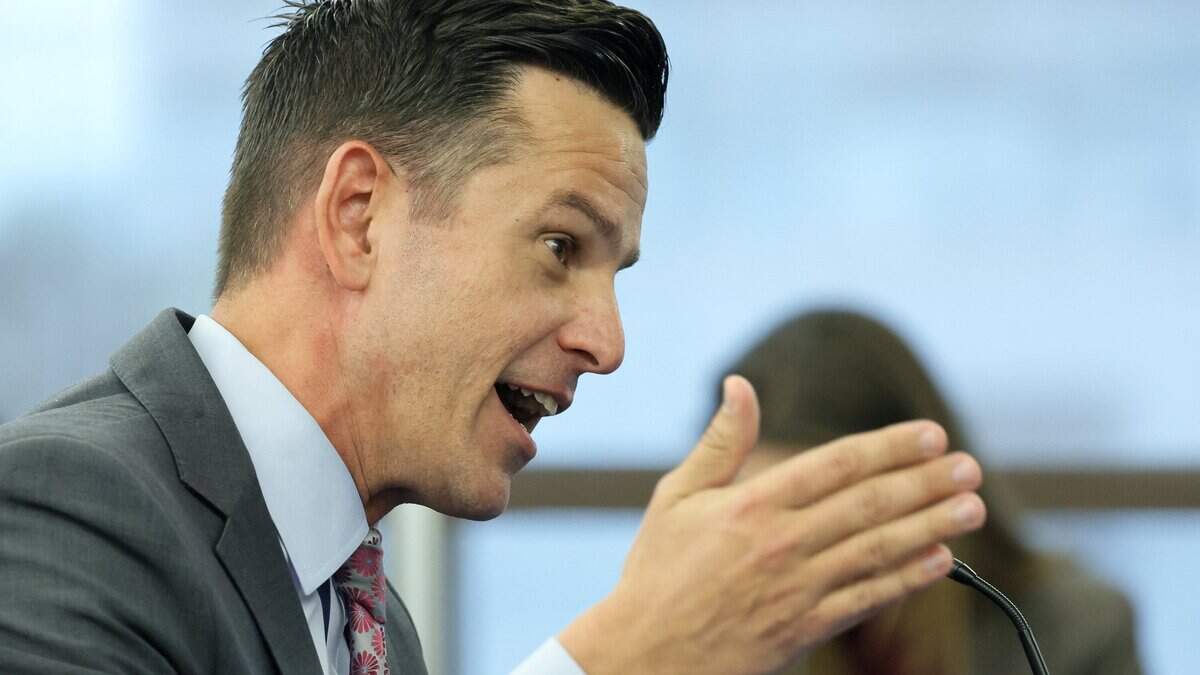
Early into his tenure this summer, Florida Education Commissioner Henry Mack took to social media to talk about the limits of artificial intelligence.
Read more ‘Really gross’: Miami Beach hopes to restore a waterway so filthy it’s been closed for years
His office had just rolled out a sweeping set of regulations meant to safeguard against the possible harms of AI in schools, including the outsourcing of critical thinking and work to the technology.
“If AI writes the brief, who knows whether the law is just? If AI designs the building, who understands proportion, beauty, and the people who will live in it? If AI manages the portfolio, who decides what a society should value,” Mack asked.
The world’s leading AI writing detection software flagged the post as possibly written by AI. Same goes for the majority of Mack’s posts and much of his other written work since he began his tenure as the state’s top education official.
Most of Mack’s official correspondence in his new job – which includes speeches, letters and memos — has likely been written by AI, according to a Miami Herald analysis using the company Pangram’s AI writing detection software. The majority of his social media posts and three published articles he’s coauthored this year also appear to have been written by AI as well.
Though the detection software does not definitively prove AI use, its consistent results across a diverse set of writing suggest that Mack has been using AI himself, often to spread the message that educators and students in Florida should not lean too heavily on the tool.
This sends the wrong message to students, says Paul Novosad, an economics professor at Dartmouth College, a school whose own provost’s use of AI in writing is being investigated by the administration.
“We’re supposed to be modeling the appropriate, ethical standards for our students,” Novosad said. “How do you teach kids to put effort into their own writing if none of the adults around them are doing it?”
Travis Jordan, Chief Communications and Marketing Officer for the Department of Education, did not directly dispute the detector’s results in an emailed statement to the Herald. However, he asserted that Mack’s writings “are his.”
“The arguments, the priorities, the voice are his. Like pretty much every other official, reporter, or professional right now, he and the people who work with him use the tools that exist for research, organizing notes, cleaning up drafts, and getting things done faster. That’s normal. The final product is still his responsibility,” Jordan wrote.
The impact of AI is one of the most salient issues in society, and leaders across sectors are relying on it for written messaging. Education is no exception. A prominent Stanford University misinformation expert overlooked made-up, AI-hallucinated citations in a court declaration he wrote using ChatGPT; the controversy is even bigger at Dartmouth.
Student interest in, and abuse of, AI is only growing as models improve. A 2026 found about 70% of American teens are using AI for schoolwork, and a growing body of research suggests that using AI to help get an answer significantly undermines student learning.
Florida’s posture – as expressed by Mack and Gov. Ron DeSantis, who said Florida “will not outsource childhood to a chatbot” – reflects some anxieties about that evidence.
In an opinion article co-written with an official at the Heritage Foundation, a prominent conservative think tank, Mack touted Florida’s strategy and highlighted the negative effects of students relying on “machines that do the hard work for them.”
“Has AI ruined education? Not in Florida,” Mack and co-author Jonathan Butcher wrote.
The op-ed was likely written entirely by AI, according to Pangram, which touts an error rate of less than one-hundredth of a percent. Two other published works co-authored by Mack this year, an op-ed in conservative news site the Daily Caller and a blog post for his previous employer the U.S. Department of Labor, come back as 100% AI and 93% AI.
Controversial science standards also flagged
The rolled out under Mack make Florida one of the more restrictive states in the country when it comes to AI in the classroom. The rules ban companion chatbots and require parental opt-in — not just an opt-out option — for direct student use of AI tools. In higher education, the state also moved to unless it’s explicitly allowed.
Though the policies make Florida relatively restrictive, they do not go quite as far as New York City, where the school system completely banned generative AI for students before high school.
While the state has limited AI’s use for students, it hasn’t limited it for the Department of Education.
The state’s have drawn criticism from groups like the National Center for Science Education that say the standards aren’t based on science education research and glosses over components of evolution and climate change. The standards also appear to have been partially written by AI.
About 32%, or 37,000 words, of the 110,000 word standards were identified as written by AI, according to Pangram. The content includes specific directions to teachers on what their instruction should include.
Glenn Branch, deputy director of the National Center for Science Education, called it “ironic.”
“If AI was used in the writing of the proposed standards, it would be ironic, since Governor DeSantis recently declared, ‘Florida will not outsource childhood to a chatbot.’ It would also highlight the limitations of AI, since the proposed standards, if adopted, would be the worst science standards in the country by far,” Branch said.
Jordan from Mack’s office disputed Pangram’s results on the science standards.
“One detector spitting out 32% on a document that runs tens of thousands of words doesn’t tell you how it was written. We don’t accept the implication that the standards are ‘AI-written’ on that basis,” he wrote.
‘Great campuses don’t float’
The way Pangram works is it uses AI to detect AI.
The company trains its own model to compare human writing and AI writing on a similar topic done in a similar style. The method allows it to track increasingly subtle differences between the two and provide scores on writing that is “possibly AI” or “is AI.” Most of Mack’s social media posts were flagged “possibly AI” due to their shorter length; all of his longer writings were given percentage scores.
Pangram trains on a wide variety of texts, including scientific and educational materials.
The model’s accuracy rate is 99.66%, per the company. The result is generally more reliable for longer texts and it won’t analyze texts shorter than 50 words. A recent update changed its classification approach such that texts between 50 and 150 words can only be deemed “possibly AI.”
Read more What’s next for Alexander brothers? Twins face Miami-Dade rape charges
The program is so effective that a cottage industry of AI-powered “humanizers,” meant to make AI-generated writing undetectable, has sprung up.
In the department’s statement, Jordan wrote that “AI detectors are a mess,” and said they regularly produce false positives.
Many experts don’t agree with that characterization when it comes to Pangram. Brian Jabarian, a professor of economics and technology at Carnegie Mellon University, published a paper highlighting Pangram’s low rate of false positives last year. He told the Herald he “would be even more confident in the accuracy” of the program now given his experience with it in recent months, especially for texts longer than 100 words.
Novosad says much of the AI writing in Mack’s case is easy to spot, even without a detection service.
“Those tweets are atrocious. No one who sees a lot of AI-generated text could have any doubt that these tweets are AI-generated,” Novosad said.
Lists of three and the construction of “it’s not X, it’s Y” are two very common tells, he said. Excessive use of dashes and imprecise metaphors are two others.
In a tweet Mack wrote about the announcement of Carnegie Mellon University’s planned $2 billion Miami campus, he uses some of those AI conventions.
“Great campuses don’t float. They rest on a talent pipeline that can actually walk through the door ready to create, discover, and build,” Mack wrote in the tweet, which Pangram identified as “possibly AI.”
Sam Woolley, a communications professor at the University of Pittsburgh who studies social media, said the posts also passed his eye test for AI content.
“I’ve looked at a lot of AI generated content over the course of my career, and to my eye a lot of this stuff has the markers of being AI generated,” he said.
About 75% of Mack’s posts to X and LinkedIn since being recommended in July for the state’s top education role are flagged as likely or “possibly” AI, per Pangram.
Just over half of Mack’s asking them to revisit their books and reading materials for sexually explicit content — including most of his suggested “90-day plan” for administrators — was written by AI, per Pangram.
Of 13 pieces of Mack’s official correspondence Pangram analyzed, 10 were flagged majority written by AI, including multiple letters and speeches. One was found to be 100% AI and two others were flagged as majority written by a human.
Of six articles or blog posts Mack has authored this year, Pangram found two to be “100% AI,” and one was 93% AI. The other three were either entirely human-written or had minimal AI involvement, per the software.
Woolley argued that the content coming from a high-ranking public official raises bigger questions.
“It breaks down the communication of deliberative democracy. You’re getting a veneer of the public official, not the real thing… Politicians are already criticized for being disconnected from their publics, and when they begin to use AI to connect with their publics, that breaks down even more,” Woolley said.
Read more: An AI school with $65K tuition is the latest sign of billionaires reshaping Miami
AI becoming ubiquitous
Though Mack’s position as an education official – particularly as one who is setting policy on students’ use of AI to do work for them – makes him unique, he is not alone among policymakers or thought leaders in likely using AI.
The provost at Dartmouth, where Novosad teaches, is still being investigated for using AI without disclosure. He reportedly used AI for writing an opinion article in the Washington Post, which was flagged as “100% AI” by Pangram, like two of Mack’s articles.
But there are those that think this kind of AI use will be the new normal.
“Unfortunately, I think that in the near future, not using [AI] to write for you will be like someone refusing to use Google Maps for directions in a new city,” Bloomberg journalist Joe Weisenthal wrote in a social media post. “A bizarre idiosyncratic choice that’s just completely incomprehensible to the vast majority of people.”
One recent study found that now more than half of all articles published on the internet are primarily AI-generated.
After billionaire Stanley Druckenmiller penned an op-ed in the pages of the Wall Street Journal that came back as 100% AI, the news outlet Semafor ran a test on other guest op-eds in three major publications – the New York Times, the Wall Street Journal and the Washington Post.
Out of 310 pieces analyzed, 10 came back as more than 80% AI-written.
The trend has also filtered down into U.S. Congressional speeches, according to Originality.ai, another detection service. The group analyzed thousands of congressional speeches and found that the “likely AI” percentage rose from 8.4% in 2025 to 12.2% so far this year.
Of Mack’s two speeches the Department of Education posted to his official correspondence page — addresses to a and the — Pangram estimated that one was 88% AI-written and the other was 87% AI.
But not all Florida politicos seem to have widely adopted AI.
The Herald conducted a similar analysis of Gov. Ron DeSantis’ posts to X of at least 50 words. Only one of 97 recent posts came back as “possibly AI” and another was flagged “possibly AI-assisted.” The rest were found to be written by a human.
But Mack can argue that he didn’t use AI when he was in school.
A Pangram analysis of Mack’s 2022 dissertation for his doctorate in education at the University of Miami, an 82,000-word defense of liberal arts education, found the document to be 100% human-written.
Read more Racist chats, expulsions and free speech: FIU trial gets under way in Miami
This story was originally published October 28, 2026 at 7:20 AM.








Post Comment