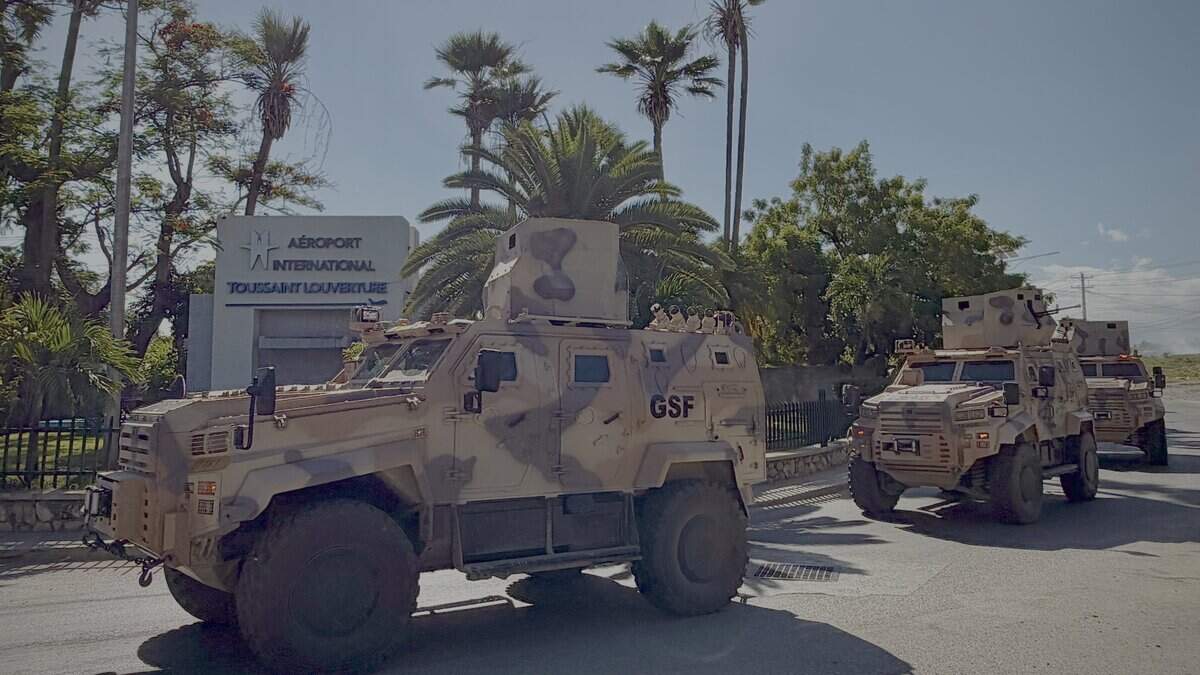
After ambush, search continues in Haiti for soldiers with gang-fighting force
Four Salvadoran soldiers remained unaccounted for in Haiti’s capital on Monday after suspected gang members ambushed their armored vehicle and set it ablaze, prompting a rescue operation in which Salvadoran military helicopters also came under fire, according to a statement by El Salvador’s armed forces.
Read more U.S. and Cuba clash at the U.N. over ‘Cuba Libre’ event ahead of embargo vote
The soldiers are aviation technicians who have been deployed to Haiti as part of the United Nations-authorized Gang Suppression Force, the Salvadoran armed forces said in a statement.
“During the attack, the criminal groups used firearms and explosive devices, triggering intense armed clashes,” the statement said. “The armored vehicle was struck by explosives and caught fire. However, all four military personnel managed to escape from the vehicle. Upon learning of the incident, helicopters from our Armed Forces were deployed to provide support, forcing the criminal groups to retreat.”
On Monday, the soldiers were still missing, leading to an aggressive search by angry gang-force soldiers who busted the gate of a local business searching for gang members and flew over the area in helicopters.
“Multiple attempts have been made to reach the area by land and air, but these efforts have been hampered by the intensity of the fighting and security conditions in the area,” the statement said.
El Salvador’s representative to the United Nations condemned the attack, detailing the ambush for members of the Security Council.
“Our immediate priority is to ensure the prompt and safe recovery of our personnel,” Ambassador Egriselda Aracely González López said. “We call for all coordination efforts to be maintained and strengthened, and for the necessary capabilities to be mobilized.”
The council meeting had been scheduled to meet Monday to discuss the progress and ongoing challenges in Haiti, where the gang-fighting force is still struggling to meet its authorized 5,500 personnel, the country’s first general elections in more than a decade is headed for postponement, and gangs continue to gain territory. During her brief address at the end of a two-hour-plus meeting, the Salvadoran ambassador stressed the need for adequate security measures and international support for the armed mission.
“The safety and protection of those participating in these operations must remain a standing priority and a responsibility of this council,” González López said. “It is essential that the implementation of the force’s mandate be supported by adequate intelligence, surveillance, mobility, communications, medical support and emergency response capabilities, including for emergencies of the kind that we are unfortunately facing today.”
Salvadoran President Naybib Bukele, she said, reaffirms his commitment with the Haitian people and is grateful for the expressions of solidarity voiced during the meeting as well as the leadership of the force, member nations and deployed soldiers who are contributing to operations to locate the missing Salvadorians.
Mike Waltz, the U.S. ambassador to the U.N., had called on González López before the meeting and said he affirmed the United States’ support to the Central American nation, its people and troops in Haiti.
“America stands shoulder to shoulder with them and offer the full support of the U.S. government in addition to the good offices of the various U.N. agencies, but more broadly to the soldiers around the world risking their lives to save Haiti, and now to save their fellow service members,” Waltz said.
While rumors have spread in Haiti that the men were killed, Waltz told colleagues on the council that, “by God’s grace, we believe the men… survived, but they do remain unaccounted for.”
Waltz then addressed the gangs and the gang leaders who carried out what he described as a “cowardly attack.
“If you think you are going to intimidate this coalition into retreat, you have made a terrible mistake,” he said.
Sunday’s attack is precisely the reason the new approach of armed international assistance to Haiti is needed, Waltz added.
“Armed thugs have robbed Haitians of their most simple freedoms, working an honest job, walking their own streets, sending their children to school without fear,” said Waltz. “But they are clearly ready to attack the international community who is sent there by this committee, this council, to protect the civilian populace. This is precisely why this council owes the Haitian people better than business as usual.”
As search efforts continued, the head of the Gang Suppression Force, Jack Christofides; the U.N. Integrated Office in Port-au-Prince, Carlos Ruiz Massieu, and Daniela Kroslak, who heads the U.N. Support Office in Haiti, also addressed the Security Council in New York.
Christofides told council members that the full circumstances of the attack are still being investigated. “We are examining the response and implications for force protection and operational support,” he said.
Read more Students reported Snapchat threat to South Mississippi schools. FBI is investigating
Since July, over 1,000 people have been killed in Haiti, including hundreds of suspected gang members, while thousands of others have been forced to flee their homes, adding to the 1.5 million Haitians who have been displaced.
Despite the presence of the gang-fighting force, which has been intensifying operations since it began deploying in April, armed gangs have continued to challenge the government’s authority and inflict violence on Haitians, as underscored with the recent August attack in the rural community of Kenscoff in the mountains above Port-au-Prince, in which at least 47 people were killed and over 50 were kidnapped.
The soldiers’ white Toyota vehicle, known as a Zoreken, was spotted around noon Sunday leaving the Damas supermarket in Fleuriot near the airport headed to the high-risk Santo 19 neighborhood about 30 minutes east to a second Damas supermarket. The soldiers were returning to their camp when the ambush occurred at about 1:30 p.m. in front of an orphanage for disabled children in the Santo 17-18, Croix-des-Bouquets area, just east of Port-au-Prince. The area is under the control of two heavily armed criminal groups, 400 Mawozo and Chen Mechan.
People familiar with the area said the initial attack was carried out by members of the Chen Mechan gang, who were than reinforced by members of 400 Mawozo, led by Joseph Wilson, aka Lanmo San Jou, one of several Haiti gang leaders wanted by the FBI. Once at war with one another, the two gangs are increasingly joining forces.
A person inside the orphanage described the scene to the Miami Herald as “a war,” with shooting and helicopters heard flying all night. They people inside spent the night huddled in one room, she said. “The kids are scared.”
In a statement confirming the incident, the gang-fighting force said its military personnel returned fire and helicopters were deployed to search for the soldiers. Residents in Santo and the surrounding area were advised to remain indoors until further notice.
The incident is the first major attack involving the force, which surpassed more than 2,000 troops from contributing countries this weekend, with 4,000 more slated to arrive in coming months. The troops are being sent by Chad, Bangladesh, El Salvador, Guatemala, Mongolia and Sri Lanka. The Sri Lankans are stationed in Haiti’s Artibonite region, just north of Port-au-Prince, while the other troops are assigned to metropolitan Port-au-Prince. Jamaica serves as deputy force commander after Mongolia.
On Sunday, Guatemala held a farewell ceremony at the Guatemalan Air Force for the personnel of the unit that will join the Haiti gang-fighting force
The ceremony was presided over by Defense Minister Henry David Saenz Ramos and included the participation of the U.S. military attaché in Guatemala.
“These missions project the country’s image in the world, strengthen the professionalization of our personnel and demonstrate that the Guatemalan Army is prepared to contribute to efforts that protect the most vulnerable populations,” the Guatemala military said in a post on X.
At the U.N. Kroslak said the Support Office in Haiti had worked diligently to overcome the challenges associated with troop preparedness, availability and transport of equipment, and “expect a significant acceleration in deployments through the end of 2026.”
The U.N. office is developing and sustaining eight operational and logistical bases across Haiti, including in Port-au-Prince and Artibonite, with Camp Vertières in the capital serving as the force’s principal headquarters and logistics hub, she said. Preparations are also advancing for expansion into a third regional department, where several hundred personnel are envisioned to operate.
Sunday’s attack and the missing Salvadoran personnel, Kroslak said, “is a stark reminder of the dangers faced by those serving to restore security in Haiti.”
Christofides said that while the current number of troops represent just over one-third of the authorized 5,500 force strength, troop commitments are not the biggest constraints.
“The constraint is moving people and equipment, communications vehicles, and intelligence,” he said. Christofides said their force’s task is to concentrate on areas where it can make a meaningful difference, but as armed groups expand their geographical presence outside metropolitan Port-au-Prince, the reality is “we cannot be everywhere at once.
“Experience is showing us how gangs adapt, how they are localizing their attacks and regrettably turning more to kidnapping. They’re exploiting opportunities elsewhere and pushing deeper into other parts of the Artibonite, Gressier and Kenscoff.” he said. “We have also seen gangs retaliate against local communities.”
He highlighted a recent killing in the Artibonite region, in which gangs carried out killings after an intervention by Sri Lankan soldiers. To date, the gang-fighting force has apprehended 26 people, including a minor who has been transferred to a special center; the others were handed over to Haitian authorities, per the protocol the force works under, within 48 hours of their arrest.
The Salvadorians operate a helicopter unit as part of the gang-fighting force, which was first authorized in September 2025 to help Haiti take on armed gangs now controlling large swaths of the capital. Along with Guatemala and Jamaica, El Salvador participated in the Kenyan-led Multinational Security Support mission, which ended its deployment earlier this year. Last month, the U.N. approved a resolution drafted by the United States and Panama authorizing the new anti-gang force for another six months.
Read more Man said he ‘mapped out roofs’ to shoot Trump at Kansas rally, charge alleges
This story was originally published October 19, 2026 at 4:47 AM.










Post Comment