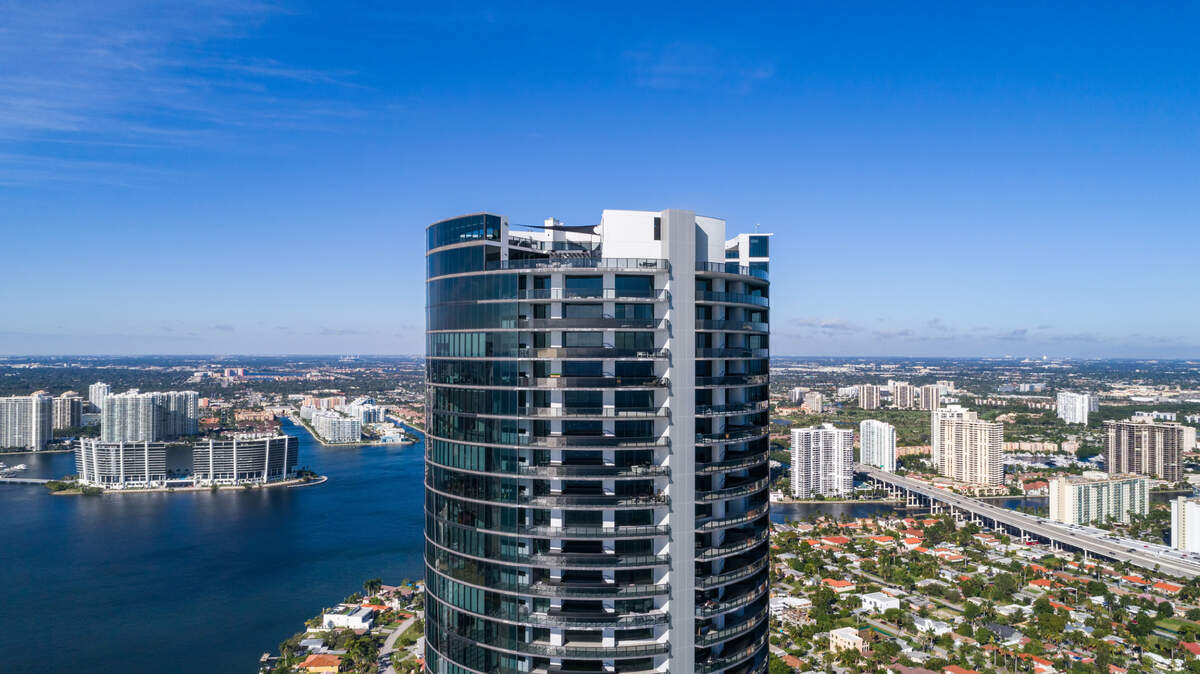
Miami-Dade skyline is sinking unevenly, new research finds
New research shows that luxury high-rises in Miami-Dade aren’t just sinking more than expected; they’re sinking unevenly, with parts of the building sinking faster than others. This so-called differential settlement, engineers say, can potentially create long-term structural damage and dramatically increase maintenance and insurance costs.
Read more We asked four ethics experts about Coral Gables mayor’s UM vote. What they said
“We can see really well now how these buildings are internally deforming, that some are shrinking and tilting….and that there is differential settlement,” said Falk Amelung, the University of Miami professor whose 2024 paper revealed that at least 35 buildings along Miami’s barrier islands — from the Porsche Design Tower to the iconic Faena Hotel and several buildings named after Donald Trump — were sinking more than expected.
High-rises are expected to settle as their enormous weight compresses the ground beneath them, but that settlement is expected to stop soon after construction. UM’s research showed that the high-rises continued to sink into the sand and porous limestone they were built on years after they were constructed.
READ MORE: Sinking skyscrapers? As buildings got bigger in Sunny Isles, so did engineering concerns
Those initial findings, officials from the affected cities said at the time, did not indicate an immediate threat to the buildings, as even settlement is somewhat manageable. Now, however, Amelung added another dimension of data: By looking at satellite data that can track how the exact position of more than one spot of a building changed over time, he was able to determine whether the buildings are uniformly sinking.
They are not, according to Amelung’s research.
“With this new data, we know for certain that there is differential settlement,” for all of the 35 high-rises, Amelung said. Engineering textbooks advise practitioners to limit any settlement to around 1 to 3 inches, depending on the soil. But between 2016 and 2023, some of the buildings also experienced differential settlement at different orders, Amelung said. His presented his research at the European Space Agency conference in June and he hopes to publish more detailed findings within the year.
Differential settlement can lead to major structural issues ranging from cracked pipes and facades, misaligned doors, twisted rebar, warped floors, or driveways that are a step higher than the lobby. While these issues can be addressed, the costs can be incredibly high, and under Florida law, developers are only on the hook for anything identified within the first seven years after a building is handed over to the homeowners association.
The Herald reached out to all buildings cited in the original study. All declined to comment. The city of Sunny Isles Beach, where many of the buildings were located, said in 2025 it had received no reports of damages associated with settling.
However, experts have cautioned that this unexpected, differential settlement needs to be taken seriously.
“This aspect is not understood well, so we need to look at the geology more carefully and make new models of the subsurface and how it is going to settle,” Anil Misra, chair of the civil and environmental engineering department at Florida International University, said of the new research.
Since the University of Miami first released its findings over the unexpected settlement of Miami’s skyline, independent experts have called for more research into the subsurface, how to best guarantee the long-term structural integrity of buildings, and monitoring of all buildings that goes beyond the construction period. In a paper published earlier this year, the former dean of the University of Miami’s school of engineering, Jean-Pierre Bardet, called for a “temporary approval moratorium on slender high-rise towers,” and “a reconsideration of the current high-rise permitting and oversight process.”
Officials, developers and their architects and engineers have either declined to comment or questioned the researchers’ motives while assuring the public that the buildings are safe. In the deadly 2021 collapse of the Champlain Towers in Surfside, investigators and other experts made clear that settlement did not play a role.
Read more Has fall arrived in South Florida? Temperatures dropping — but there’s a risk
A $4-million complaint over structural cracks
Two-story motels used to dominate places like Sunny Isles Beach, where the subsurface consists of a mix of sand, silt, a little peat and porous limestone, but a building boom beginning in the 2000s saw ever larger towers.
A Herald investigation has shown that engineers quickly realized that these heavy high-rises experienced more settlement than they had accounted for. In hopes of stabilizing future buildings, they began recommending ever deeper foundations.
Developers of the Bentley even decided to shave about three floors off to make it lighter, according to the latest geotechnical report the Herald has reviewed. For the remaining 716 feet, engineers recommended foundations reaching down 200 feet — even deeper than those of the world’s tallest building, the Burj Khalifa in Dubai, which is four times higher than the Bentley.
UM’s initial research also suggested that new construction — and the drilling of foundations — could cause neighboring buildings to settle. Just like shaking a tin of ground coffee creates more space on top, they argued, the vibration from drilling into the subsurface could compress and compact sand grains.
The Herald has found that a complaint involving the Millennium Tower and the neighboring Porsche Design Tower supports that theory. In 2016, the Millennium’s HOA filed a complaint over cracks in unit ceilings, the marble floor in the lobby, the swimming pool tiles and the deck, and “structural cracks in the garage, front entrance and building columns,” citing the construction of the Porsche as the reason. The Millennium sued over close to $4 million in repairs.
“These structural issues seem to be very significant,” said Bardet, who reviewed the court documents at the Herald’s request.
That complaint was settled for an undisclosed figure, in large part because the Porsche didn’t violate the building code, which defines the maximum vibration allowed during construction.
A few years later, in 2024, when construction of the 60-floor St. Regis began, the HOA of the neighboring Marenas Beach Resort became so worried over the vibration that they installed a $20,000, wireless sensor system that tracks minute changes within the building. That doesn’t just ease the minds of residents, the HOA president told the Herald, but equips them with data that could be used in potential litigation.
The company that installed the sensors, SmartCore, told the Herald that the Marenas was its first client, but that since UM’s study and the Herald’s investigation, five additional high-rises in Miami-Dade have installed SmartCore sensors. Another six are scheduled to be online by the end of the year.
Independent experts have also called for amending building codes to require long-term monitoring of settlement. Though the official response has been muted, Bardet wrote that in doing so, “policymakers can ensure that Miami’s vertical growth is anchored by a foundation as robust as its ambition while the equity of unit owners is protected.”
Read more Gas prices rising in South Florida — will they go up more? Check your area









Post Comment