We asked four ethics experts about Coral Gables mayor’s UM vote. What they said
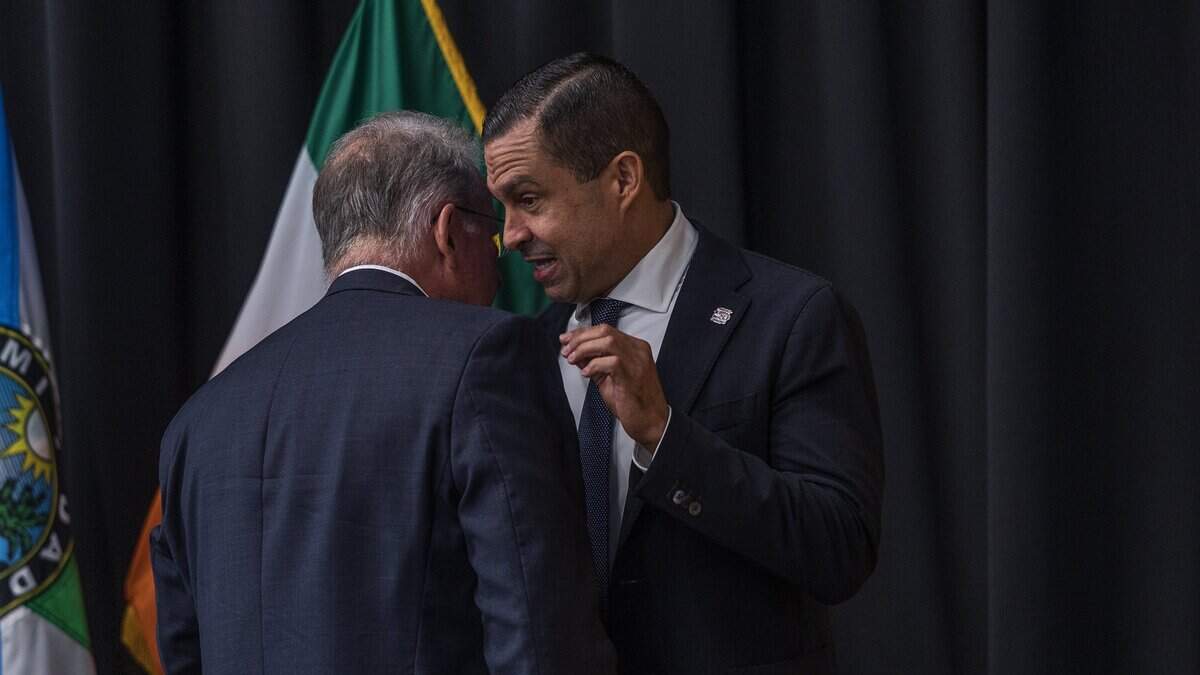
Coral Gables Mayor Vince Lago is facing criticism during his reelection campaign for the key role he played in crafting a 30-year development agreement between the city and the University of Miami.
Read more Has fall arrived in South Florida? Temperatures dropping — but there’s a risk
Political opponents have raised concerns over whether Lago has a conflict of interest and should not have been involved in, or voted on, the UM deal that commissioners approved this month because of his new job as principal of a construction firm whose parent company is an authorized UM contractor.
Commissioner Melissa Castro, a political rival of the mayor who is also running for reelection, has publicly questioned whether Lago or his company has financially benefited — or will benefit — from the deal that gives the private university the ability to plan for more students, new housing and other new buildings on its growing campus. Jackson “Rip” Holmes, one of two opponents running against Lago for mayor, has accused Lago of violating state law and filed an ethics complaint against him last week, although experts told the Miami Herald the county’s Ethics Commission is unlikely to review the matter until after November’s election to avoid the appearance of political interference.
Lago, who’s spent much of his career building educational facilities across South Florida, including for UM, described the allegations as political theater as he runs for a final term and points out that the Florida Commission on Ethics earlier this year found probable cause against Castro regarding potential conflicts with her own outside employment. (No final determination has been made in Castro’s case.) Lago said his private attorney advised him that he had “no obligations to recuse myself” and that his new role at Hammer Commercial focuses on workforce housing “outside of Coral Gables.” Its parent company, Hammer Construction Corporation, did work for UM as recently as several months ago, permit information shows.
Four ethics experts contacted by the Herald said that, based on the publicly available information about the mayor’s job and the UM deal, Lago does not appear to have run afoul of any state ethics laws. But they said he needs to be careful moving forward.
“The optics are terrible,” said Bob Jarvis, a law professor who specializes in ethics at Nova Southeastern University and who lives in Naples. Jarvis said he would have recommended that Lago recuse himself from the vote to avoid even the appearance of a potential conflict of interest — it’s like “giving your opposition red meat that they can throw around at election time.”
“But that is a different question from ‘Are you doing anything illegal?’ and I don’t think that Lago is doing anything illegal,” he added. He described the situation as a problem that occurs when residents are “not willing to pay for a full-time mayor and full-time commissioners.” In Coral Gables, like most other local governments in Miami-Dade County, the mayor and commissioners are allowed to maintain outside employment.
Jarvis and the three other experts the Herald spoke with said Lago did the right thing by seeking advice from his private attorney before voting on the deal. They recommend he go a step further and seek an opinion from the city attorney, the county ethics commission or state ethics commission on how to navigate his public and private roles, when he worked for BDI Construction, another company that sometimes does work for UM.
Lago told the Herald he doesn’t plan to seek further guidance because he “feels very comfortable” with the guidance he already has from the city attorney, the ethics commission and his personal attorney.
“I have great legal counsel who has provided the necessary guidance, and prior to me making any decisions, I always follow that protocol,” Lago said. Lago said he has not yet seen Holmes’ complaint.
Caroline Klancke, director of the independent, nonpartisan Florida Ethics Institute in Tallahassee, said there’s no inherent issue with public officials having private employment, but certain boundaries need to be in place.
“It is not illegal to be entrepreneurial in the great state of Florida and be a public citizen — that is perfectly permissible — but care is required, ultimately, to safeguard the public’s trust and confidence that [public officials] are acting in the best interests of their community,” said Klancke.
The problem is that Florida’s ethics laws are kind of vague — the “lines are squiggly, and they move” — which can sometimes make it difficult to know what is and is not a potential conflict of interest, according to Mike Carr, an attorney and former Collier County judge who previously served on the Florida Commission on Ethics.
Both Carr and Klancke, who herself previously served as general counsel and deputy executive director of the Florida Commission on Ethics, said the best way to get rid of speculation is to seek guidance from the state ethics commission.
The more simple approach: Follow the “bad man theory of law,” Carr says.
“Try and do whatever you’re going to do as if you’ve got a bad man looking over your shoulder who’s working hard to misinterpret what you’re doing … you kind of have to go the extra mile,” Carr said.
Here’s what to know:
The UM deal
The deal, which Lago and City Manager Peter Iglesias worked on for years alongside city staff, is a renewal of a previous agreement and was unanimously approved by commissioners earlier this month.
As part of the deal, UM will pay just over $1 million a year to the city for the next 30 years, with the payment increasing by 4% annually. The university will also give the city one of Lago’s key asks: nearly six acres of grassy land to transform into the city’s largest park.
In return, the city increased the cap on how many full-time undergraduate students UM can have on its Gables campus, gave it more “development square footage” to build on, and agreed to rezone several university-owned properties on the same strip as the popular Titanic Brewery and Restaurant from commercial low-rise intensity to university campus purposes. The changes would make it possible for UM to open a new medical facility in the area.
“There’s no conflict because I don’t have any personal gain. … There isn’t any set prescribed public benefit which I would receive at this current moment,” Lago told the Herald. He said the UM deal “has many, many moving parts, and a lot of it is not having to do with construction. A lot of it has to do with just the mechanics of the University of Miami over the next three decades, so I don’t have a conflict because I don’t have any personal gain.”
Lago’s job
For years, Lago worked at BDI Construction, and three months ago, he became a principal at the recently established Hammer Commercial Construction. It’s an affiliate company of Hammer Construction Corporation, which is “an approved University of Miami contractor,” according to its website.
Read more Gas prices rising in South Florida — will they go up more? Check your area
Lago’s friend Norman Newell, whose family owns Hammer, is listed as both principal and the registered agent for both companies in state business records. Hammer Commercial was registered with the state in March.
The parent company has done work at 11 Gables addresses in the past five years, including pool resurfacing and gazebo-related work at Lago’s house in 2025 and summer 2026, as well as work in Newell’s home over the past several years, according to permit records.
This year, it got permits for work at UM’s Orovitz building at 1507 Levante Ave. The building is near Titanic Brewery and adjacent to the strip that will be rezoned for potential hospital use, records show. The city has not issued any permits to Hammer Commercial, the company Lago is principal of, records show.
Lago, in a recent commission meeting, said Hammer Commercial is a new company “that was created this year to build workforce housing outside of Coral Gables because there is no workforce housing.”
While Lago is listed as “principal” of both Hammer companies on its website, he clarified to the Herald that he only works for Hammer Commercial. Lago also said to the Herald, and in a recent city meeting, that he holds “no stock, no equity and no ownership interest in Hammer Construction” or in Hammer Commercial.
“To claim that Hammer might somehow benefit from a 30-year agreement covering buildings that have not been designed, funded or bid is pure speculation and, under Florida law, is speculative benefit. It’s not a conflict,” Lago said in a recent meeting.
Ethics commissions review complaints “as a snapshot in time” based “on the facts in existence at the time of the vote,” said Klancke, the Florida Ethics Institute director. Previous advisory opinions have said that “a past relationship or even a possible future relationship is not implicative of a present tense conflict” because it could “stymie” the ability of qualified candidates to serve as public officials.
Essentially, the state “wants people who have expert knowledge and expertise to be in public service. We don’t want to prevent them by holding past relationships or even speculative possible future relationships against them,” Klancke explained.
What ethics experts say
Jarvis and Ben Wilcox, research director at the Tallahassee-based nonprofit Integrity Florida, said Lago’s new job is similar to the role he previously held with BDI Construction and therefore, he should continue to follow a 2018 opinion issued by then-City Attorney Miriam Soler Ramos.
Ramos’ 2018 opinion concluded that Lago, a commissioner at the time, was not prohibited from working for BDI, even though it sometimes does work for UM, but Ramos recommended he avoid voting on any BDI projects for the university that may appear before the commission. Lago said he’s followed that guidance ever since and plans to continue doing so.
“That is my exact plan,” Lago told the Herald. “And I am not doing business in the city of Coral Gables.”
Florida ethics laws prohibit public officials from voting on measures that could economically benefit or hurt them, their relatives and business associates, but it puts the burden on public officials to decide, on a case-by-case basis, whether to recuse themselves, according to Klancke.
The advice Carr and the other experts have? When in doubt, recuse yourself from voting.
And voting isn’t the only area where city leaders need to tread carefully. Under Florida’s ethics laws, for example, Lago would be prohibited from doing business with the city through Hammer, but it doesn’t mean the company is “necessarily prohibited” from doing business with other entities within the city, such as the University of Miami, according to Klancke.
What that means, she said, is Lago can still vote on UM projects, but he needs to avoid voting or working on any Hammer-related UM projects, similar to the previous guidance he was given for his work at BDI. Lago already says his work will be outside the Gables.
Florida’s ethics laws also prohibit public officials from “putting their thumb on the scale in favor of themselves, in their private capacity or their businesses that they own,” including by using information that only they may be privy to due to their position, according to Klancke. However, it’s usually only through an ethics investigation that a determination can be made on whether that part of the law was broken.
Wilcox, of the anti-corruption Integrity Florida organization, said government officials should be mindful of public perception, because “public perception affects the public’s confidence in their government.”
“Just be as transparent as possible about how you’re conducting your private business as it relates to your public business because, again, it may not technically be a violation of Florida’s ethics laws, but if it looks bad to the public, doesn’t smell good, then take that into account,” Wilcox said.
Read more BSO looking for woman who pepper sprayed a store clerk in North Lauderdale












Post Comment