A Miami land king says it’s time to ‘take downtown seriously’ — and he has plans
Moishe Mana has an eye for the neglected part of town about to become the new hot neighborhood.
Read more Martelly puts elections rumors to rest, registers to run for Haiti presidency
The billionaire businessman has made a lot of money betting early on the rise of industrial neighborhoods, like Lower Manhattan’s Meatpacking District and Miami’s Wynwood.
But after the recent mega-sale of much of his Wynwood portfolio to hedge fund executive Ken Griffin, Mana is at a crossroads.
In an interview this month with the Miami Herald, he said he’s pivoting to downtown, where he owns about 80 properties, mostly along Flagler and adjacent streets. Once Miami’s bustling main drag, Flagler is now mostly quiet and lined with shuttered storefronts.
But Mana envisions a livelier future for Flagler: a pedestrian-friendly street with shops, galleries and restaurants. He said he wants people to “take downtown seriously” after years of overlooking it.
For years, Mana was known as the largest private landowner in Wynwood — and the whole city of Miami. He began buying land in Wynwood more than 15 years ago, and downtown more than a decade ago. But sitting on vast swaths of land for years and building very little has earned him some criticism.
Over the years, he’s clashed with local officials and fellow Wynwood business leaders.
Earlier this year, he was forced to sell a parcel back to the county and hand over the proceeds after failing to build a community center he’d promised a decade before. And during a feud with the Wynwood Business Improvement District in 2020, several developers called him out for not building on the land he owned in the neighborhood, and instead operating businesses under temporary use permits.
Some call him a land hoarder, or a speculator who has cashed in on skyrocketing property values in gentrifying neighborhoods. Mana disputes those characterizations.
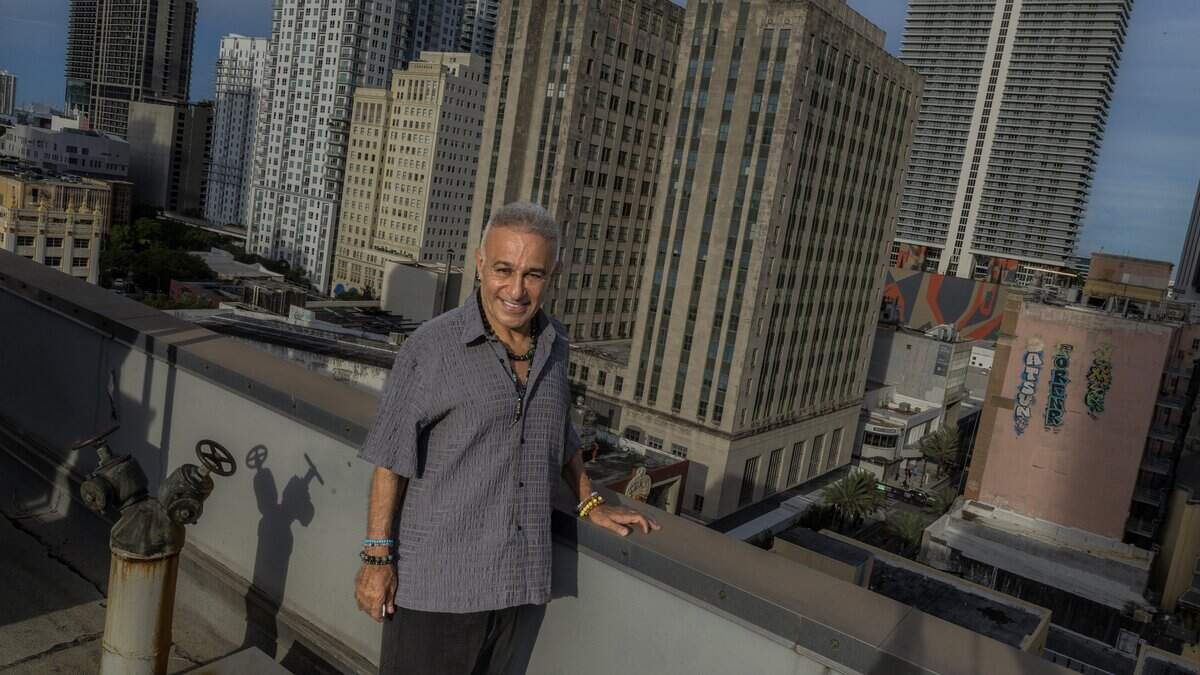
On a recent evening, Mana walked down Flagler Street, pointing out each building he owns — “most of them,” he said. He described his plans to renovate each one: a new lobby for the One Flagler office building on the corner of Flagler and Northeast First Avenue, a full restoration for the historic Beaux-Arts style Shoreland Arcade.
“This is a bigger vision,” Mana said of his plans for downtown Miami. “Our project is not about just putting up buildings. The content is more important. The neighborhood of the building is more important.”
How Mana got his start
A young man walking on Flagler recognized Mana and stopped to shake his hand, congratulating him on the recent billion-dollar sale in Wynwood.
The 69-year-old Israeli-born businessman cuts a memorable figure. He’s short and slight, with spiky silver hair. That day, he sported a loose-fitting collared shirt with short sleeves, a more relaxed look than the staid suits and ties some developers favor. His wrists were stacked with bracelets, and he wore a chunky, brown beaded necklace and Louis Vuitton loafers.
Mana splits his time between New York and South Florida, with places in Miami and Boca Raton. He grew up poor in Tel Aviv and moved to New York as a young man in the 1980s. He began working as a dishwasher and then in construction. He first found success with a moving company, Moishe’s Moving Systems, and later got into the storage business.
In the 1990s, Mana turned one of his storage facilities in the Meatpacking District into the industrial-chic creative hub Milk Studios. It was one of the first arts destinations in the neighborhood that would later be home to the Whitney Museum of American Art. These days, the trendy Meatpacking District is one of New York’s most expensive neighborhoods.
In Jersey City, Mana developed the arts venue Mana Contemporary out of old factory and warehouse space. He did the same in Pilsen, a gentrifying neighborhood on Chicago’s Southwest Side.
Mana told the Herald that working in the storage business was part of what got him interested in the arts. He said he hated seeing art collections stashed in storage and wanted to create places where people could see and interact with art.
That’s what he wants to do with Miami-Dade’s historic downtown courthouse, too. And he’s willing to spend likely more than $35 million to do it. He doesn’t own the building, which the county recently put up for auction, but he wants to buy it and turn it into a cultural hub.
Mana submitted plans to Miami-Dade in September to buy the 1920s landmark for $5 million, significantly below the county’s minimum bid of $35 million. The offer is just a show of “good faith,” he said, and he’d probably put another $30 million to $40 million into rehabbing the courthouse building.
“This is part of creating the bigger vision,” Mana said. “Sooner or later, I know we’ll make money from it. I’m not worried about it. It will come together.”
How Mana changed Wynwood
Though Mana’s personal fortune was already considerable before the billion-dollar sale in Wynwood, he told the Herald that the recent payday gives him “more flexibility” to invest in his development projects, even ones that may not immediately turn a profit.
Mana takes a longer view in many of his investments, often buying land without using financing, so he’s not under pressure to build right away and pay back a loan.
Starting in 2009, before Wynwood’s development boom started, Mana began building his portfolio in the neighborhood. That’s around the time he began pivoting from New York, where he started his career, to Miami, which he saw as an emerging global city connecting the U.S. to Latin America and beyond.
As the once-industrial Wynwood transformed, Mana bought up around 45 acres in the neighborhood. Mana said he thinks Wynwood, which is now known for its vibrant murals and arts scene, has become “the coolest neighborhood in America.”
And his acquisitions in Wynwood have proved lucrative. Mana reportedly paid around $70 million over the years to assemble Mana Wynwood, a 30-acre event venue developed out of a collection of warehouses. He sold the venue last month to Griffin for a whopping $1.1 billion.
The Citadel CEO is donating the land to Carnegie Mellon University for its new Miami campus.
Mana retained about 15 acres in Wynwood after the sale, and he told the Herald he plans to build two office buildings on some of that land. But otherwise, he said he’s stepping away from Wynwood.
Read more National No Kings movement hosts South Florida events to promote early voting
Mana said he’s “excited” about the site’s future as a college campus and is “relieved” to have sold it, adding that he thinks it’s in “better hands” with Griffin, a man whom he characterizes as wealthier and more influential. While Mana is a billionaire in his own right, his wealth pales compared to Griffin’s nearly $60 billion fortune.
But Mana has enough money that he’s not shy about pouring millions into his projects. He estimates he’s invested $600 million in the Flagler Street area so far.
What’s next for downtown Miami?
Mana’s history of buying land, announcing grand plans for it and ultimately selling it leaves some questions about downtown’s future. After years of acquiring real estate downtown and in Wynwood, he hasn’t built much in either neighborhood.
Kobi Karp, a Miami architect who described Mana as a friend, said he doesn’t expect Mana to fully redevelop Flagler, but rather to eventually sell his massive downtown portfolio to another developer.
What Mana did develop was Mana Wynwood, which has operated as an event venue for more than a decade, hosting events like the alternative music festival III Points. But Mana always said he had bigger plans for the site. He wanted to turn it into a massive international trade and entertainment complex with hotels, offices and event space.
Mana won approval from the city for a 10 million-square-foot mixed-use special area plan in 2016. But in the decade since, the project languished and Mana never got underway on the development that would have replaced the venue currently on the site.
But Mana said those plans were still on the table when Griffin’s team approached him about buying Mana Wynwood about three years ago. That’s why he initially refused the offer and spent three days weighing the billion-dollar deal before agreeing to it, he said.
In Miami’s real estate community, some say Mana has more of a gift for seeing an area’s potential than for building or developing.
Putting together the land
Karp, who has worked with Mana on projects like Mana Wynwood, said Mana has a “good heart and good mind” and has called him a “visionary in his own right.” He doesn’t consider Mana a developer, but rather a “land assembler.”
Mana creates value for a future developer by putting together large assemblages and leaving them largely undeveloped, Karp said. Often, neighborhoods can become fragmented, with small parcels owned and developed piecemeal by different people. But a land assembler can make it easier for a developer to come in and execute a unified plan for the area.
It’s why Carnegie Mellon will have more than 30 acres in the heart of Wynwood for its new campus. And while some criticized Mana over the years for holding onto that land and not building, Karp said he thinks people now get why he did it.
“It takes a while to assemble the little parcels of land, but once you’re able to assemble them, the people can understand,” Karp said. “Now he’s a hero.”
Karp said he’s working with Mana on a project in Allapattah, but he declined to give details. Although Mana’s real estate portfolio in Wynwood and downtown gets more attention, he has also been buying up land in Allapattah, a working-class neighborhood just west of Wynwood.
Mana generally doesn’t build residential, and he tends to focus on renovating and repurposing old buildings, rather than building new. But he has always said his real estate investment strategy is more than simply banking land and waiting to sell to the highest bidder.
Mana said his plans to redevelop Flagler Street are genuine — and getting underway. He’s spent nearly a decade working with the city to repave Flagler Street, which was a multimillion-dollar effort that he said got bogged down in city bureaucracy.
Now, a multi-block stretch of Flagler’s sidewalks are smooth and uniform, and the street has been resurfaced with new pavers. It was one of the first steps of many toward realizing his vision for the area, Mana said.
A few signs of life have begun to peek through on Flagler. Several trendy bars and restaurants have opened on the street in recent years, including popular Florida-themed bar Over Under, recently opened Vietnamese spot Pho Nam and Fratesi’s Pizza, which draws crowds for its thin-crust pizza.
Mana doesn’t own the buildings where the restaurants are, but he said they are the kind of places he likes to see opening in the neighborhood. He also wants to bring in more galleries, like gallerist Aura Copeland’s, which operates in a building he owns on Flagler.
Right now, Mana is renovating several buildings along the corridor. One, the historic Biscayne Building, is being remodeled into what Mana said will be a building focused on fashion with showrooms and a ground-floor restaurant.
Nearby, Mana is remodeling an office building that will become the Nikola Tesla Innovation Hub, which will have office space for tech companies. Mana said the Serbian inventor and futurist is an inspiration of his. He broke ground on the project in 2021, and it’s now nearing completion.
And in an office building near the county courthouse, Mana is making over existing legal offices and has plans to open a membership club for attorneys next door. He also brought a cafe to the ground floor and wants to open a bar, too.
He said he thinks these projects will bring a new “lifestyle” that will help transform the city core. But downtown’s transformation has been slow-going so far.
“People here very impatient sometimes because they want to see buildings,” Mana said. “I’m not here to put buildings. I’m here to put a whole neighborhood, so we need to curate it. We need to be careful what we’re doing because once you put something up, you cannot take it down.”
As the sun set on a recent weekday evening, few people were walking on Flagler Street. An orange-shirted ambassador from the Downtown Development Authority recognized Mana and came over to shake his hand.
Five years from now, Mana insists this area will look completely different. And to the critics who ask why his vision, more than a decade in the making, is taking so long, he says: “Wait for the results.”
Read more This Cuban restaurant that was shut down last year is reopening in Coral Gables
Miami Herald staff writer Shirsho Dasgupta contributed to this report.
This story was originally published October 17, 2026 at 5:05 AM.









Post Comment