Private schools cheer new federal scholarships. Can FL public schools also benefit?
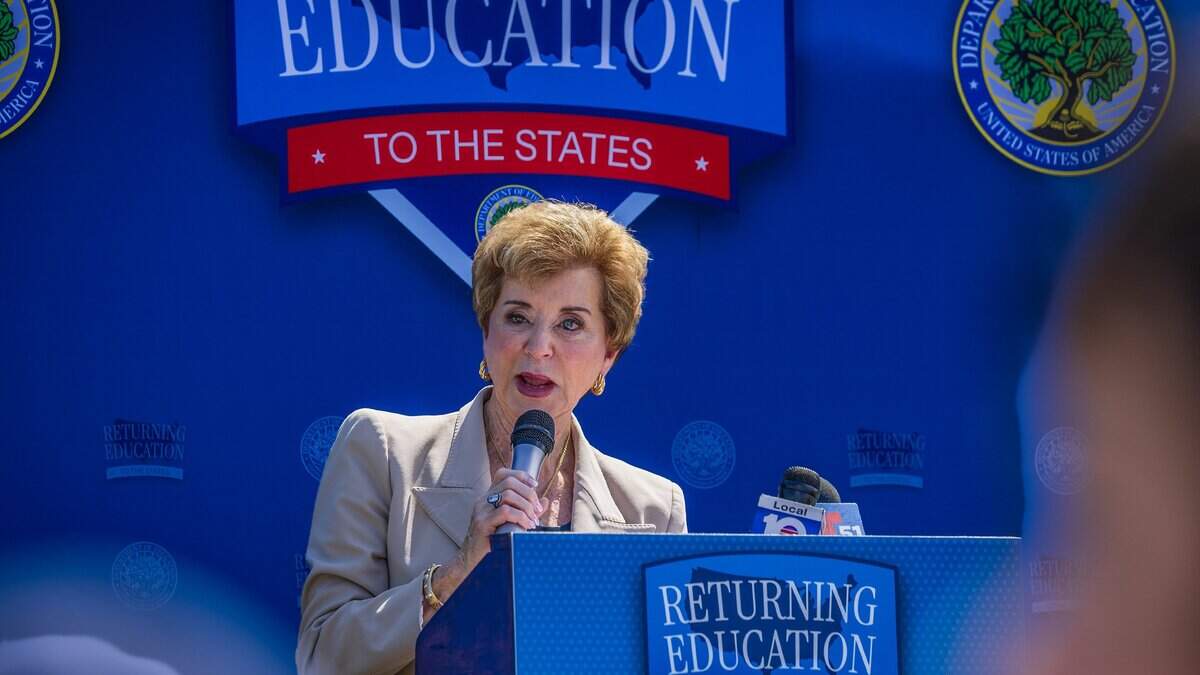
U.S. Secretary of Education Linda McMahon came to Florida Tuesday to tout one of the prized policies of the national school choice movement and a byproduct of President Trump’s Big Beautiful Bill — a new federal scholarship program for K-12 students.
Read more Death penalty on the table for Miami man accused of killing witness, appeal court says
At the Lubavitch Educational Center, a private Jewish day school near North Miami Beach, students halted pickup basketball games and soccer matches as McMahon took to a provisional stage set up on the school’s soccer pitch to discuss the first-of-its-kind federal program welcomed by their school administrators – and, likely, many of those students’ parents.
The Federal Scholarship Tax Credit, also called the Education Freedom Tax Credit, kicks into effect on Jan. 1, 2027, creating scholarships of up to $1,700 to cover tuition, fees and other expenses for students in private and, presumably, public schools. So for parents who send their kids to private school like Lubavitch Educational Center, which already receives the state-funded vouchers, this money could represent more savings on school expenses.
But even though McMahon mostly promoted the program Tuesday as a way to help private school families offset the cost of their children’s education, the tax credit could also potentially bring new money to public schools, which educate the vast majority of American students. However, private schools may be better positioned to capture the money — and public school advocates worry that the program could ultimately advance the privatization of education.
Rabbi Benjy Korf, who leads the school and the Chabad-Lubavitch movement in Florida, welcomed McMahon and said the tax credit would help more families afford schools with a moral and “faith-based” emphasis like his.
McMahon focused on how the scholarships would further the “school choice” movement.
“Children are not wards of the government. They belong to their parents… As a mother and grandmother, I understand firsthand that no bureaucrat in Washington, D.C., will ever know as much about their children’s unique needs, strengths, and aspirations as their own parents. Yet, for too many families, the ability to act on that knowledge depends on what they can afford,” McMahon said at the event.
The program’s benefits for private school families are relatively clear. What’s less certain is whether public schools can secure a meaningful share of the money.
What about public schools?
The school choice movement has been particularly successful in Florida, where the vast majority of private school students are eligible for an $8,000 state-backed voucher to help fund their tuition. This school year, voucher funding is expected to top $4.5 billion.
Unlike state-funded private school vouchers, these scholarships will be funded by donations. Donors get up to $1,700 — $3400 for married couples — in federal tax credits. The amount available for Florida scholarships will depend on how much Florida donors contribute and which scholarship-granting organizations they contribute to.
The hope is that these tax credits will unlock billions in donations that will make their way directly to students.
Private school administrators view this as a win for their operations and their mission.
Korf framed the tax credit, and the work of the Trump administration, as a push against the secularization of schooling in America.
“In the ‘60s, the United States Supreme Court legislated God out of the schools, and crime rates skyrocketed. With [McMahon’s] help, faith-based education is on the rise, and teaching children that there is a God – like it says on the dollar bill, ‘In God we trust’ – that runs this world that we live in and gives us a moral foundation to combat all these difficulties,” Korf said.
But McMahon made a point to mention public schools briefly in her remarks, stressing the program “isn’t just about private schools.”
Read more BSO calls death suspicious after body and rope found in pool behind Weston home
The program describes itself as offering “federally generated, privately funded” scholarships. Donors will give the money to state-approved organizations, which will then distribute the money. These organizations, called SGOs, determine which applicants get the funds. They are not allowed, however, to direct the funds to specific students, though they can earmark scholarships to go to students from a specific school. In theory, schools could set up their own SGOs to receive donations — including public school districts.
Though the state-level voucher is universal regardless of income, the federal program has some limits. The scholarship is only available for students who come from families making less than 300% of the area median income – , that threshold would be $269,400.
If 10% of eligible taxpayers in Florida contributed, the state total could surpass $500 million, per the American Federation for Children, a private school advocacy group.
Private schools generally have a more robust tradition and infrastructure centered around fundraising that could give them a leg up on cashing in on the new federal program. McMahon said Tuesday that the number of public schools that will benefit from the scholarships is entirely dependent on which states opt in and which organizations get the donations. As of this week, 19 largely Democratic states have yet to opt into the program, though it’s no cost to their state coffers.
Some public school advocates have called the tax credit as a wolf in sheep’s clothing aimed at further privatizing public education. The American Federation of Teachers and the National Education Association – the country’s two leading public school teachers unions – called the program “a Trojan horse carrying near-universal K–12 private school vouchers into every state.”
‘Real money on the table’
That’s not everyone’s position.
Josh Cowen – a professor, voucher opponent and author of the book “The Privateers: How Billionaires Created a Culture War and Sold School Vouchers” – has been one of the fiercest critics of state-level private school vouchers like the one in Florida. But he said public schools should work to get the money if it’s out there.
“Is there real money on the table for Florida public schools? 100%, yes. Is it a substitute for all the harm that’s been done financially by vouchers? No. Is it a substitute for the state not making new direct, sustained investments in those public schools? No, it’s not a substitute for any of it. But I’d be lying if I told you this was all bad. There’s money on the table, and I take the position that once the state is in, go get the money,” Cowen said.
The use case for private schools is fairly clear: apply to an organization like Florida’s voucher pass-through Step Up for Students and possibly get an extra scholarship on top of your voucher.
But some national groups and state groups, including Step Up, are gearing up to receive donations for public school students’ scholarships as well.
Step Up has already set up its scholarship granting organization, called the “Step Up, Step Further Scholarship Fund,” that public schools can partner with which a spokesperson for the group said was “open to all applicants.”
A national group, the Future School Fund, was recently set up explicitly to benefit public school students.
Still, the plan is very new. Miami-Dade County Public Schools has not yet responded to a request for comment on its plans to utilize the money that could be available, if at all.
Cowen said he hopes public schools can end up using it to break a common policy trend: when something works well, it tends to work best for the wealthy, and when it works poorly the poor are the hardest hit.
“The same fundamental structural problems of inequity are going to be in this thing like as in everything else, which means that we need to be intentional and not just say, ‘Oh, let the market figure it out.’ That never works when it comes to schools. Let’s actually build this thing with as much intentionality as we can to help some kids who need it. It’s possible, but it’s going to take work,” Cowen said.
Read more Traffic alert: Gas rupture shuts down stretch of Florida’s Turnpike in Broward
This story was originally published October 16, 2026 at 4:30 AM.







Post Comment