Can Donalds convince Black voters to leave the Democratic Party, like he did?
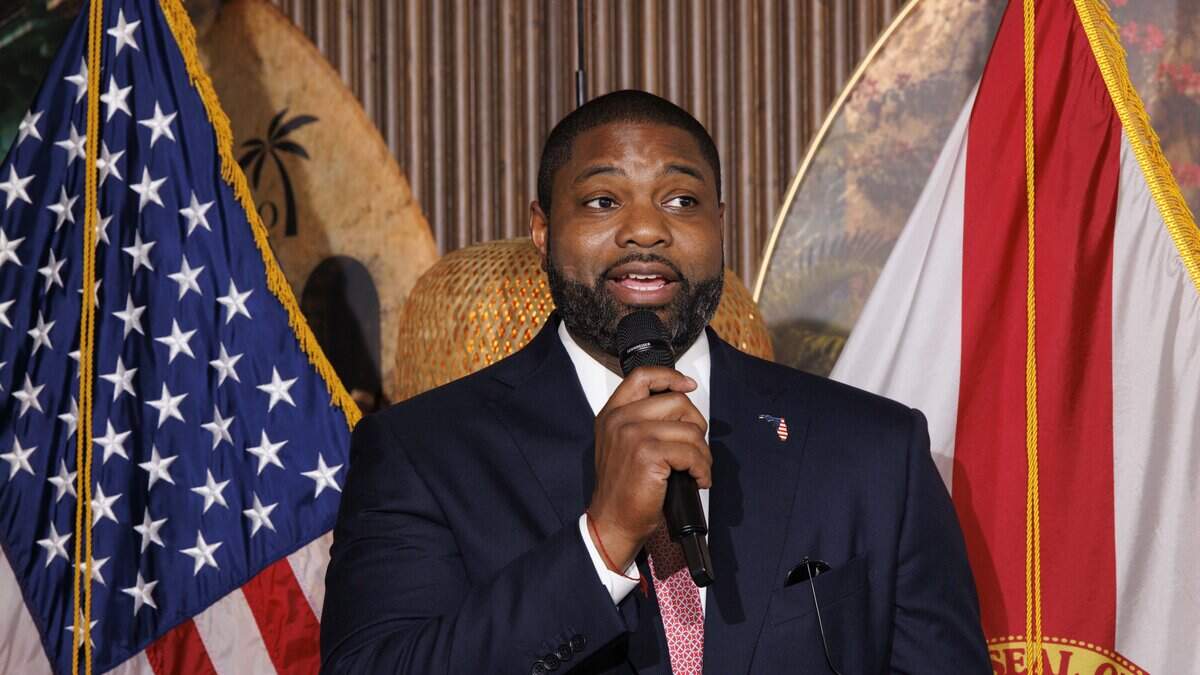
There was a smattering of applause in the partly full auditorium when Byron Donalds, the Republican campaigning to become Florida’s first Black governor, walked on stage Tuesday at the historically Black university where he once briefly studied.
Read more Former Chiefs star believes he has CTE at age 46. A test could be coming soon
The skeptical crowd at Florida A&M booed when he talked about supporting Donald Trump’s immigration agenda and audibly groaned when he said the Republican Party has “always been” the party that fought for civil rights.
As the forum stretched late into the night — with police escorting out at least one critical student and a brief chaotic intermission from a 9:00 p.m. fire alarm — Donalds made his most direct campaign plea yet to Black voters to abandon the Democratic Party.
“I’m just gonna be blunt: stop moving like a monolith,” Donalds told the room. “Since 1963-ish, Black people have largely supported the Democratic Party. Have they actually followed through with what they said?” he asked. “Have they actually done all the things that they’ve promised? You’ve been faithful to that party; have they been faithful to you?”
Donalds’ comments at FAMU are the latest in a series of targeted efforts to win over some of Florida’s diverse Black voters — and to build a coalition that can withstand a possible Trump backlash and counteract the loss of rural white voters who snubbed Donalds in the Republican primary.
Last month, he met with Haitian voters in Little Haiti and gained support from some Black leaders, including Gainesville Commissioner Cynthia Chestnut, a FAMU graduate and Democrat. She said her endorsement was a “declaration” that “Black voters are not political property.” On Thursday, he rolled out an endorsement from Black Haines City Commissioner Anne Huffman.
“As a Democrat for 40 years, I’ve watched my party take our votes for granted,” she said in a statement blasted out by the campaign.
Historically, relatively few Black voters have bought what the GOP is selling in Florida. In a state with over 13 million voters, fewer than 100,000 are Black Republicans, according to from the Florida Division of Elections. Conversely, nearly three in 10 Florida Democrats are Black.
Incoming Miami-Dade Commissioner Steve Gallon, a registered Democrat and another FAMU alumnus, said it is important to “note that Black voters are not monolithic.”
“Our support should never be presumed by either political party or a candidate based on race, ethnicity, or gender,” he said. “I think each candidate, having been a candidate for the past 10 years, has to make the case to the voters across party lines, across ethnic lines, across socioeconomic lines.”
At the FAMU Orange Blossom Classic last month at Hard Rock Stadium, Donalds posed for photos alongside Gallon and Miami-Dade Commissioner Keon Hardemon, among the most prominent Black leaders in Miami. As the image spread through online Black networks, it became a symbol of potential growing divisions between Black voters and the Democratic Party.
Gallon, who met Donalds for the first time at the event, said the photo was not an endorsement. He said it was just “three Black men that attended FAMU, who all happened to be elected officials discussing fatherhood and the sacrifices required of public service when you have young children.”
He said today’s political climate has become so polarized that the photo is “deemed political,” even though they didn’t discuss the campaign or politics. But he stopped short of saying he plans to endorse David Jolly, Donalds’ Democratic opponent.
“You extend collegiality and respect to fellow elected officials, even though you may disagree with their politics,” he said.
A difficult position for Black voters
The Donalds campaign is making concerted efforts to reach out to people like Gallon — who are open to Donalds personally but skeptical of his politics. Some Democrats say there’s an opening for Donalds among historically Democratic Black voters.
Former U.S. Rep. Sheila Cherfilus-McCormick, Florida’s first Haitian-American congresswoman, says Black Democrats are stuck in a difficult position between choosing Jolly, once a Republican, and Donalds, a former Democrat and now MAGA Republican: “They feel like it’s two Republicans,” she said.
Cherfilus-McCormick, who has pleaded not guilty to criminal charges that she stole COVID relief funds, said that while Donalds is the only candidate who knows what it’s like to live in Florida as a Black man, he hasn’t leaned heavily into that experience.
Donalds, who is of Jamaican and Panamanian descent, has downplayed the role of race in his campaign and repeatedly said he believes in a meritocratic system.
At the FAMU event, he told students that he planned to uphold , signed by DeSantis in April, which come January will ban Diversity, Equity, and Inclusion initiatives.
“I don’t support discrimination. I don’t support racism. I don’t support bigotry. I don’t support antisemitism. I denounce all of that,” he said. “But we also have to have a market system based upon opportunity and merit and achievement. And if you have that, what ends up happening is people with real skills have the ability to excel.”
Cherfilus-McCormick, who lost her reelection bid to U.S. Rep. Debbie Wasserman Schultz in a primary dominated by discussion about race, said Donalds’ candidacy comes at a time when Black people are questioning who is looking out for their best interests and raising concerns about whether the Democratic Party is still a political home for them.
She said she hasn’t yet decided who to support in the race for Florida governor.
“I think most people are not convinced,” she said. “I think people are concerned about both because they both have a Republican history.”
At Tuesday’s FAMU event, when asked about his support for Florida’s new congressional maps and how to ensure they don’t weaken minority voting power, Donalds accused Democrats of selectively invoking Black representation in redistricting fights. He used Florida’s 20th District Democratic primary, which featured four Black candidates, including Cherfilus-McCormick, as an example.
“The same people who came and argued and yelled at me about Black representation … they didn’t care about that in South Florida,” he said.
Donalds’ close ties to Trump and firm stance on immigration could complicate his efforts to persuade Black voters that he prioritizes their interests.
Iana Bridges, a third-year pre-law FAMU student from Broward County, asked Donalds directly Tuesday night: “How do you argue that you understand or care about the struggles of Black Americans when your political alignment and personal circle are rooted in spaces that historically exclude them?”
Read more Gov. Gavin Newsom vetoes bill to bar former ICE officers from California jobs
Donalds told her that the Republican Party has “always fought for civil rights in our party, and we still do to this very day.” He pointed to his agreement with a 2013 Supreme Court ruling that narrowed the 1965 Voting Rights Act, arguing that, “they struck it down because in the past 25 years in voting in the United States, there has not been one instance of systematic discrimination against any voter in our country.
“When we talk about some of the issues around my party and my positions, and how do I understand and support the plight of Black people in America, the first thing is we want to have a society based upon merit, opportunity, access, and ability,” he said. “Number two, it’s about making sure that young people have full access to education.”
Another student brought up his sponsorship of the D.C. Crime Act, which recommended reducing the maximum age of youth offenders in Washington, D.C., from 24 to 18 years. The student pointed out that Donalds had benefited from a diversion program when he was arrested for marijuana possession in 1997.
Donalds acknowledged that the program gave him a second chance at life but defended his sponsorship of the bill that will limit such benefits.
“What I was able to take advantage of to help stabilize myself and prepare for my future in Florida, we’re not changing now. We’re not going to take that away from anybody. What happened in D.C. was very, very different,” he responded.
In interviews with the crowd of students attending his forum at FAMU, hardly anyone said they were a Donalds supporter, and most said they showed up Tuesday to hear him out and confront what they see as his hypocritical policies.
And despite an extended forum, many felt his answers did not address their concerns and left unimpressed. Six students who spoke to the Herald said Donalds’ bid to become Florida’s first Black governor was not influencing their decision.
“Yes, it’s cool that he is a Black man running for governor and all of those things, but his views do not align with mine and most people on this campus cause we are very progressive, so we prefer someone who is progressive, regardless of their race,” said Amyla Kinsey, a third-year broadcast journalism student.
Gallon said that Black voters desire the same things as all voters. He emphasized that both candidates need to be intentional about addressing issues such as affordable housing, improved quality of life and safe environments for children and families.
“All skin folk ain’t kin folk, and what that simply means is that symbolism of race is insufficient to merit the credibility, to merit the support, and to merit the trust of the black community and of black voters,” he said. “So simply being Black is not the end-all and be-all.”
Impact of immigration
While Florida could ultimately break the pattern, Black gubernatorial candidates haven’t fared well in recent elections. After struggling in 17 predominantly white counties across Florida during the primaries, Donalds faces an even stronger urgency to build support among Black voters.
But Jolly has accused him of having an “anti-Black” agenda and pointed to Donalds’ 2024 comments that “during Jim Crow, the Black family was together.”
Donalds has since clarified those comments, saying he was just referring to the period. At a campaign event last week in Miami Beach, Donalds said he wants “to see Black male children have the skills and the abilities to be economically strong and powerful, so they can get married, have kids, and actually stabilize Black families and the Black community in the state.
“If that’s anti-Black, I don’t even know. I don’t even know what that means,” he said.
Donalds advocated for continued funding for HBCUs and in 2022 voted to condemn threats against them.
But his association with Trump policies is a key factor for some in the Black immigrant community who are turning to Jolly.
As Donalds tries to woo Haitian-American voters, he is learning that immigration is a top concern. At the FAMU event, he was booed when he challenged a student’s assertion that college students are being deported.
Florida House Rep. Wallace Aristide, a Haitian-American Democrat and former school principal whose district includes Miami Gardens, the largest majority Black city in Florida, said it would be good for a Black person to lead the Sunshine State. But when he looks at the issues plaguing his community, such as Haitians losing deportation protections – Jolly is the one “bringing to the table things that connect with me and connect with me in the community.”
“I think right now the problems are too big. The challenge is too great. We’ve got to make a decision. Who is going to be in our best interest? And for me, I believe it’s Mr. David Jolly,” he said Tuesday at a Haitian-American voters engagement event in Pembroke Pines.
His sentiments echoed those of other Haitian community leaders at the event, who said Donalds’ meeting last month in Little Haiti did not include all community leaders. They said he just wanted their vote without providing his plan for Haitians impacted by Trump’s immigration crackdown or condemning his broadsides against Haitian immigrants.
“If anything, he has supported what was said about the Haitian community,” said Democratic state Rep. Marie Woodson. “Right now we are at a crossroads, and we cannot take any lies or any information that is not going to benefit our people.”
However, Black Republican figures such as Sheriff T.K. Waters—Duval County’s first Black Republican Sheriff, who has campaigned for Donalds—said he was won over after sitting down with Donalds and listening to his story.
He said that if Black voters look past the Republican label, “people will see him for who he is. And that’s a good man.”
“A man,” he said, “who is not unfamiliar with some of the struggles that we go through as Black Americans.”
Read more NTSB releases first report into deadly Amazon plane crash at Miami airport
This story was originally published October 1, 2026 at 3:49 PM.



Post Comment