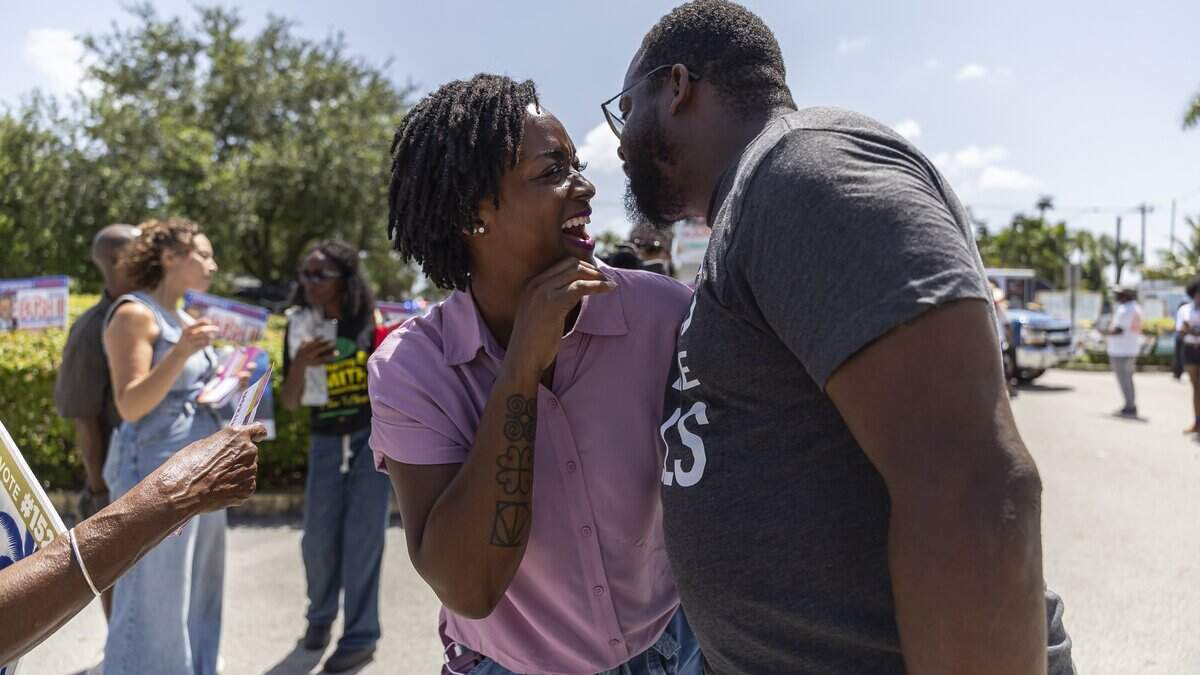
Angie Nixon’s campaign runs through the labor, Civil Rights movements
When Angie Nixon took to the Florida House floor this spring to raise a ruckus about Republicans’ newly redrawn congressional districts, the Democratic U.S. Senate candidate channeled the lessons of mentors in the organized-labor and Civil-Rights movements.
Read more Trump, irked by reporting, announces Florida rallies to boost Byron Donalds
Clad in a signature pink jumpsuit and armed with a matching bullhorn, Nixon loudly disrupted a hearing to pass a new map expected to help the GOP expand its dominance in the state by unravelling Florida’s historically Black congressional seats. Days later, she walked over to the governor’s office, sat in front of the receptionist’s desk and announced she wouldn’t leave until Gov. Ron DeSantis gave her an audience.
She did end up leaving without a meeting — in handcuffs. But the protests framed her upstart candidacy to become Florida’s first Black U.S. senator, a campaign steeped in the tactics and mantras of past movements that overcame daunting power dynamics and steep political disadvantages.
“We are literally witnessing people in power that are trying to return us back to the worst chapters of our history,” Nixon, 42, told the Miami Herald. “They are attacking our rights. They have gutted the Voting Rights Act…They are making it harder for people just to live, and that is reminiscent of what my grandma and my mom told me they had to grow up in.”
READ: With voting rights changes, what’s at stake for Florida’s young Black voters?
Though Nixon’s decision this year to join the Democratic Socialists of America was the entry point for much of the coverage on her surprising Democratic primary victory last month, organizing has been at the crux of Nixon’s career, dating back to her work for state Rep. Mia Jones. She also served as executive director for Florida for All and worked for the progressive grassroots organizations such as Florida Rising before she decided to run for a Jacksonville state House seat in 2020, unseating a moderate incumbent.
Since then, Nixon has staged protests inside the Florida Capitol in violation of House rules. She has performed sit-ins. And she has used her office to rail with a pastor’s cadence against what she says is the erosion of civil rights for Black people and other marginalized communities.
She credits her mentor, the late SEIU Florida Public Services Union President Alphonso Mayfield, for the focus on organizing and centering people in her work. Mayfield served as an advisor at the onset of her campaign and helped bring on some of the people who currently serve on her campaign. She says he played a pivotal role in her first campaign for elected office, serving as a senior advisor.
His spirit, she said, is running through her campaign.
“He stated that hardworking, everyday people should get to shape what our communities look like and what our economy looks like, and that is my north star,” said Nixon. “That is what drives me. That is what motivates me, and that’s what we’re keeping central and rooted inside this campaign.”
RELATED: Who is Angie Nixon, the Jacksonville DSA candidate challenging Ashley Moody?
A student of the movement
Raised by a single mom who worked two jobs, Nixon’s rise comes at a meaningful moment both for her career and American politics, as Democrats, Black activists and legal scholars say the gains of the Civil Rights Movement are under attack.
In April, the Supreme Court voted 6-3 to narrow the Voting Rights Act, effectively removing a provision that would have allowed state lawmakers to consider race when redrawing voting districts even if it’s done in a way that prohibits racial discrimination. The decision blessed the Florida Legislature’s mid-decade redistricting, which diluted a majority Black district in South Florida expected to be represented come January by Democrat Debbie Wasserman-Schultz, who is white.
But Nixon isn’t new to running and winning statewide campaigns or leading statewide organizations, having been the vice chair of the Duval County Democratic Executive Committee and a field director and political director for the Florida Democratic Party.
“If folks want to continue to say trust Black women and protect Black women and let black women lead,” Nixon said, “they need to put their money where their mouth is to actually do it.”
READ: The Supreme Court just issued the redistricting ruling DeSantis was waiting for
State Rep. Yvonne Hayes Hinson, who at 15 was involved in sit-ins and protests during the Civil Rights Movement, said Nixon, an astute student of political organizing, has been preparing for this moment for years.
“She literally consumed what I was saying that we did during the civil rights era, and tried to figure out how to put it into practice during the time that we were redistricting,” said Hinson, now 78.
She said Nixon’s grassroots organizing was reminiscent of Barack Obama’s first campaign, which used a network of organizers to bolster his presence throughout the United States. Hinson, who also did organizing work for Obama’s campaign, said Nixon inspires the same hope he did at a time when the rights she fought for are being chipped away at.
Read more Florida’s attorney general seeks a halt to OpenAI development
“I’m watching my fight go in vain,” Hinson said. “Angie is fighting for that.”
RELATED: ‘Not race neutral’: How Florida’s new voting maps favor white voters
Historian Marvin Dunn said the Civil Rights Movement succeeded in part because it made an emotional appeal to people and made them feel they were involved. “Movements need a central figure, and ideally, that central figure should come from up among the people, not someone who’s already on top,” he said.
Nixon embodies that for people, Dunn said, adding that her authenticity also attracts supporters. “That’s her magic right there. You cannot challenge this woman’s authenticity. She is what she is. There’s no fake about her,” he said. “That makes her different from a lot of other people who are now on the political scene.”
Dunn said Nixon’s approach to running her campaign is reminiscent of civil rights activist and politician Athalie Range and state Rep. Gwen Cherry, who had the ear of residents and were unafraid to stand up to those in power.
Dunn told the story of Range showing up to a Miami-Dade County commission meeting with garbage bags when trash collectors refused to pick up in Black communities. “The next week, the city was picking up trash in Black neighborhoods,” he said.
Challenges and confidence
Nixon’s advocacy has earned admirers, to be sure, but also plenty of scorn.
DeSantis called her sit-in at his office “performative nonsense.” She was reprimanded by the House Rules and Ethics Committee for her stunt with the bullhorn. She was criticized by Republicans and Democrats for introducing a resolution in 2022 to call for a ceasefire in Gaza — a vote she said she called on behalf of “all marginalized communities.”
A super PAC promoting her opponent, Republican U.S. Sen. Ashley Moody, has been airing a campaign ad highlighting a speech Nixon gave at a church in Gainesville in which she quoted Assata Shakur, the Black liberation activist and revolutionary convicted of killing a state trooper during a shootout in 1973 in New Jersey. Shakur, who denied pulling the trigger during the firefight, became a folk hero in the movement against anti-Black state repression during the ensuing decades prior to her death last year in Cuba, where she fled after breaking out of prison.
Moody has accused her of quoting “cop killers.”
Recent polling suggests Nixon is a longshot to win, and Moody has the advantages of incumbency, far more money and the luxury of a state voter base heavily weighted toward Republicans.
University of Florida political science professor Sharon Wright Austin said Nixon’s affiliation with the Democratic Socialists of America may also be a complication, as it could raise eyebrows with people who are uncomfortable with the organization. But she said her fearless campaign can win over skeptics, noting that Nixon comes from Jacksonville’s Moncrief neighborhood, which has a reputation as one of the most disadvantaged communities in the city — allowing her to campaign from a position of empathy as Floridians struggle to pay their bills.
“She shows that underdogs can succeed, and also she shows that even if you came from a disadvantaged background, you can overcome that,” Austin said. “ And she also shows that you don’t have to be afraid of people like Ron DeSantis or Donald Trump who’ve criticized her, Ashley Moody, the insiders. You can challenge the insiders and have a realistic chance of winning.”
Dunn is doubtful efforts to disparage Nixon’s attachment to DSA will work, noting that doing so could lead to greater turnout. He pointed to a 1939 election in Miami in which the Ku Klux Klan went to Overtown and hung dummies with a sign around their necks saying, “This [n-word] voted,” in an attempt to scare Black voters. Instead, it led to one of the largest voter turnouts among Black people in Miami.
“You try to tell people you can’t or you better not. It makes a lot of people try,” he said.
Former Congressman Kendrick Meek Sr. said messaging will be key in Nixon’s campaign going forward, saying if she stays the course of focusing on the economy and other kitchen table issues, she could win the election.
“I think her biggest asset is the present situation and how she’s going to change it,” he said. “If she stays on that message, then she will bring that pro-civil rights community along with her financially, and it will work towards getting boots on the ground and pounding the pavement on the grassroots effort that she has obviously embraced in her strategy to win.”
For all the criticisms lobbied at her – from her DSA affiliations to her appearance – Nixon said she isn’t worried about the misconceptions people have of her. She said she is focused on getting her message to Florida voters.
“I’m going to meet people where they are,” Nixon said. “That’s how you energize the base. You have conversations with them. You let them know that they deserve to have a seat at the table.”
On Tuesday, five months after she was arrested for protesting at the Florida Capitol, Nixon was ordered to pay a $250 fine and complete 15 hours of community service rather than endure a trial. She did not admit to any wrongdoing.
“I will complete that process without changing my position or backing away from what brought me there in the first place,” Nixon said in a statement. “I have spent my life showing up, speaking out and fighting for people who too often feel like their government isn’t listening. An arrest didn’t change that. This case won’t change that. I’m still standing, I’m still fighting, and I’m still going to show up.”
Read more Hope Florida led people with disabilities to dead ends as state misused $10M
This story was originally published September 25, 2026 at 5:10 AM.






Post Comment