As rising seas invade the Everglades, spoonbills are finding new homes
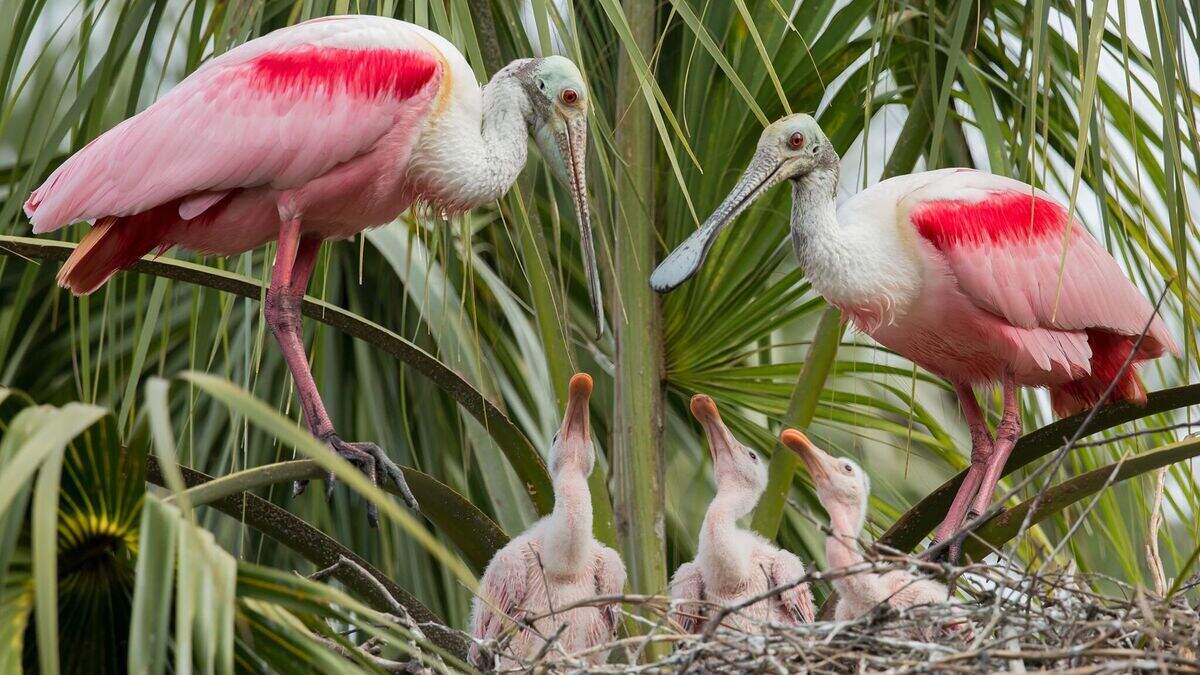
Deep in the Everglades, through the knee-high mud and up, up, up in the trees, tucked into nests made of twigs, are the squawking, flapping and distinctly pink offspring of one of Florida’s most iconic birds: the roseate spoonbill.
Read more Broward GOP congressional candidate: ‘You cannot be born gay. That’s impossible’
“You see a bunch of pink, fuzzy balls. They made this very cute clacking noise,” said Shauna Sayers, a wading bird research specialist for Audubon Florida. And then there’s the smell. “They’re stinky little guys.”
Humans have sought out these nests for nearly a century in Florida. First, to plunder them and pluck the prized feathers to adorn the hats of fashionable ladies, and then, to learn more about the birds. Audubon has been tracking them since the 1930s.
These decades of research have pointed out a curious pattern for where the spoonbills make their nests — an inland shift. The culprit, the science suggests, may be sea level rise.
Rising waters threaten the birds’ ability to feed their babies, said Bryant Dossman, director and principal scientist of the Audubon Everglades Research Station. They drag their distinctive, spoon-shaped bills through the water waiting to feel something vibrate nearby before they snap it up.
Spoonbills have called the Everglades home for centuries, so they’ve grown to depend on its wet and dry seasons. In the dry season, when they have their babies, water levels drop. Fish and other tiny critters get grouped together in the remaining shallow puddles.
“The problem is if there’s a lot of water, too much water, their ability to encounter small fish is diminished,” Dossman said. “They’re designed for the scenario where there’s a high concentration of fish.”
Researchers have figured out spoonbills prefer to snag their fish from puddles five inches deep, or less. The problem is that sea levels have risen about five inches in the Everglades since 2000.
Audubon researchers warned in a study on the topic that “80-90% of the historic foraging area may no longer support foraging activity for Roseate Spoonbills nesting in Florida Bay.”
That’s squishing the spoonbills to new corners of Florida Bay, both to inland spots of the Everglades that used to be dry and have gone soggy and to some of the tiny mangrove islands flecking the bay. In the past, those islands had little pools of water in the center that were too shallow to support fish. Now, they’re deep enough to serve as a proper spoonbill buffet in breeding season.
Read more North Miami Beach police captain jailed for filming woman as she showered: MDSO
New homes for a South Florida native
But sea level rise isn’t the only factor steering spoonbills around the state.
Their population in Florida Bay has waxed and waned along with Everglades restoration efforts. Too much or too little water flowing south from Lake Okeechobee can wreak havoc on the historic nesting grounds for the long-legged birds.
In the last 30 years, the number of spoonbill nests in Florida Bay has been on a slow decline, Sayers said. Most recent years, researchers counted around 200 nests — a steep drop from the 1,250 or so high Audubon reported in 1979. Even two or three decades ago, scientists were spotting between 500 and 900 nests a season.
But there was good news this year. Sayers and other researchers counted 244 nests this breeding season, the first time the count has been higher than 200 since the 2020 nesting season.
And as nests have disappeared in Florida Bay, Dossman said they’ve started to see spoonbills flourish in new homes. Spoonbills have been spotted nesting in Savannah, Georgia, and North Carolina. Wayward pink birds have even been sighted as far away as Maryland and Minnesota.
“Essentially, their range is expanding northward at a dramatic clip. We see them declining here. We see them increasing in Tampa Bay,” he said. “While not all related to sea level rise and warming temperatures, it’s just a part of the equation. It’s what’s driving a lot of that expansion.”
This movement is easy to spot these days because scientists have attached bands — some with GPS trackers — onto about 3,000 spoonbills. When researchers or birders spot a spoonbill sporting the plastic anklet, that data helps inform state and federal policy to protect the birds.
It’s why Dossman doesn’t see the low number of nests in Florida Bay as the end-all, be-all for spoonbills.
“The story of spoonbills in Florida Bay,” he said, “is one of perseverance and adaptation.”
Read more One of Tuesday’s two big lottery winning tickets was bought in South Florida
Spot a banded spoonbill? Report it on Audubon’s form.












Post Comment