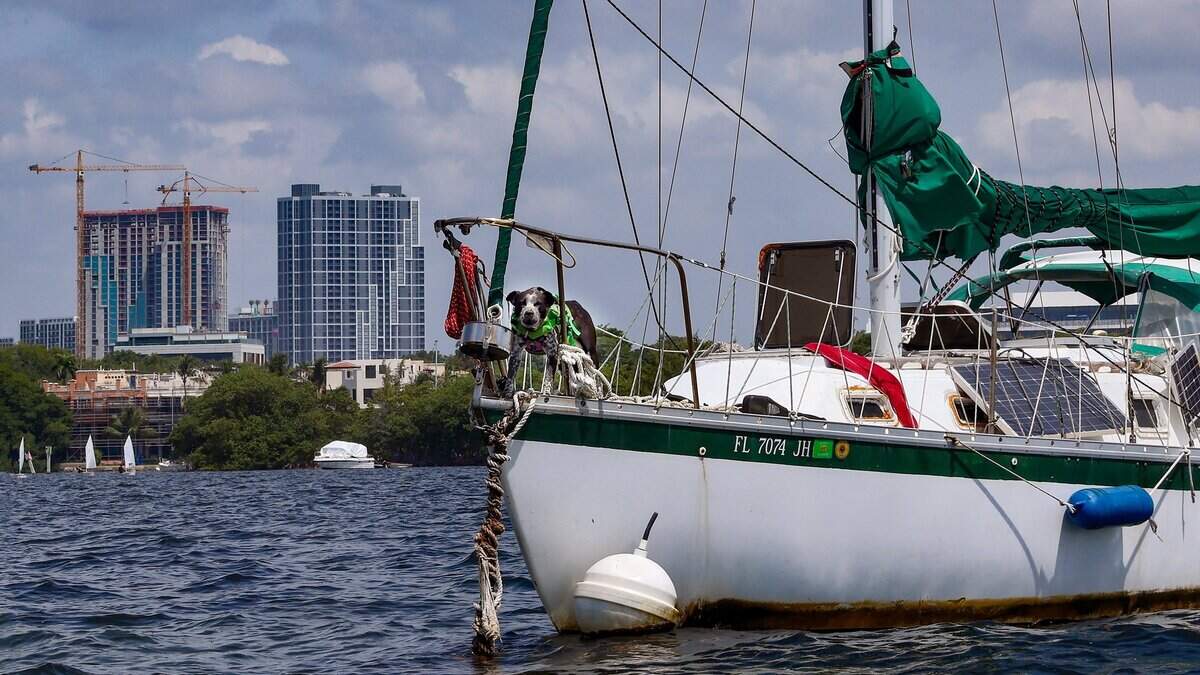
Living aboard is a way of life in Miami-Dade. But a crackdown may be coming
Christopher Chandler wasn’t born in a hospital — or even a house. Fifty years ago, his parents welcomed him into the world in the small V-berth of their sailboat in the San Diego Bay. It even says so on his birth certificate.
Read more Toxic toads, walking risks, World Cup scams, skeeter swarms. How to survive Miami
Ever since, the water has been home.
“I had a house for about a year,” Chandler said. “I hated it. It was terrible.”
For Chandler, his wife and their two dogs, living aboard their 50-foot catamaran anchored just south of Miami’s Dinner Key Marina is a way of life. Some mornings, he wakes to dolphins and sea turtles gliding past the hull. During the summer, children learn to sail just beyond the anchorage. His parents even live aboard the boat next to theirs.
“It’s a nice, comfortable, great home,” Chandler said. “We can be right here next to the city, and then jump in our dinghy and be just a 10-minute ride away. And yet it feels like we’re out in the country. It’s beautiful.”
Now, however, Chandler and many of his neighbors are wondering whether they will be able to remain in the waters they have long called home.
Miami-Dade County is considering new restrictions on overnight anchoring that would prohibit vessels from remaining in the same location for more than 30 days within a six-month period unless they are in a designated mooring field or conducting permitted marine construction or maintenance. The proposal would align county code with a Florida law signed by Gov. Ron DeSantis last year that applies to counties with populations of 1.5 million or more, including Miami-Dade, and limits how long boaters can anchor overnight in one location.
The county’s proposal follows similar action by coastal municipalities. Palm Beach adopted the restrictions in November 2024, while Miami Beach and several other municipalities in Miami-Dade began enforcing the limits in May 2025 after the state law took effect.
More recently, St. Lucie County and the city of Fort Pierce cleared out all liveaboards on sailboats in the Fort Pierce Inlet between Wesley’s Island and South Causeway Beach on June 1.
The Miami-Dade bill’s sponsor, County Commissioner Vicki Lopez, said the legislation is intended to encourage liveaboards to dock their vessels or move into mooring fields — designated, managed areas where boats are secured to permanent moorings, basically anchors attached to floating balls, instead of anchoring freely.
“If you want to live on the water, you want to stay for an extended period of time, you will do it in a safe place,” Lopez said.
If approved, boaters who remain anchored beyond the 30-day limit could face a civil citation and a $100 fine for a first offense. Repeated violations could result in fines of up to $250, while vessels that continue to violate the ordinance may be subject to removal under state law.
Lopez said the ordinance is intended to curb long-term vessel living and address derelict boats, which contribute to water pollution and can damage other vessels when they drift or break free.
“The waterways are not intended to be long-term and permanent housing,” she said. “It’s intended to make sure that people can traverse the waters for a short period of time. For those that want to live in their boats, they can go to the mooring fields or to the marinas, whichever works best for them.”
But many boaters say those alternatives are already at capacity, leaving them with few places to go if the ordinance is approved.
The Miami Herald contacted several Miami-Dade marinas to gauge the availability of wet slips — designated spaces where boats remain in the water full-time.
Pelican Harbor Marina and Regatta Harbour had no wet slips available. Crandon Park Marina has a waiting list for wet slips, with an estimated wait of six years for 30-foot boats and seven to 10 years for 45-foot vessels. Matheson Hammock Marina had a waiting list of more than 482 people for its most in-demand 30-foot slips, with at least one applicant waiting since 2012. Herbert Hoover Marina said it expects about 15 wet slips to become available this month.
Mooring fields also have limited capacity, and many restrict the size of vessels they can accommodate. The Dinner Key Mooring Facility, for example, accepts boats up to 50 feet long, leaving boaters with larger vessels — including 55-year-old Capt. Burt Kopela — without an option.
“Our hands are tied,” said Kopela. “It’s like, where are you going to take your boat? There’s no place to go.”
Read more Living aboard is a way of life in Miami-Dade. But a crackdown may be coming
Kopela has spent nearly his entire life on the water. His father founded the family’s marine towing and salvage business in Miami in 1957, and Kopela grew up living on boats in Coconut Grove and around Dinner Key.
Today, he lives aboard a 65-foot sportfishing boat anchored off Dinner Key and works in the same business his family started nearly seven decades ago.
Like many liveaboards, Kopela believes abandoned and derelict vessels have become a serious issue in Biscayne Bay. But he argues the proposed ordinance unfairly treats responsible boaters the same as neglected vessels.
“There could be a better program on getting rid of these derelict boats,” said Kopela. “Yeah, it sucks. It should not have happened, these boats should not have sunk. But when you run everybody out, it isn’t fair, either.”
Burt said the shortage of marina slips has worsened in recent years as more people have purchased boats without a corresponding increase in dockage. He said working-class boaters have increasingly been priced out of marinas, leaving anchorages as one of the few affordable options.
Boaters first began leaving Palm Beach County after restrictions were adopted there. Many later relocated to Miami Beach before moving to the waters around Miami Marine Stadium and Watson Island as enforcement expanded. As those areas also became subject to tighter regulations, many eventually settled off Coconut Grove.
“They left one municipality to go to another one,” Burt said. “Now they’re here in Coconut Grove.”
The debate unfolding in Miami-Dade is part of a broader push across South Florida to regulate long-term anchoring and vessel living. Officials say the rules are intended to reduce pollution, address public safety concerns, and curb the number of abandoned or derelict vessels in local waterways.
Some waterfront communities have taken an even stricter approach. Miami Beach has implemented regulations that make it difficult for liveaboards to come ashore, including limits on where dinghies can land.
Last December, the city of Miami approved an ordinance sponsored by Commissioner Damian Pardo establishing an overnight anchoring limitation area within portions of Biscayne Bay. The ordinance prohibits vessels from remaining anchored in designated waters for more than 30 nights within a six-month period and restricts anchoring within 300 feet of a public mooring field.
The legislation cites concerns about “unregulated vessel living,” which officials say contributes to pollution, including human waste and trash entering the bay, and increases the number of abandoned vessels that require public funding to remove.
“These changes will help prevent marine squatters from occupying public waterways, address abandoned vessels, and ensure we can better manage transient dockage for residents and visitors alike,” Pardo said in a social media post.
But liveaboards say they are increasingly being pushed from one jurisdiction to another, and are just moving around the problem. And with each new ordinance, they say, the available places to anchor shrink further.
For Chandler, the uncertainty is becoming harder to ignore. The water has been home for as long as he can remember, and for now, he is unsure what he and his wife — who both work in the marine industry, he repairing boats and she employed at a marine supply store — would do if the ordinance passes.
“My wife’s family business, they’ve been here for since the ‘60s, so we can’t just up and leave,” he said. “We’ll figure it out one way or another. I have no intention of moving to a dock by any means. That ruins the beauty of it. … It’d be a horrible thing to have to leave.”
The Board of County Commissioners is scheduled to review the ordinance during a public hearing before the Recreation, Tourism and Resiliency Committee on July 14.
Read more Gas prices have changed in South Florida after July 4 weekend. Check your area












Post Comment