2026 Honda Ridgeline vs. Ford Maverick: 5 Key Differences Worth Knowing
Both of these have four doors, a bed and a unibody, and that is close to the end of what they share. Honda built the Ridgeline for families who occasionally need a truck, on a midsize platform with standard all-wheel drive and a V6. Ford built the Maverick for people who want a truck without paying for one at the pump or the dealership, on a compact platform with a hybrid and front-wheel drive. The gap between them is $12,450 at the entry point and 16 mpg combined, which are the two largest differences in any comparison at this price. Three more separate them, and together they explain why these trucks rarely end up on the same shopping list.
Read more Nvidia’s cash could reshape an AI cloud contender
What’s New for 2026
Ford’s compact continues with the powertrain split that made it a phenomenon. The standard 2.5-liter hybrid produces 191 combined horsepower with front-wheel drive and returns up to 42 mpg in the city, and the optional 2.0-liter EcoBoost delivers 250 hp with all-wheel drive available. Pricing starts at $28,145, which remains the least expensive way into a new pickup in America. The 4K Tow Package lifts towing from 2,000 lbs to 4,000 on non-hybrid configurations.
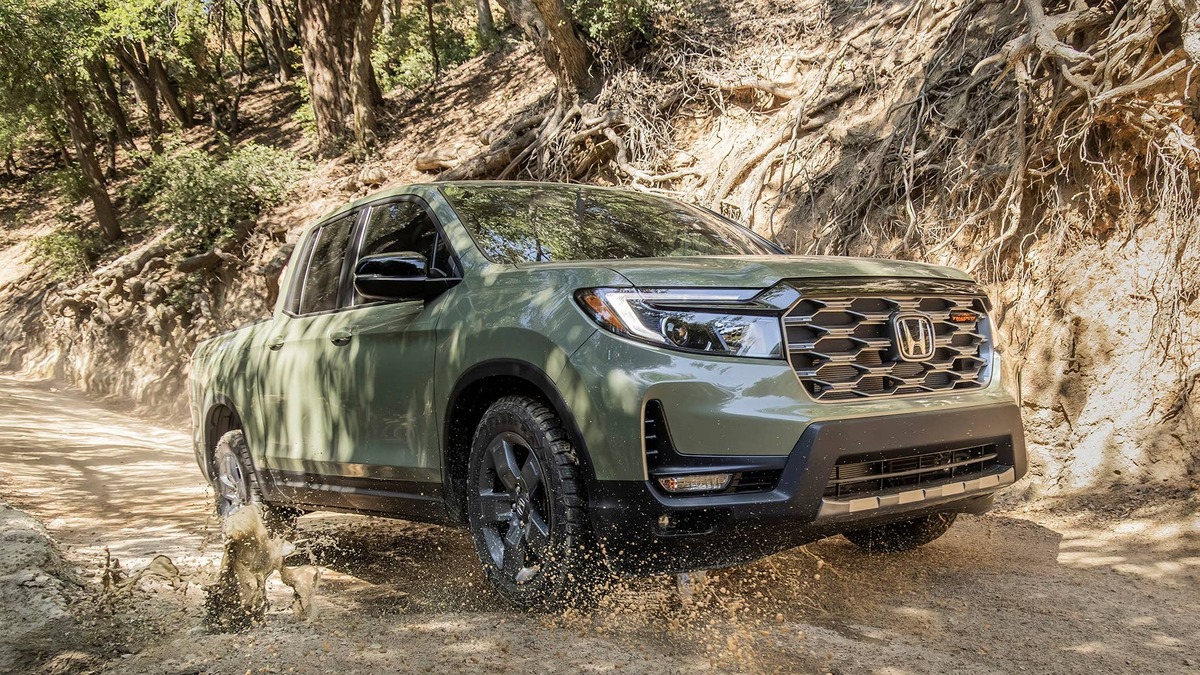
Honda’s Ridgeline carries over with one powertrain and no options to consider. The 3.5-liter V6 makes 280 hp and 262 lb-ft through a nine-speed automatic with all-wheel drive standard on every trim, rated 18 mpg city, 24 highway and 21 combined. Base pricing sits close to $40,595. The dual-action tailgate that swings out or drops down and the lockable In-Bed Trunk both continue, and neither has an equivalent in Ford’s lineup.
The Basics
2026 Ford Maverick
- Starting price: $28,145
- Standard engine: 2.5-liter hybrid, 191 combined hp
- Optional engine: 2.0-liter EcoBoost, 250 hp
- Drivetrain: front-wheel drive standard, all-wheel drive available with the EcoBoost
- EPA: up to 42 mpg city, 37 mpg combined as a hybrid
- Towing: 2,000 lbs standard, 4,000 lbs with the 4K Tow Package
- Payload: 1,500 lbs
- Curb weight: 3,674 lbs
- Bed: 4.5 ft, close to 33.3 cu ft
- Rear underseat storage: 2.6 cu ft
- Dimensions: 199.7 in long, 77.9 wide, 68.7 tall
- Passenger volume: 100.3 cu ft
2026 Honda Ridgeline
- Starting price: close to $40,595
- Engine: 3.5-liter V6, 280 hp and 262 lb-ft
- Transmission: 9-speed automatic
- Drivetrain: all-wheel drive, standard on every trim
- EPA city/highway/combined: 18/24/21 mpg
- Towing: 5,000 lbs
- Payload: close to 1,583 lbs
- Curb weight: 4,420 lbs
- Bed: 5.3 ft, 33.9 cu ft
- In-Bed Trunk: 7.3 cu ft, lockable, with a drain plug
- Rear underseat storage: 2.9 cu ft
- Dimensions: 210.2 in long, 78.6 wide, 70.8 tall
- Passenger volume: 109.7 cu ft
Ford’s range opens at $28,145 and climbs through equipment grades with two powertrains and an off-road Tremor variant. Honda sells the Ridgeline with a single engine and drivetrain across every trim, so the decision is equipment rather than capability.
The hybrid arithmetic that makes the Maverick work is the same one that governs the rest of the market, except that here the hybrid is also the least expensive version rather than the premium one.
$12,450 separates them before a single option
This is the difference that keeps these two off the same shopping list. A Maverick starts at $28,145 and a Ridgeline at close to $40,595, a gap of $12,450, or 44% of the Ford’s entire purchase price. Matched for equipment the gap narrows somewhat, with comparably specified versions quoted at $29,990 and $42,290, but it never closes.
What the money buys is a different class of vehicle rather than a better version of the same one. The Ridgeline is a midsize truck and the Maverick is a compact, and Honda includes all-wheel drive, a V6 and a 5.3-foot bed in its base price where Ford includes a hybrid four-cylinder, front-wheel drive and a 4.5-foot bed.
At the bottom of the market that gap is decisive. Anyone shopping at $30,000 is not choosing between these two, because only one of them exists at that number.
The Maverick returns 16 more mpg combined
Fuel is the second-largest difference and it compounds the first. The Maverick Hybrid is rated up to 42 mpg city and 37 mpg combined, which is a figure most sedans struggle to reach and which no other pickup on sale approaches. The Ridgeline returns 18 mpg city, 24 highway and 21 combined.
That is a 16-mpg combined advantage, close to a 76% improvement, and it exists partly because the Maverick weighs 746 lbs less and partly because a hybrid four-cylinder is a fundamentally different proposition from a naturally aspirated V6 driving all four wheels.
Choosing the Maverick’s EcoBoost narrows it considerably, since a 250-hp turbocharged four with all-wheel drive is closer to the Honda’s consumption than to the hybrid’s. The 37-mpg figure belongs to the front-wheel-drive hybrid and disappears the moment you specify anything else.
The Ridgeline tows 5,000 lbs and the Maverick needs a package to reach 4,000
Capability is where the money goes. The Ridgeline is rated at 5,000 lbs with no options required, enough for a boat, a pair of ATVs or a camping trailer. The Maverick manages 2,000 lbs as standard and reaches 4,000 only with the 4K Tow Package fitted to a non-hybrid configuration, so the towing figure and the fuel figure cannot be had on the same truck.
Payload runs closer. The Ridgeline carries close to 1,583 lbs against the Maverick’s 1,500, a difference of 83 lbs that matters far less than the 1,000-to-3,000-lb towing gap.
Power follows the same order. The Ridgeline’s V6 makes 280 hp and 262 lb-ft against 191 hp from the hybrid and 250 from the EcoBoost, and it delivers confident acceleration merging onto a freeway or climbing a grade with a trailer attached. The Maverick Hybrid’s instant electric torque makes it feel livelier in town than its output suggests and does not answer the Honda on a mountain pass.
The Ridgeline’s bed is 10 inches longer and hides a trunk
Bed dimensions separate them by more than the numbers suggest. The Ridgeline’s bed measures 5.3 feet against the Maverick’s 4.5, and holds 33.9 cubic feet against close to 33.3. Ten inches of length is the difference between a sheet of plywood lying flat with the tailgate down and one that needs strapping at an angle.
Underneath it sits the feature neither Ford nor anyone else in this segment offers. The In-Bed Trunk holds 7.3 cubic feet, locks, and includes a drain plug so it can be filled with ice and used as a cooler. Combined with the dual-action tailgate that swings sideways or drops down, the Ridgeline’s bed is more usable than a straight volume comparison shows.
The Maverick’s answer is its own bed system with configurable tie-downs and slots, which is genuinely clever and does not replicate a lockable, weatherproof compartment. Rear underseat storage is 2.9 cubic feet in the Honda against 2.6 in the Ford. Larger vehicles change the storage equation completely, but within this pairing the Ridgeline wins every cargo measurement.
One is a midsize truck and one is a compact
Size is the difference that decides where each one fits in a life. The Ridgeline measures 210.2 inches long, 78.6 wide and 70.8 tall against the Maverick’s 199.7, 77.9 and 68.7. Ten and a half inches of length is a parking-space problem in a city and a non-issue in a driveway.
Interior space follows. Passenger volume is 109.7 cubic feet in the Honda against 100.3 in the Ford, a 9.4-cubic-foot difference that shows up mostly in rear-seat comfort on long trips. The Ridgeline is the more refined and quieter vehicle, with a car-like ride its extra mass and size help produce.
Read more Mitsubishi Pajero Hybrid May Put a US Montero Return Back in Play
The Maverick’s compact footprint is a feature rather than a compromise for a large share of its buyers. It parks in spaces a midsize truck cannot, it navigates tight streets, and it is 746 lbs lighter, which is most of why it returns 37 mpg.
What Five Years Actually Costs
Figures assume 12,000 miles a year over five years, 60,000 miles total, and fuel at $4.00 a gallon regardless of grade. Depreciation and repairs are excluded because no matched five-year estimate exists for both.
2026 Ford Maverick Hybrid
- Starting price: $28,145
- Fuel over 60,000 miles at 37 mpg: $6,486
- Five-year purchase and fuel: $34,631
2026 Honda Ridgeline
- Starting price: close to $40,595
- Fuel over 60,000 miles at 21 mpg: $11,429
- Five-year purchase and fuel: $52,024
- Gap: $17,393 to Ford
Purchase price supplies $12,450 and fuel the remaining $4,943, so both columns run the same way and neither is doing all the work. The Maverick burns 1,236 fewer gallons across 60,000 miles. Put differently, five years in a Ridgeline costs $17,393 more than five years in a Maverick Hybrid, which is more than half the Ford’s entire purchase price and the largest gap in any comparison at this end of the market. Insurance is the third running cost and favors the less expensive truck.
Which Trim to Actually Buy
Ford’s answer depends on which of the two Mavericks you actually want. The hybrid with front-wheel drive is the one that delivers 37 mpg and the $28,145 price, and it is the reason the nameplate exists. The EcoBoost with all-wheel drive and the 4K Tow Package is a different truck with different economics, and if that is the configuration you need, the Ridgeline comparison becomes far closer than the headline figures suggest.
Honda’s answer is any trim, since all of them share the 280-hp V6, all-wheel drive, the 5.3-foot bed and the In-Bed Trunk. Climbing the range buys equipment rather than capability, which makes the lower trims the value picks and removes the usual risk of specifying the wrong one.
What the Differences Add Up To
Honda takes three of the five outright. It tows 5,000 lbs against 2,000, its bed is 10 inches longer and hides a lockable 7.3-cubic-foot trunk, and it is the larger, quieter and more refined vehicle with 9.4 more cubic feet of passenger volume. Payload and power go the same way.
Ford takes two and they are the two that most buyers weigh first. It costs $12,450 less and returns 16 more mpg combined, which compound into a $17,393 gap across five years. Neither of those is a small margin and together they are close to decisive.
The pattern is that the Ridgeline wins everything a truck is supposed to do and the Maverick wins everything a purchase is supposed to be. Which set matters depends entirely on how often you actually use a bed.
So Which Should You Buy?
The Maverick, for most people, and the reasoning is arithmetic rather than enthusiasm. Five years and 60,000 miles cost $34,631 against $52,024, a $17,393 gap built from $12,450 of purchase price and 1,236 gallons of fuel. It parks in spaces the Ridgeline cannot, it returns 42 mpg in the city, and its 4.5-foot bed and 1,500-lb payload cover the light hauling that most pickup owners actually do. For a buyer who wants truck utility a few weekends a year, paying midsize money for midsize capability is spending against how the vehicle gets used.
What the Ridgeline does better is everything that happens once a load is attached. It tows 5,000 lbs with nothing optional required, against a Maverick that needs the 4K Tow Package and a non-hybrid engine to reach 4,000. Its bed is 10 inches longer and its In-Bed Trunk holds 7.3 locking, drainable cubic feet that Ford does not answer at any price. It makes 280 hp against 191, carries 9.4 more cubic feet of passenger volume, and rides with a refinement the lighter truck cannot match.
Two situations make the Honda the correct purchase rather than the more expensive one. If you tow above 4,000 lbs, the Maverick is not rated for it in any configuration. And if you need all-wheel drive and real economy together, the Ford makes you choose, because its 37-mpg figure belongs to the front-wheel-drive hybrid alone while every Ridgeline drives all four wheels.
Buy the Maverick Hybrid if the bed is for occasional use and the payment matters, because $17,393 over five years is a substantial amount to pay for capability you rarely reach. Buy the Ridgeline if you tow, if you need the longer bed, or if this is the only vehicle in the household, and treat the difference as the cost of a truck that does not run out of ability.
Alternatives to Consider
The Toyota Tacoma offers body-on-frame construction and a hybrid option, with genuine off-road capability neither of these unibody trucks attempts. The Hyundai Santa Cruz shares the Maverick’s compact unibody brief with a more car-like interior. The Chevrolet Colorado brings midsize towing beyond the Ridgeline’s 5,000 lbs at a similar price. And the Ford Ranger sits between the two on size for buyers who want a traditional frame under a mid-size bed.
Frequently Asked Questions
Which is more affordable, the Ridgeline or the Maverick?
The Maverick, at $28,145 against close to $40,595, a difference of $12,450. Over five years the gap grows to $17,393 once fuel is counted.
Which is more fuel efficient?
The Maverick Hybrid, at up to 42 mpg city and 37 mpg combined against the Ridgeline’s 18/24/21. That 16-mpg combined gap is worth $4,943 over 60,000 miles.
Which one tows more?
The Ridgeline, at 5,000 lbs with nothing optional required. The Maverick manages 2,000 lbs standard and 4,000 lbs with the 4K Tow Package on non-hybrid models.
Which has the bigger bed?
The Ridgeline, at 5.3 feet and 33.9 cubic feet against the Maverick’s 4.5 feet. It also adds a lockable 7.3-cubic-foot In-Bed Trunk with a drain plug.
Read more FSU offers new Early Decision admissions option for 2027
Copyright 2026 The Arena Group, Inc. All Rights Reserved
This story was originally published September 6, 2026 at 9:00 AM.










Post Comment