The next MOSH: How a Jacksonville landmark is being built again
The dinosaurs are gone. So are the giant mouth, the Currents of Time and Atlantic Tails.
Read more Games-From dressing as a man to competing with the elite, no backpedalling for Afghan Hashimi
MOSH, Jacksonville’s longstanding Museum of Science & History, closed last year, and the building has been all but demolished. A new MOSH is in the works and should begin rising on the St. Johns River in downtown Jacksonville early next year, provided that organizers can raise another $50 million to get it done.
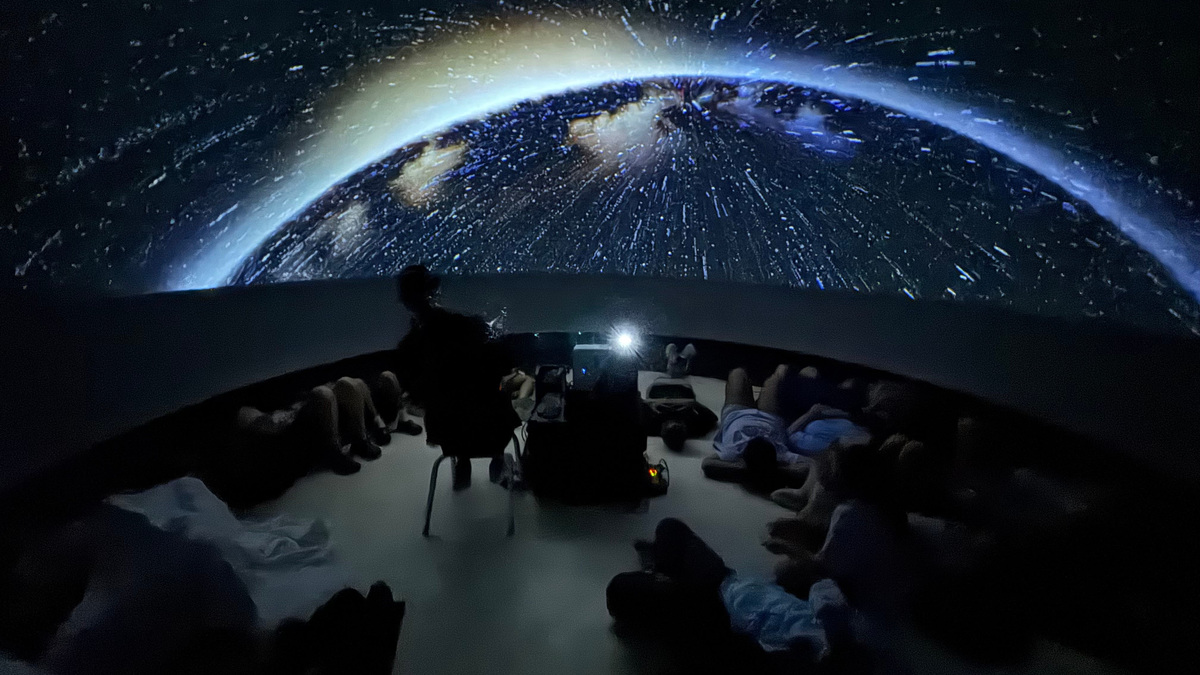
MOSH is still out there, though. Educators from the museum are keeping busy while waiting for construction by taking the museum to the people. An all-electric van and an inflatable planetarium allow the team to visit festivals, schools and senior centers, spreading the word about science.
“The museum does still exist,” said Maureen Mercho, the museum’s chief development officer. “We’re not place-based, we’re community-based.”
The planetarium dome holds about 35 people and uses high-resolution projectors to take visitors on a flight through space, visiting distant planets and galaxies, said Eddie Whisler, MOSH’s director of Planetarium and Outreach Programming. In July, he took it on 17 different outings and he said he’s willing to bring it to any group that wants to learn – as long as it’s not too far afield.
“We have a brand-new BrightDrop van,” Whisler said. “It is fully electric, so we are limiting our range to the range of the vehicle itself. We don’t go more than 75 miles.”
For larger audiences, Whisler and his team use projectors and an audio system to create a multimedia show. That show can be set up in a school auditorium or any large room. A popular program looks at the discoveries of the James Webb Space Telescope, but Whisler said he’s always looking for new topics that allow him to explore science in an interactive way.
The museum is also producing a video series, which will appear on its website, that will document the process of building the new MOSH, exploring the science behind planning, architecture and construction.
Plans for the new MOSH call for it to be a bit fancier than an inflatable planetarium.
What’s next for MOSH?
For now, MOSH’s collection is stored in a climate-controlled warehouse. Tonca, the American alligator turtle that lived in a tank in the old museum, has been relocated to the Reptile Preservation Institute near Melrose in Clay County, and plans do not call for him to return to the new MOSH.
The new MOSH will rise in what is now EverBank Stadium’s Lot X, at the foot of A. Philip Randolph Boulevard where Hogans Creek empties into the St. Johns River. MOSH 2.0 will have almost twice the space as the previous facility, in a five-floor, 125,000-square-foot building.
The Northbank Riverwalk will pass through the 7.2-acre property, and a river taxi stop is planned. MOSH will lease the land from the city, which will retain ownership.
No actual site work has been done yet. Geotesting, to check contamination levels in the soil at the former shipyard site, was a pleasant surprise. “We anticipated it to be much worse than it was,” said Jill Davis, chair of MOSH’s board.
Work is expected to start in the first quarter of 2027, with opening tentatively set for late 2029. The city requires at least 50,000 square feet of exhibit space, but that doesn’t include classrooms, storage space, mechanicals or a gift shop or cafeteria. The building will ultimately enclose about 125,000 square feet and is expected to draw a half million visitors annually. It will include ten exhibits, a cafe and community spaces.
Renderings were submitted to the Downtown Investment Authority in late August. If those plans area approved, MOSH has everything it needs to start building.
It’s an ambitious plan, and the budget has ballooned from an initial $85 million to a current estimate of $150 million. Even if they don’t raise another penny, MOSH plans on going forward with the new museum. “We are past the point of no return,” Mercho said. “If we don’t get the money, we’ll still build something.”
Where’s the money coming from?
Like many large projects, the costs keep rising. MOSH originally pitched a plan in 2019 to renovate the old museum at a cost of around $80 million. The cost for the new building was originally estimated at around $85 million and estimates now stand at $150 million.
Mercho said MOSH has about $100 million in binding pledges in hand, from private donors, foundations and grants. The city has kicked in $50 million and other big donors include CSX, which contributed $10 million, and Jaguars owner Shad Khan, who pledged $5 million. At least 80 people or organizations have donated $50,000 or more to the campaign. It’s the largest single fundraising campaign for a cultural institution in Northeast Florida history, said Davis, who was named in August as Outstanding Volunteer Fundraiser by the Association of Fundraising Professionals’ First Coast Chapter.
“We have collected almost $100 million, and we don’t even have a picture to show,” Mercho said.
Still, they’re $50 million short of their goal, and the museum will be held responsible for cost overruns. Davis said she expects to raise the money from private, corporate and family foundation sources. She said they are also hoping for some support from the state, but haven’t pursued any federal funding options.
MOSH will also launch a campaign to seek smaller donations from the public. “We haven’t done a broad, communitywide campaign yet, but that’s on the horizon,” Mercho said. If you are interested in contributing, go to themosh.org and click on the big orange “Make a Gift” button.
Who is in charge of MOSH?
Alistair Dove, who was named CEO of MOSH early in 2024, resigned at the beginning of this year. Mercho took over temporarily, and Lysa Barbano was named executive director in April.
Barbano actually works for VyStar Credit Union as vice president of partnerships. The credit union was one of the earliest donors to the project, pledging $2.5 million in 2020, when plans still called for expanding the old museum. VyStar president and CEO Brian Wolfburg serves on the MOSH board and is co-chair of the capital campaign, and the museum’s temporary offices are in the downtown Vystar building. The company is loaning Barbano to MOSH to oversee the fundraising and construction projects, for as long as needed.
Read more Manatee students selected for All-County Orchestra
“This is perfectly aligned with what I’ve done in the past,” Barbano said.
She’ll serve as a liaison between the board, donors and partners in the project. She still represents VyStar on several boards and lives in the Orlando area. “My day job is the museum,” she said.
She’ll also help with the search for a new CEO. She said they’re looking for someone who looks at the post as a destination, not a stepping stone. The new CEO will need to understand the business side of running a cultural institution, Davis said. They will need to evaluate staff, facilities and volunteers and create a safe and enjoyable environment that people will want to come back to. “I think it’s pretty much a jack of all trades,” Davis said.
What will the new MOSH be like when it opens?
The new museum is planned for a lot that juts out into the St. Johns River, at the mouth of Hogans Creek. The property, part of a former shipyard, has been used for years as Lot X, a parking lot for fans attending events at EverBank Stadium across the street. Opening day is planned for sometime in the fourth quarter of 2029, a date that has moved several times since the project was announced.
The St. Johns River will be the thread that holds the museum together. A two-story water feature that represents the 27 feet the river drops from its headwaters in Indian River County, will be one of the first things visitors see. As they walk through the museum, visitors will encounter “islands,” each focused on some aspect of science. The science island, for instance, will display live data to show what is happening on the 310-mile river.
There will be things for kids to climb on and places for adults to relax, trips to space and hands-on activities. “”It will be for all ages,” Barbano said. “I think that’s really critical. It doesn’t matter what age you are.”
SmithGroup, which designs university buildings, hospitals, parks and other large public projects, is the architect for the project. Ralph Appelbaum Associates, which created exhibits for the Obama Presidential Center, the National Museum of African American History and museums around the world, is in charge of the displays. Davis said there was no shortage of firms willing to work on the project. “You don’t often get to build a museum on a river,” she said.
The new MOSH is also one of the final pieces in the redevelopment of the Northbank. Ongoing projects include construction at Riverfront Plaza and EverBank Stadium, which is midway through a billion-dollar-plus renovation, plus the Four Seasons Hotel, planned for completion later this year. Metropolitan Park Marina just reopened after a three-year rebuild and the Jaguars just moved their offices into a new 10-story riverfront building. The USS Orleck, a retired U.S. Navy destroyer docked just up the river from the new MOSH site, is a floating Navy museum.
Davis said she doesn’t want MOSH to be the culmination of the downtown renaissance, but the start of a new one. “Let’s make MOSH the first piece of the puzzle, not the last,” she said.
Timeline: A history of MOSH
48: Jacksonville Children’s Museum, chartered in 1941, opens in a mansion at the corner of Riverside Avenue and Lomax Street. The museum’s exhibit budget was reportedly $25 per year.
1969: Jacksonville Children’s Museum moves to new 33,000-square-foot facility on the Southbank.
1977: Name changed to Museum of Art & Science 1988: Name changed to Museum of Science & History, building expanded to 74,500 square feet, 2010: $1 million renovation of planetarium completed. March 2019: MOSH announces plans to raise $80 million to renovate and expand Southbank facility.
October 2020: MOSH abandons renovation project and announces MOSH Genesis, a plan to build a new facility at 2.5-acre city-owned Shipyards property. Target date for opening set as fall of 2024.
November 2020: Jacksonville Jaguars owner Shad Khan and his family donate $5 million gift to build new MOSH facility.
January 2023: First conceptual exhibit plans for new museum released, with a strong emphasis on the St. Johns River.
April 2023: City Council committees approve 40-year lease for the MOSH property, commit $20 million and pledge to extend A. Philip Randolph Boulevard and the Northbank Riverwalk to improve access to the site. A provision in the lease calls for the museum to be completed by the end of 2027. MOSH announces that it has collected about $16 million in pledges.
March 2024: Big donations move the needle on the MOSH Genesis project. CSX donates $10 million to become presenting sponsor, James E. and A. Dano Davis Family Charities contributed $1 million earlier the same month and Jill and Jed Davis added another $500,000. Other early donors include include $2.5 million from VyStar Credit Union; $1.1 million from the Lastinger family, including $1 million from the St. Augustine-based Lastinger Family Foundation and $100,000 from Lindsey Lastinger Riggs and Ryan Riggs; $1 million from the Ponte Vedra Beach-based Neviaser Foundation; $500,000 from PNC Bank and a “significant contribution” from the C. Herman and Mary Virginia Terry Foundation.
July 2024: After missing a city-imposed December 2023 deadline to raise $40 million, MOSH announces it has raised the money. Construction is expected to begin in 2025 and plans call for the new MOSH to open in 2027.
October 2024: The City of Jacksonville commits $50 million toward the project as part of its 2025-29 capital improvement plan.
May 2025: MOSH announces plans to close its Northbank museum at end of summer.
April 2026: Lysa Barbano named executive director. Maureen Mercho, chief development officer, had been in charge since the January resignation of CEO Alistair Dove. Barbano is Senior Vice President of Partnerships for VyStar, which agrees to “loan” her to the museum. June 2026: Demolition of old Northbank MOSH building begins.
This article originally appeared on Florida Times-Union: The next MOSH: How a Jacksonville landmark is being built again
Reporting by Tom Szaroleta, Jacksonville Florida Times-Union / Florida Times-Union
Read more Will race matter more than party in Florida’s governor election?
USA TODAY Network via Reuters Connect
Copyright Reuters or USA Today Network via Reuters Connect
This story was originally published September 20, 2026 at 5:10 AM.







Post Comment