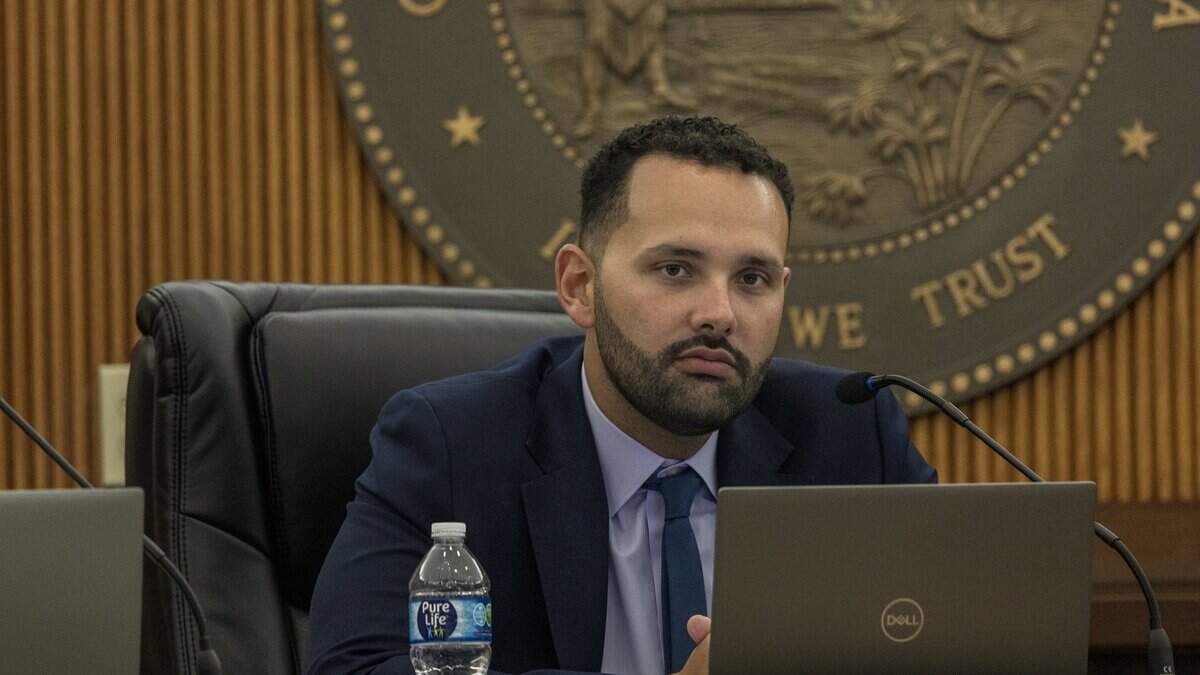
Calvo once pushed to lower Hialeah’s property tax rate. Now he wants to keep it the same
Once upon a time, Bryan Calvo saw Hialeah’s property tax rate as an opportunity to give residents a break.
Read more Car crashes into a Palacio de los Jugos. Three people hospitalized, MDFR says
Now, as mayor, he is proposing to keep the same rate he once argued effectively raised taxes on homeowners.
Calvo’s proposed fiscal 2027 budget, a $514.4 million spending plan, keeps Hialeah’s millage rate at 6.3018, the same rate the city has had for 13 years. But taxable property values have risen 6.1%, and the city expects to collect an additional $8 million in tax revenue from property owners. In property-tax terms, a mill is equivalent to $1 in tax per $1,000 in taxable value.
The City Council approved the budget on first reading 6-1 on Sept. 8, with Council Member Gelien Perez the sole dissenting vote. She cited the short time she had to review the budget and a “lack of transparency.”
Calvo told the Miami Herald, “As mayor I’m giving tax back to residents.”
His budget does include relief through lower water bills. But utility relief is not new to Hialeah. Under former Mayor Esteban “Steve” Bovo, the city also took steps to reduce utility costs, including suspending its 4% water and wastewater franchise fee.
The biggest difference is how Calvo once viewed property tax relief.
As a councilman, Calvo spent three consecutive years arguing that Hialeah should lower its property tax rate as property values rose.
During Bovo’s first budget as mayor, in September 2022, Calvo was the only council member to vote against the spending plan.
“I promised the residents there would be no increase and no matter how creatively we are doing it, we are raising taxes for Hialeah residents, and I cannot support this budget,” Calvo said at the time, objecting to the decision to keep the millage rate unchanged.
After his third year on the council, Calvo left City Hall to run for Miami-Dade County tax collector. He later returned to Hialeah politics and won the mayoral seat.
Read more Car crashes into a Palacio de los Jugos. Three people hospitalized, MDFR says
Now, he is proposing the same millage rate he once opposed.
The city’s budget describes the rate as “held flat” since 2013. Calvo’s budget letter says the city is “asking no more from Hialeah taxpayers.”
But a flat millage rate does not necessarily mean a flat tax bill. As taxable values rise, some property owners can see their city tax bills increase even though the rate remains unchanged. Individual bills vary depending on taxable value, exemptions and other factors, but the city’s budget anticipates $8 million more in property tax revenue.
Calvo can point to other forms of relief.
One of the most visible tax relief measures he has taken as mayor came earlier this year, when the city provided a one time property tax stimulus check to qualifying senior homeowners.
The roughly $1.2 million program went to seniors earning less than $38,000 a year and was funded through surplus general fund revenue, driven in part by savings from early pension payments that reduced long term costs. About 2,225 families, or 6.9% of Hialeah households, benefited, receiving an average rebate of $539.
But that was a one time payment made in February. It is not included as a new property tax relief program in Calvo’s proposed fiscal 2027 budget, and there is no guarantee that qualifying seniors will receive another rebate next year.
The distinction matters. The senior stimulus provided relief to a small group of homeowners, while the millage rate applies to the broader property tax base.
Calvo’s current budget does include utility relief. Beginning in the new fiscal year, the city plans to reduce the median bimonthly residential water and sewer bill from $78 to $62, a 21% reduction based on an average monthly consumption of 5,250 gallons. The budget says a typical household will receive a 25% reduction, while eligible seniors will receive an additional 25% relief credit, bringing their total reduction to 50%.
That water relief is separate from property taxes. A homeowner whose taxable value rises may see a higher property tax bill without receiving any corresponding property tax reduction.
Read more Car crashes into a Palacio de los Jugos. Three people hospitalized, MDFR says








Post Comment