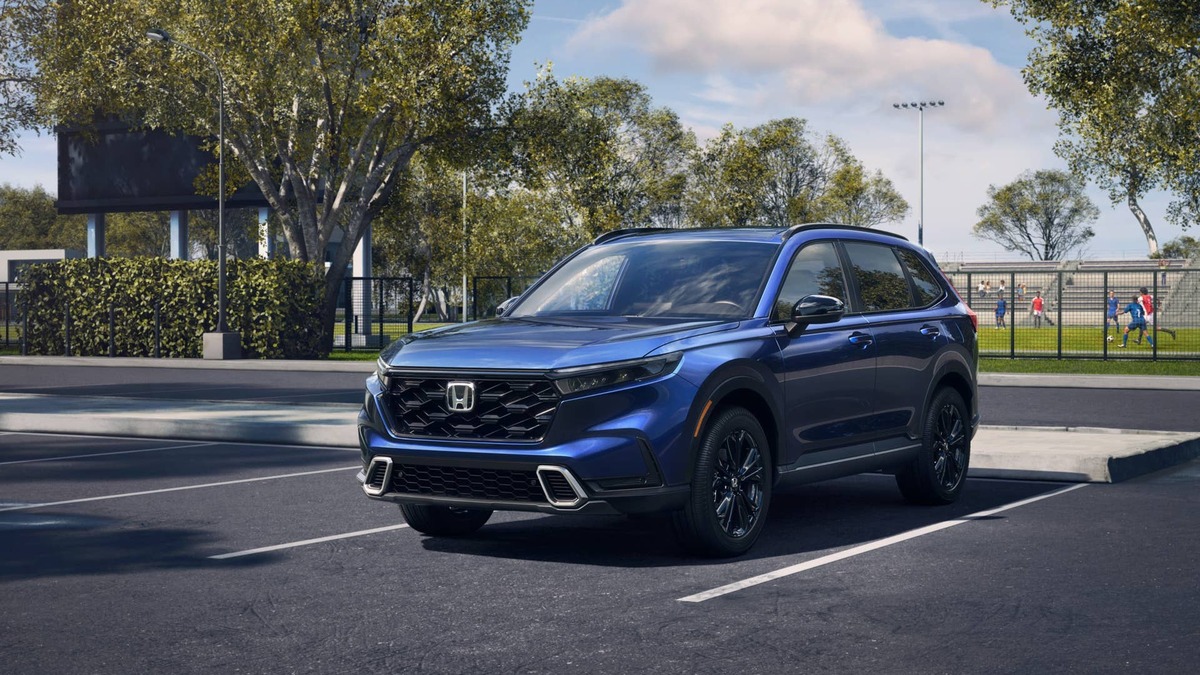
2026 Honda CR-V vs. Chevrolet Equinox: One Makes a Stronger Case for Your $32,000
Seventy-five dollars separates these two at the entry point, which is the smallest gap in any comparison on this site and means the budget decides absolutely nothing. Both fit $32,000 comfortably, both leave near a thousand dollars for options, and both are compact SUVs with turbocharged four-cylinder engines and similar footprints. What separates them is 15.1 points of depreciation, which is the widest retention gap we have measured in this class and worth $4,706 before anything else is counted.
Read more Kroger knows what’s wrong with its stores
What’s New for 2026
Honda improved the CR-V’s technology floor rather than its ceiling. Wireless Apple CarPlay, Android Auto and a wireless phone charger now arrive on every trim, closing gaps that used to separate a base car from a mid-range one. The 1.5-liter turbocharged four continues at 190 horsepower and 179 lb-ft, the two-motor hybrid above it produces 204 horsepower and reaches up to 40 mpg combined, and pricing starts at $30,920.
Chevrolet carries the Equinox forward from its 2025 revamp, which makes it among the freshest designs in the class. The 1.5-liter turbocharged four produces 175 horsepower and 203 lb-ft, an 11.3-inch touchscreen with navigation, natural voice recognition and a six-speaker stereo is standard, and heated front seats and a heated steering wheel are fitted to every trim. Pricing starts at $30,995 and the first scheduled service is complimentary.
The Basics
Honda CR-V
- Price: From $30,920, leaving $1,080 of the budget
- Standard engine: 1.5-liter turbocharged four, 190 hp, 179 lb-ft
- Hybrid: 2.0-liter two-motor, 204 hp, up to 40 mpg combined
- Transmission: Continuously variable
- EPA city / highway / combined, front-wheel drive: 28 / 33 / 30 mpg
- Cargo behind rear seats: 39.3 cu ft
- Maximum cargo: 76.5 cu ft, best in class
- Towing: 1,500 lbs
- Standard technology: Wireless Apple CarPlay and Android Auto, wireless charger, 9-inch display
- Estimated annual repair cost: $407
- Five-year depreciation: 34.5%
Chevrolet Equinox
- Price: From $30,995, leaving $1,005 of the budget
- Engine: 1.5-liter turbocharged four, 175 hp, 203 lb-ft
- Hybrid: None offered
- EPA combined: Near 28 mpg front-wheel drive, 26 mpg all-wheel drive
- Maximum cargo: Near 63.5 cu ft
- Interior volume: 104.3 cu ft
- Standard technology: 11.3-inch touchscreen with navigation, natural voice recognition, six-speaker stereo
- Standard comfort: Heated front seats and heated steering wheel
- Included servicing: First scheduled maintenance visit
- Five-year depreciation: 49.6%
Both carry the same three-year or 36,000-mile basic warranty and five-year or 60,000-mile powertrain coverage, so neither buys an advantage there. The CR-V range splits between gas and hybrid powertrains, and the Equinox lineup runs three trims on one engine.
Chevrolet’s standard-equipment approach also decides its comparison against Kia, where the Equinox includes heated seats the Sportage charges for. That front-loading is consistent across the range and it is the strongest argument the Equinox makes anywhere.
Powertrains and Driving
Honda wins horsepower and Chevrolet wins torque, which is the usual split between two turbocharged fours of the same displacement tuned differently. The CR-V produces 190 horsepower and 179 lb-ft against the Equinox’s 175 and 203, so Honda leads by 15 horsepower and Chevrolet by 24 lb-ft. Chevrolet’s torque also arrives lower in the range, which makes the Equinox the more responsive vehicle pulling away from a stop.
Powertrain breadth is where Honda separates itself decisively. The CR-V Hybrid produces 204 horsepower from a two-motor system and returns up to 40 mpg combined, and Chevrolet offers no hybrid Equinox at any trim or price. A buyer who wants electrification in this pairing has exactly one option, and it costs the same at the entry point as the Chevrolet that has none.
Both use continuously variable or similarly tuned transmissions aimed at efficiency rather than engagement, and neither is a vehicle bought for how it drives. Reviewers describe both as competent and composed, which is what compact SUV buyers actually want.
Real-World Fuel Economy
Honda wins the gasoline comparison and the hybrid ends it. The CR-V returns 28 mpg city, 33 mpg highway and 30 mpg combined with front-wheel drive, against the Equinox’s near 28 mpg combined in front-drive form and 26 with all-wheel drive. That is a 2 mpg gap on the mainstream engines and it widens with four driven wheels.
Over 60,000 miles the gasoline difference amounts to 143 gallons, or $571 at $4.00 a gallon, which is $114 a year. That figure is modest and it is not where the ownership gap in this comparison comes from.
The hybrid is a different order entirely. At up to 40 mpg combined the CR-V Hybrid returns 12 mpg more than a front-drive Equinox and 14 more than an all-wheel-drive one, and Chevrolet has no answer because it does not build one. Both gasoline engines run on regular unleaded, so neither carries a fuel-grade penalty.
Design and Presence
Chevrolet has the fresher shape, having revamped the Equinox for 2025, and the result is clean and contemporary without being distinctive. It looks newer than the CR-V on a dealer lot, which matters to a buyer choosing on appearance and matters less over a decade of ownership.
Honda’s CR-V is the more conventional object and it will date more slowly for exactly that reason. Large windows and an upright glasshouse make the cabin feel open, and the design serves visibility and packaging rather than styling ambition.
Outward visibility favors the CR-V, whose taller glass area is a deliberate Honda choice that pays off in parking and lane changes. Neither will turn a head and both look like what they are, which is the correct priority in a segment bought on practicality.
Cabins and Technology
Chevrolet front-loads the equipment and the list is genuinely strong at this price. Heated front seats and a heated steering wheel are standard on every Equinox, which is a meaningful daily difference in a cold state, and the 11.3-inch touchscreen arrives with navigation, natural voice recognition and a six-speaker stereo included.
Honda’s answer is narrower and it closed a real gap for 2026. Wireless Apple CarPlay, Android Auto and a wireless charger now arrive on every CR-V trim including the base, which removes a common complaint aimed at entry-level Hondas. The 9-inch display is smaller than Chevrolet’s and the content surrounding it is competitive rather than leading.
Interior volume favors Chevrolet at 104.3 cubic feet, which is competitive for the class and reflects a cabin designed for passenger space. The practical framing is that the Equinox gives you more equipment at the entry point and the CR-V gives you more room to put things, which the section below covers.
Practicality and Space
Honda wins cargo and the margin is the widest measurable difference between them. The CR-V holds 39.3 cubic feet behind its rear seats and 76.5 cubic feet with everything folded, and that maximum figure is the largest in the compact class.
Chevrolet’s maximum sits near 63.5 cubic feet, which is 13 cubic feet behind Honda and a substantial gap in a segment where nobody has volume to spare. On two vehicles of similar external size, that is a packaging result rather than a difference in footprint.
Loading favors the CR-V further. Its wide tailgate opening and low liftover height make heavy items easier to lift in, which owners notice weekly rather than occasionally. Both seat five, neither offers a third row, and both tow 1,500 lbs, so capability does not separate them.
Safety and Driver Assistance
Both fit comprehensive standard driver-assistance suites to every trim, with Honda Sensing on the CR-V and Chevy Safety Assist on the Equinox. Each covers automatic emergency braking, adaptive cruise control, lane keeping assist and blind-spot monitoring in its current form, so neither gates core protection behind a trim walk.
Both perform competitively in independent crash testing and neither buys a decisive advantage on published results. Neither vehicle has a record that should concern a buyer, and the choice between them should not rest on safety.
Read more Tom Cruise’s mom lived in Florida, co-founded a film festival. What to know
Brand-level reliability rankings separate them more than the equipment does. In an assessment of 22 brands Chevrolet ranked sixteenth, and Honda placed considerably higher, which reflects broader engineering and build consistency rather than anything specific to these two models.
Resale and Cost of Ownership
This is where the comparison is decided and the gap is the widest we have measured in the compact class. The CR-V surrenders 34.5% of its value across five years and the Equinox 49.6%, so Honda retains 15.1 points more. Applied to their near-identical entry prices the Equinox sheds $15,374 and the CR-V $10,667, a difference of $4,706 on two vehicles priced $75 apart.
That figure alone is more than sixty times the purchase difference, which is why the sticker is the wrong number to compare here. Honda’s 34.5% is among the strongest retention figures in any mainstream segment, and Chevrolet’s 49.6% is typical for the brand rather than unusual for this model.
Repair costs point the same direction. The CR-V’s estimated annual figure is $407, which is among the lowest in the segment, against a Chevrolet compact reference near $600. Chevrolet’s complimentary first service is a genuine perk and it covers one visit against a $193 annual difference across five years.
Depreciation is the largest single line in either ownership column, and the point at which the curve flattens decides whether selling at year three or holding longer is the less expensive move. On a vehicle retaining 65.5% after five years, holding longer costs less than it would on most rivals.
What Five Years Actually Costs
Assumes 12,000 miles a year over five years, 60,000 miles total, regular fuel at $4.00 a gallon, and gasoline models with front-wheel drive on both. Repairs use Honda’s demonstrated $407 a year against a Chevrolet compact reference of $600.
Honda CR-V
- Purchase price: $30,920, leaving $1,080 of the budget
- Fuel over 60,000 miles at 30 mpg: $8,000
- Depreciation over five years at 34.5%: $10,667
- Repairs and maintenance at $407 a year: $2,035
- Five-year cost to own: $20,702
Chevrolet Equinox
- Purchase price: $30,995, leaving $1,005 of the budget
- Fuel over 60,000 miles at 28 mpg: $8,571
- Depreciation over five years at 49.6%: $15,374
- Repairs and maintenance at $600 a year: $3,000
- Five-year cost to own: $26,945
The CR-V costs $6,243 less to own across five years on a purchase price $75 lower. Depreciation accounts for $4,706, repairs for $965 and fuel for $571, and all three run the same direction. That is the widest ownership gap we have measured between two compact SUVs, and it happens on vehicles that cost effectively the same to buy, which makes the sticker comparison actively misleading here.
Which Trim to Actually Buy
On the Honda side, the LX at $30,920 is better value than it was, since wireless smartphone mirroring and a wireless charger now arrive on every trim rather than requiring a step up. The hybrid at up to 40 mpg combined is where the CR-V becomes compelling rather than merely competent, though it sits above the $32,000 budget and carries slightly less cargo space than the gasoline models.
On the Chevrolet side, the LT at $30,995 already includes the 11.3-inch touchscreen with navigation, heated front seats and a heated steering wheel, which makes the entry trim unusually complete and is where the Equinox’s case actually sits. The Activ and RS near $35,000 add appearance rather than capability and move beyond the budget.
At exactly $32,000 both fit with near a thousand dollars remaining, so a buyer is choosing on what each includes rather than on what each costs. That is an unusual position in this segment and it makes the ownership figures below the deciding evidence.
Scorecard
- Design and presence: Equinox. A 2025 revamp makes it the fresher shape, against Honda’s more conventional and slower-dating profile
- Cabins and technology: Equinox. Heated front seats, a heated steering wheel and an 11.3-inch screen with navigation standard on every trim
- Powertrains and driving: CR-V. 190 hp against 175 and a hybrid reaching 40 mpg that Chevrolet does not build
- Practicality and space: CR-V. 76.5 cubic feet folded against near 63.5, the largest figure in the compact class
- Real-world fuel economy: CR-V. 30 mpg combined against near 28, widening to 26 on all-wheel-drive Equinoxes
- Capability: Draw. Both tow 1,500 lbs and neither is engineered for anything beyond light duty
- Resale and cost of ownership: CR-V. $6,243 less across five years, and 34.5% depreciation against 49.6%
CR-V 4, Equinox 2, one draw.
So Which Makes a Stronger Case for $32,000?
The CR-V, and the depreciation figure is large enough that nothing else in the comparison can offset it. Honda sheds 34.5% of its value across five years against Chevrolet’s 49.6%, a gap of 15.1 points worth $4,706 on two vehicles priced $75 apart. Add $965 in repairs and $571 in fuel and the CR-V finishes $6,243 ahead, which is the widest ownership gap we have measured in this class.
Space reinforces it where compact SUV buyers feel it. Seventy-six point five cubic feet with the seats folded is the largest figure in the segment and sits near 13 cubic feet ahead of the Equinox, with a wide tailgate and low liftover height making the difference practical rather than theoretical. The hybrid at up to 40 mpg combined is the other structural advantage, since Chevrolet offers no electrified Equinox at any trim.
Chevrolet’s case is genuine and it is concentrated entirely at the entry point. Heated front seats and a heated steering wheel are standard on every Equinox where Honda does not fit them, the 11.3-inch touchscreen arrives with navigation and natural voice recognition included, and the first scheduled service is complimentary. Its 203 lb-ft also beats Honda’s 179 and arrives lower in the range, which makes it the more responsive vehicle in traffic.
Three buyer profiles should take the Equinox. Anyone in a cold climate who does not want to pay for heated seats, since Chevrolet includes them and the heated wheel alongside. Anyone who values a larger screen with navigation built in, because 11.3 inches with those features standard is more than Honda offers at this price. And anyone keeping the vehicle briefly or leasing it, since a lease never realizes Honda’s resale advantage and the depreciation gap that decides this comparison stops mattering.
One caution applies to the Equinox for anyone buying to keep. A 49.6% five-year depreciation rate on a vehicle costing effectively the same as the CR-V means $4,706 more value lost, and no amount of standard equipment recovers that at trade-in.
Take the Chevrolet Equinox for heated seats, a bigger screen with navigation and a fresher design. Take the Honda CR-V for the largest cargo hold in the class, a 40 mpg hybrid and a five-year cost $6,243 lower.
Alternatives to Consider
The Toyota RAV4 is hybrid-only for 2026 at up to 43 mpg combined with the strongest resale in the class. The Kia Sportage offers gas, hybrid and plug-in hybrid powertrains with a ten-year powertrain warranty. The Mazda CX-50 includes all-wheel drive on every trim with a considerably better cabin. And the Subaru Forester fits symmetrical all-wheel drive as standard with 8.7 inches of ground clearance.
Frequently Asked Questions
Which is more affordable?
They cost effectively the same, $75 apart at $30,920 against $30,995. Across five years the CR-V costs $6,243 less to own because it sheds 15.1 points less of its value.
Which has more cargo space?
The CR-V, with 76.5 cubic feet folded against the Equinox’s near 63.5, a difference of near 13 and the largest figure in the compact class.
Which is more fuel efficient?
The CR-V, at 30 mpg combined against near 28, and its hybrid reaches up to 40 mpg. Chevrolet offers no hybrid Equinox at any trim.
What does the Equinox include that the CR-V does not?
Heated front seats, a heated steering wheel, an 11.3-inch touchscreen with built-in navigation, and one complimentary scheduled service visit.
Read more Etihad Airways sees strong demand, higher passenger capacity despite Iran war, CEO says
Copyright 2026 The Arena Group, Inc. All Rights Reserved
This story was originally published September 14, 2026 at 8:00 AM.








Post Comment