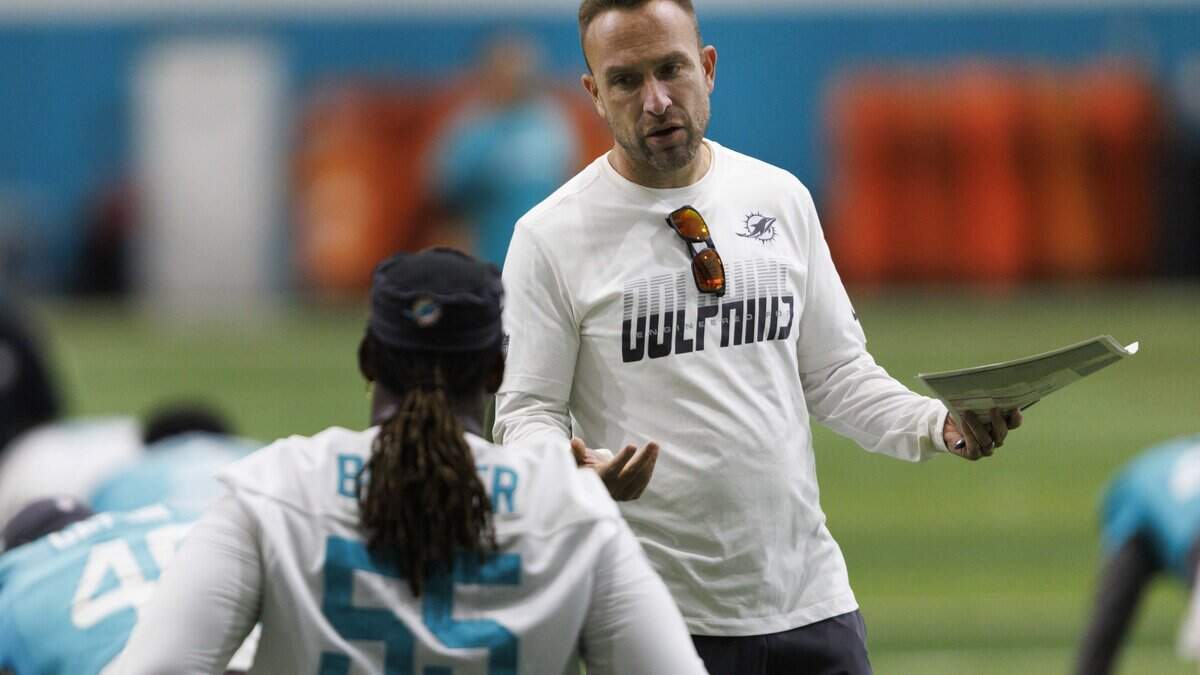
Candor on key Hafley/McDaniel difference. And how Dolphin coach should be judged
Of all the differences between new Dolphins coach Jeff Hafley and predecessor Mike McDaniel, here’s one that seems stark: The tolerance for, and response to, mindless mistakes and rules violations.
Read more Miami-Dade school board OKs leaner budget, braces for possible cuts
Because Hafley’s first season — which begins Sunday at Las Vegas (4:25 p.m., Fox 7) — hasn’t played out, nobody knows for sure if any players will be brazen enough to repeatedly violate team rules without significant consequences, as a handful did with McDaniel. But based on my conversations with players, the odds seem very much against it.
“Here was the problem,” said one returning Dolphins player who requested anonymity and isn’t named. “Mike wanted to be your buddy, and nobody took it seriously when he tried to” become more of disciplinarian and attempted to stop players from showing up late or missing meetings.
While players respected McDaniel’s offensive mind and generally liked him personally, there was no healthy fear and not the type of respect for his rules and his demands, the player said, adding that a few players were openly disrespectful to coaches. That made McDaniel ineffective in the final months of his tenure and why a coaching change probably was necessary, the player said.
That’s not the case so far with Hafley, who’s warm and congenial but also gives off no-tolerance vibes. Hafley established from the outset that errors he views as egregious (like unsportsmanlike conduct penalties) won’t be accepted quietly.
That became clear when Hafley removed running back Ollie Gordon II from the second preseason game after he drew a penalty for throwing the ball to the turf, then sternly discussed it with him on the sideline… and discussed it with him again the next morning… and then brought it up in a team meeting.
Linebacker Cameron Goode, who played three years under McDaniel (who’s now the Chargers’ offensive coordinator) and a few months under Hafley before being released last month, put it this way: “You’ve got to stand on what you say. If you say something won’t be tolerated, you’ve got to do things like that and take people out [of games] and hold guys accountable. I know people have said that has been a problem for the Dolphins in the past, whether it has been or not.”
Linebacker Willie Gay Jr. said of Hafley: “Whether it’s jumping offsides or unsportsmanlike conduct, false start, anything, coach Hafley is going to call it out before anyone else does. He will penalize us worse than the flag. To know he’s hard on that is big; it holds us accountable.”
And Hafley also is not going to tolerate tardiness, a problem throughout the McDaniel regime. “He’s strict on us in a good way,” Gay said of team rules. He’s “like someone who beats your butt when you need it and pats your back when you’re doing good.”
New Dolphins edge rusher Joshua Uche said the Hafley “regime has been a tough one. He’s instilling a new culture. We are building tough, detailed and disciplined guys here. He’s an intense coach. The inspiration he gives to us with pregame speeches, the energy, I know I’m bought in.”
Dolphins safety Zayne Anderson, who was coached by Hafley with the Packers the past two seasons, said players understand “you can’t cross the line” with Hafley.
“He’s really stressed how much [bad penalties] can affect the team,” Anderson said. “He’s done a great job of conveying that. It’s also toeing the line. Don’t be soft out here, but you can’t toss the ball [at someone]. Toe the line with aggressiveness.”
Anderson said Hafley has comported himself as a head coach much as he did as the Packers’ defensive coordinator: “When he first came there, he was less concerned with getting calls right [but] playing with the right tenacity and attitude, and that’s carried over to the whole team. Guys can play loose, play fast, play physical. Hopefully that physicalness shows on display.”
Physicality has become a buzzword around here, because Hafley and general manager Jon-Eric Sullivan have made clear that they detest any suggestion that their teams will be soft — a justified criticism against past Dolphins teams.
When asked specifically about how Hafley compares with Brian Flores — the Dolphins’ last “tough guy” coach before Hafley — Dolphins defensive lineman Zach Sieler said: “What I’ve loved from when Flo was here and what Haff preaches now is just that situationally tough, smart football team.”
Read more Miami-Dade school board OKs leaner budget, braces for possible cuts
The message, conveyed repeatedly by Hafley, is one built around physicality. “Eleven hats to the ball, not turning down a hit and just running,” is how Sieler explained it. “It starts in the front, ends in the back with the DBs, receivers, everybody getting the block. Offensively they kept saying ‘no block, no rock,’ and I love that.”
Linebacker Jordyn Brooks appreciates Hafley’s efforts to change the “physicality” narrative but also acknowledges: “Every team is going to preach physicality. I think the difference is… Do you actually go out there and be physical rather than just talking about it?
“To me, physicality is a choice that takes no talent. It’s just a decision that one man’s got to make, whether he wants to be physical or not. And so that’s a mindset that we’re trying to bleed into this team on a consistent basis.”
Hafley, who seems pretty savvy, seemed to realize pretty quickly that he erred by telling Stephen A. Smith that this season is “not going to be measured in wins and losses” but more about “developing who we are as a football team.”
Hours later — and twice since — Hafley adroitly clarified those comments, unprompted, seemingly aware that’s not a message some fans want to hear and a message that isn’t ideal for players to hear, either.
“We, and I, want to win everything that we do. But success is not just defined by winning,” Hafley said hours after his comments to Smith became public. “But at the same time, we need to make sure that this foundation and the process is built the right way.”
Though it’s taboo for coaches to dismiss wins and losses, his comment to Smith is likely a reflection, to a large extent, of how the organization feels and (in my view) should feel in the first year of a major rebuild. With a dearth of talent, the Dolphins’ final record isn’t the way to measure Hafley this season.
Here are six areas where it is fair to judge Hafley:
1). Does his team give maximum effort at all times?
2). Do his players not merely preach being physical, but actually do it?
3). Does Hafley’s approach to discipline reduce mindless penalties and team rules violations?
4). Do Hafley’s defensive schemes elevate a unit with subpar talent? If the Dolphins finish anywhere above 23rd (outside the bottom 10) in points allowed, that’s a victory, considering the deficiencies in the defensive backfield and edge rusher.
5). Does he competently handle managing of timeouts and challenge flags and other game management decisions that can bedevil some coaches?
6). And this could be No. 1 on the list: Do the players become better and maximize their talents? That means extracting every bit of ability from first-rounders Chop Robinson and Kenneth Grant, second-rounder Jonah Savaiinaea, third-rounder Caleb Douglas and fourth-round safety Kyle Louis, among others.
No coach is going to get the most out of every player to a point commensurate with their draft position. But the Dolphins need to do it with most of these players; that will be a direct reflection of Hafley’s coaching and development skills and whether he put together a good staff.
If he masters all six, then you will know the Dolphins have found the right coach. He already has several factors going for him: He’s smart, meticulous, a taskmaster and concise/direct in messaging with players but also approachable. That’s certainly a good start.
Read more Fact Check: Where Donalds and Jolly stand on partnering police with ICE







Post Comment