After media dust-up, Miami-Dade sheriff tells mayor: That can’t happen again
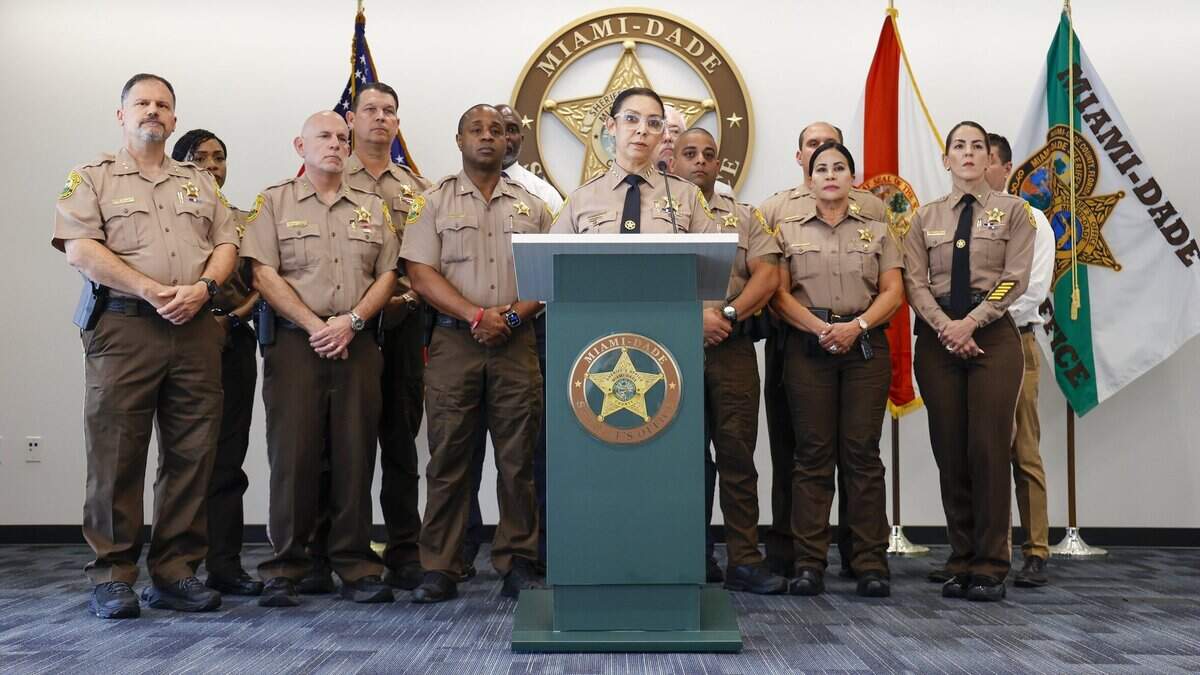
Miami-Dade’s sheriff on Wednesday defended taking the lead at a press briefing before television cameras after Sunday’s plane crash at Miami International Airport and called it inappropriate for a top county staffer to suggest that Mayor Daniella Levine Cava should have spoken first.
Read more ‘Too fast,’ ‘too low’ warnings called out ahead of MIA plane crash, NTSB says
Sheriff Rosie Cordero-Stutz made her case in a letter to Levine Cava, in which the sheriff said the mayor’s presence at the Sunday press conference was a courtesy in what was otherwise a scene controlled by the Sheriff’s Office. Unless the mayor declares a public emergency, Cordero-Stutz wrote, the sheriff should be the one leading the public response to what she described as a “law enforcement incident.”
“What is not appropriate,” Cordero-Stutz wrote, “is a member of the Mayor’s staff attempting to direct the Sheriff at the scene of an incident the Sheriff commands.”
The letter is the most direct and detailed response yet from either the Sheriff’s Office or the mayor’s office on what would have been a private dust-up if not for the presence of a live microphone at a press conference hours after a cargo plane’s crash killed five people on the ground.
As Cordero-Stutz and Levine Cava stood before microphones awaiting the start of an outdoor press briefing, it became clear the sheriff was preparing to speak first.
The mayor’s chief of staff, Chris Hudtwalcker, stepped forward and said to Cordero-Stutz that he thought Levine Cava should go first because she oversees the two government agencies most involved: Miami International Airport itself and Fire Rescue, whose rescue squads responded to the crash scene within 30 seconds. In an exchange captured by a live television feed, Cordero-Stutz refused: “Sir, with all due respect, I’m going to speak first.”
In a response letter released Wednesday evening, Levine Cava said the county charter gives the mayor “clear responsibility” for the kind of “emergency management event” that Miami-Dade faced at MIA. She cited a rapid environmental cleanup from the fuel spill, the logistical nightmare facing stranded passengers during MIA’s hourslong shutdown, and the Fire Rescue response to the injured and the fire.
The mayor “has the authority to mobilize County resources and lead the County’s response to an event of this scale” Levine Cava wrote.
The dueling letters did not seem to offer much common ground in a dispute between two of Miami-Dade’s most powerful officials nearly two years after Cordero-Stutz took office as the county’s first elected sheriff in decades. Both wrote that cooperation was vital to Miami-Dade when emergencies hit, but they offered conflicting views on what their roles should be.
Cordero-Stutz maintained she should have led the briefing because they were speaking at a site secured by her deputies as her detectives launched investigations into the fatalities. Her staff members were the ones contacting relatives of the five people who died and held a press conference Tuesday at the Sheriff’s Office headquarters in Doral to reveal the names of the victims.
Read more Did Coral Gables Commissioner Melissa Castro violate state ethics law? What we know
When an incident involves a potential crime or a law enforcement response, Cordero-Stutz wrote, the Sheriff’s Office “decides what information can be released and when, so that notifications reach families before they reach the press and so that nothing said at a podium compromises the investigation.”
The sheriff’s letter also challenged who was in charge at the press conference itself. Levine Cava’s staff met behind closed doors with federal aviation investigators ahead of the media briefing to go over what should be said — a meeting a source said Cordero-Stutz was invited to but did not attend. In the letter, Cordero-Stutz described the press conference as something she personally delayed so that the mayor could be before the cameras, too.
“When the exchange occurred, I had already delayed the Sheriff’s Office briefing so that you could arrive, be brought inside the perimeter my deputies had secured and address the press,” the sheriff wrote. “I did that deliberately and as a courtesy, because your presence was appropriate and I wanted the public to see the County’s leadership standing together.”
When county commissioners asked about Sunday’s exchange at a committee hearing this week, Deputy Mayor Roy Coley noted the Miami-Dade charter puts the mayor in charge during an emergency. “It’s explicit, and that’s how we’ve always functioned,” Coley said.
For decades, the county police department reported to the mayor. That changed in early 2025, when a change in Florida’s Constitution shifted police powers from the county’s mayor to its newly elected sheriff. Cordero-Stutz, a Republican, won the county’s first sheriff election since the 1950s against a Democrat backed by Levine Cava.
In her letter, Cordero-Stutz requested that their two staffs work out an agreement on how to address the public in the future. Those protocols should give the sheriff the lead during a “law enforcement incident,” while the sheriff would defer to the mayor “during a declared state of local emergency.”
Levine Cava’s letter took issue with that framing, saying the mayor’s authority to manage an emergency doesn’t exist only when the county is under a formal emergency declaration. “Not every emergency of this magnitude results in a formal declaration,” she wrote. “But that does not diminish the County’s authority to act in those circumstances, nor the Sheriff’s.”
Cordero-Stutz urged Levine Cava to do what it takes to avoid moments like Sunday’s confrontation. “The next one may come at a scene where the confusion has consequences,” she wrote.
Read more ‘Too fast,’ ‘too low’ warnings called out ahead of MIA plane crash, NTSB says







Post Comment