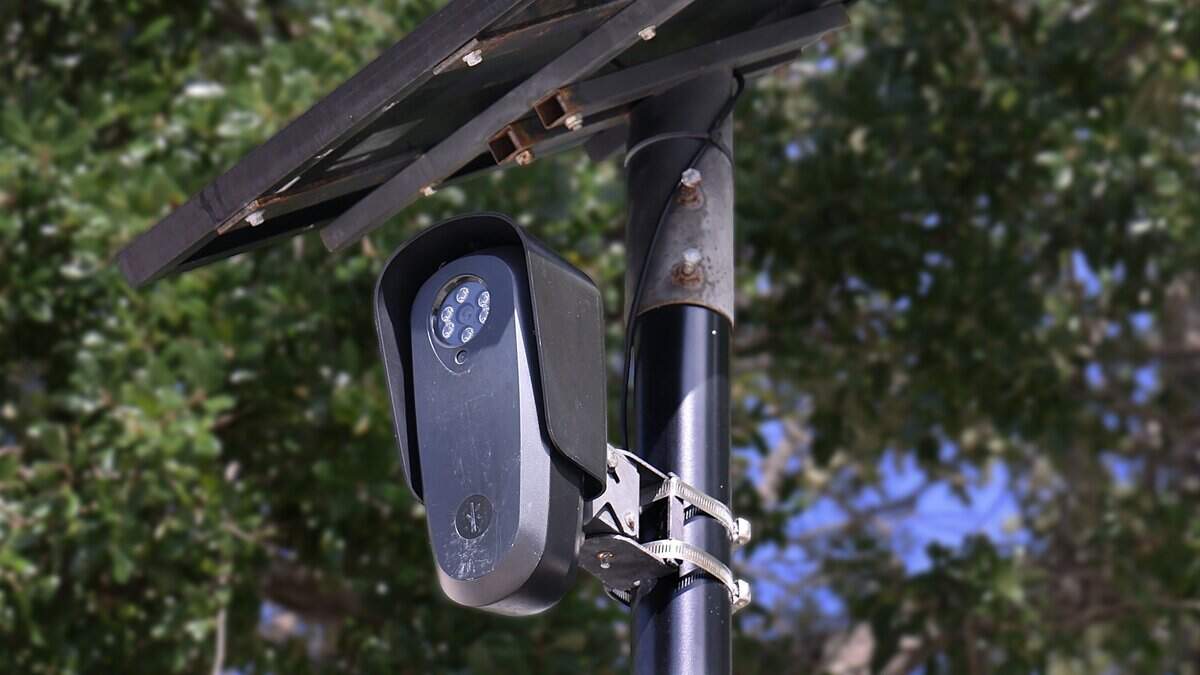
‘Pervasive and ungovernable.’ South Florida’s surveillance network is entrenched
Drive through Fort Lauderdale, and you are almost certainly swept into South Florida’s hidden multi-million dollar surveillance network — your movements tracked, your privacy at risk — joining a national database of millions.
Read more Coral Springs school cop fired after women report ‘sexual’ conversations: police
Driving through any major city in Miami-Dade or Broward raises your likelihood of having your personal data searched by law enforcement agencies without your consent and for any reason, a Miami Herald analysis found.
Once lauded as the future of crime-fighting, the proliferation of automated license plate readers has drawn criticism as privacy concerns mount. On Monday, the Florida Department of Transportation announced a landmark mandate to all local law enforcement: Take down your license plate readers on public roads that intersect with the state’s highway system in the next 30 days.
Despite the state’s action, the Herald has found it might not meaningfully decrease the massive volume of license plate readers that have boomed in the past few years to more than 2,000 cameras in Miami-Dade, Broward, Palm Beach and Monroe counties.
South Florida agencies began their fledgling surveillance networks with a few dozen cameras, but Flock Safety paved a path to hundreds more in recent years as it marketed its tech directly to cities, businesses and homeowner associations, the Herald found. All of these cameras can be interconnected for law enforcement use.
READ MORE: Florida Department of Transportation blocks Flock cameras on state roadways
The state’s ban came after Florida Gov. Ron DeSantis warned on Aug. 26 that these cameras could create a “surveillance state” that logs “regular Floridians’ movements” as the U.S. Senate Judiciary Subcommittee on Crime and Counterterrorism launched an investigation into the company’s access to Americans’ personal data.
Digital-privacy experts such as Rindala Alajaji have long sounded the alarm over automated license plate readers. She believes the state’s intervention is only a small blow to the vast surveillance network.
“I think pulling the state road permits for [the cameras] is a great first step, but it’s definitely not the end-all, be-all,” said Alajaji, the associate director of state affairs at the Electronic Frontier Foundation, a nonprofit organization that defends and researches digital privacy.
The state’s sudden reversal caused rapid reactions from law enforcement agencies — some immediately complying, others unsure of the next steps. The drastic change also sparked seven Miami-Dade municipalities to band together against it.
‘Public safety at risk’
The Miami-Dade Sheriff’s Office said Tuesday that not only will its state road cameras go dark, but Sheriff Rosie Cordero-Stutz took it a step further, announcing the “license plate reader program will be suspended in its entirety.”
“We also recognize that technology must come with appropriate safeguards through clear policies, strong oversight, transparency, accountability, and appropriate auditing, protecting the constitutional rights and privacy of the people we serve,” Cordero-Stutz said in a statement.
READ MORE: ‘Suspended in its entirety’: Miami-Dade sheriff to take down Flock cameras
Just a few weeks earlier, the sheriff’s office had announced it would put license plate readers on the trucks of deputies who patrol the county’s rural farmlands. At the time, the sheriff’s office described the tech as “a valuable tool for both our deputies and the community, providing real-time alerts connected to license plates, including stolen vehicles and other important law-enforcement alerts.”
It will now be part of the license plate reader program’s suspension and removal.
The Pembroke Pines Police Department took a similar response to the state’s demands. The agency announced Wednesday it would suspend all of its license plate reader programs. Records show the city of Pembroke Pines has spent over $300,000 on more than 60 automatic license plate reader cameras.
“The use of this technology must be guided by uniform law enforcement standards and clear laws that maintain the trust and confidence of our communities,” the department said in a statement.
On Tuesday, the Palm Beach County Commission unanimously voted to pause all new license plate reader camera permits.
Other agencies, including Miami Gardens police, told the Herald they have “not made a decision yet.” Miramar police are also reviewing what to do.
The Fort Lauderdale and Davie police departments told the Herald they will comply with the state’s order. Records obtained by the Herald show both agencies have automated license plate readers that are not on state roads and thus would be unaffected by the state’s order.
The Broward Sheriff’s Office did not comment on the state’s removal order.
Expert research and a Herald analysis of the Florida Department of Transportation’s permits found that removing state road cameras will not meaningfully hinder the surveillance network already in place.
The Herald reviewed permits issued in Miami-Dade, Broward, Palm Beach and Monroe counties between August 2023 and April 2025, and found that only about 120 of the cameras approved during that time would be affected by the state’s ban. Hundreds more cameras could be left operating and unaffected throughout the four-county region.
DeFlock, an open-source project that maps where the cameras are in the U.S., shows around 2,400 license plate reader cameras in South Florida, and about 70-75% of them are Flock Safety cameras.
There are about 550 cameras in Miami-Dade, 600 in Palm Beach and at least a dozen in Monroe. Broward is home to more than 900 cameras — the largest concentration in Florida, according to DeFlock.
“Most license plate readers in Florida are actually not on state roads to begin with,” Alajaji said. “They’re on city streets, on county roads and [some] operated by HOAs.”
On Tuesday, Miami Beach Mayor Steven Meiner and six other mayors in Miami-Dade called for Gov. DeSantis and FDOT Secretary Jared Perdue to put an immediate pause on the state’s order. His letter was also signed by the mayors of Bay Harbor Islands, Bal Harbour, Aventura, Sunny Isles Beach, Golden Beach and Indian Creek.
“I share the state’s respect for privacy rights and recognize the legitimate concerns that prompted the decision,” Meiner wrote on his social media on Tuesday. “But a blanket revocation with no transition plan puts public safety at risk.”
READ MORE: Miami Beach mayor vows to fight state’s new Flock camera ban
The Miami Beach Police Department does not partner with Flock Safety or use its technology, an agency spokesperson told the Herald. However, the department does use readers from Motorola Solutions and Axon Outpost. They are placed in “strategic locations” and in some police vehicles.
Police departments have lauded Flock’s and other companies’ license plate readers as a key crime-fighting tool. On Wednesday, the Broward County Chiefs of Police Association released a letter of its strong support for the “responsible use” of license plate reader technology.
“By providing timely information and investigative leads, [license plate reader] systems can help law enforcement respond more effectively and strengthen criminal investigations,” wrote the association, which includes a majority of Broward’s police departments. The organization also emphasized that the usage of the tech must be met with regular audits and supervisory reviews to ensure “strong safeguards” and “appropriate accountability.”
The Fort Lauderdale Police Department has used license plate reader cameras for over five years and told the Herald it has helped the agency solve several crimes.
In June 2021, a camera helped locate a murderer, Joseph Jean, 56, who sped off after stabbing a 38-year-old woman on a sidewalk in Fort Lauderdale, the agency said. Jean was sentenced to life in prison, according to Florida Department of Corrections records.
In May, two children were taken by their mother, violating a court order, and were reported missing in Hillsborough County. Fort Lauderdale cameras located the car and the children, helping officers rescue them, the agency said.
Fort Lauderdale and Miami Beach police said their agencies have developed strict policies for usage of the surveillance cameras and allow only trained personnel to access the information that the cameras collect.
How do license plate readers work?
A license plate reader is usually mounted in a fixed position and scans and logs all vehicles within its viewing range.
Whether it’s cameras from Motorola Solutions or Flock Safety, the two giants of the camera-tracking industry, the devices do more than catalog license plate numbers.
They also capture identifying vehicle details, including color, make, model, features, bumper stickers, markings and damage. Using this information, law enforcement can obtain a person’s name, address and other details from other databases.
Read more Coral Springs school cop fired after women report ‘sexual’ conversations: police
READ MORE: What are Flock cameras and where are they in Miami-Dade and Broward?
Flock says its devices do not collect biometric data, such as facial recognition. Motorola says the same.
The American Civil Liberties Union created the “Get the Flock Out” campaign to educate citizens on how intrusive the collection of just vehicle information can be, and to put an end to automated license plate readers as a whole.
“Automatic license plate readers from troubling companies like Flock Safety are popping up across the country, taking photos of all vehicles that come into view and logging them into massive nationwide databases,” the ACLU writes on its website. “These creepy cameras make it possible to track everyone’s movements — even if you haven’t been accused of a crime.”
In mid-August, Flock Safety announced sweeping changes following national outcries over privacy concerns, the largest affecting the keeping of information and accountability measures.
Originally, the default retention period for license plate camera data was 30 days, but that was shortened to 7 — however, existing contracts’ agreed upon retention times will still remain. Flock also now requires all law enforcement agencies to use its Audit Assistance feature, which detects “abnormal activity,” then suspends the user and finally flags an agency administrator.
“Abuse of Flock technology, at any level, is unacceptable,” it’s website read. “The goal is to intervene before misuse becomes recurring or widespread.”
South Florida law enforcement agencies began partnering with companies such as Vigilant Solutions, later acquired by Motorola, for their license plate reader needs from 2015 to the early 2020s.
However, around 2022, Flock rapidly emerged as a dominant player in the local market, advertising systems as smaller, single purchases that could connect into a nationwide network of other cameras — similar to the business model of Ring cameras. The lower cost has led to a boom in surveillance cameras that businesses, homeowner associations, cities and police departments can purchase.
The Electronic Frontier Foundation has been looking into license plate readers since the early 2010s, when companies such as Vigilant Solutions and Motorola were the big players in surveillance technology.
“[Flock] was a new kind of technology that was kind of drawing itself as a more transparent … useful tool,” Alajaji said. Flock’s big selling point is its nationwide network, Alajaji said.
Once a law enforcement agency purchases a camera or access to Flock Safety’s data network, it gains the capability to search thousands of cameras across the country for license plate and vehicle information. For example, a South Florida cop trying to find a vehicle could search and find a person’s information from thousands of miles away in other states, a selling point that gained Flock dozens of law enforcement contracts, the Herald found.
Broward’s largest law enforcement agencies shared details of their Flock relationships with the Herald. Their records showed millions of dollars have been spent and over 170 million cars have been tracked.
The Herald questioned several Miami-Dade law enforcement agencies, including the Miami-Dade Sheriff’s Office, Miami Gardens Police, Miami Police and Miami Beach Police, which have yet to share detailed information on automatic license plate reader quantities or costs.
The Miami Police Department said it entered a five-year agreement to access Flock’s platform of nationwide camera data, but did not share records or confirm if it bought Flock technology.
Millions of dollars invested, millions tracked
In Broward, Florida’s second most-populous county, law enforcement agencies have spent over $3 million combined to build their surveillance networks.
The Broward Sheriff’s Office, Fort Lauderdale Police and Hollywood Police make up the largest agencies in the county and account for at least 170 Flock cameras, according to a Herald analysis of purchase orders.
Fort Lauderdale police told the Herald that their 88-camera network has already catalogued over 174 million vehicles, roughly 1,000 times the city’s population. The agency shares the information it collects with 252 agencies across the country.
BSO and Hollywood Police did not share how many vehicles they have tracked. BSO disputed it need to share such information under Florida’s public-records law, citing that the agency is not required to produce or create new records to fulfill a request. Other South Florida agencies told the Herald revealing the locations of the cameras would create security risks.
According to records obtained by the Herald, BSO and Fort Lauderdale’s earliest agreements with Flock date to 2022, while Hollywood’s first purchase came in July 2026.
To date, BSO has spent at least $239,000, Fort Lauderdale $800,000 and Hollywood $2.2 million, records show.
Hollywood’s big number reflects the city’s $1.7 million purchase in July of Flock’s newest technology — automated first-responder drones. Over the next five years, the department will be making payments that afford them at least five drones, their installation and the software to run them, a contract shows.
Once Hollywood deploys that technology, Flock boasts on its website, the drones will fly to crime scenes, disturbances or investigations to provide an “immediate aerial view.”
Several of the contracts with Flock are spread over two- to five-year contracts, some of which are still active. The state’s order throws into question how these contracts will now be executed.
“Once we see city level, county level and state level license plate readers being removed, that’s when we can say the job is done,” Alajaji said.
‘Pervasive, sprawling and just ungovernable’
Dean Fraser didn’t think much of his interaction with two Florida Fish and Wildlife Conservation Commission officers who questioned what he was doing on the side of the road in Weeki Wachee, north of Tampa, where he was catching salamanders.
It was a quick interaction on Sept. 2, 2024, the 31-year-old environmental activist told the Miami Herald — only about 10-15 minutes. Fraser told the officers he had the proper permits to fish. They never asked to see his driver’s or fishing licenses and soon went on their way.
What Fraser didn’t know at the time was that the next day, FWC searched several years’ worth of his personal information.
He found agents used Flock’s database to track his movements and obtained records through Florida’s Driver and Vehicle Information Database. He discovered this by requesting from FDOT how many times his license plate has been searched by law enforcement and entering his license plate on the website “Have I Been Flocked.”
Florida’s Driver and Vehicle Information Database can only be accessed by authorized law enforcement, and contains sensitive information like driving records, Social Security numbers and addresses.
READ MORE: ‘Appalled.’ FWC looks at its critics’ info in database meant for criminal probes
The “Have I Been Flocked” website allows people to see whether authorities have searched their data through audit logs that track searches made within the Flock system. It was created by a single, anonymous web developer who is funded but not overseen by the Alternative Newsweekly Foundation, a watchdog nonprofit, the website reads.
“I truly do believe that no matter what you do, especially on the internet, your information’s out there,” Fraser said.
Fraser’s experience encapsulates what digital-privacy experts have been warning about.
In November 2025, the Electronic Frontier Foundation published an analysis of 10 months of nationwide searches on Flock Safety’s servers. They discovered that more than 50 federal, state and local agencies ran hundreds of searches through Flock’s national network of surveillance data in connection with protest activity.
“Whenever you search the system, you have to put in a reason for why you’re making the search, and most of these searches just had something like ‘No Kings’ or ‘protest,’ ” Alajaji said.
The cameras are “pervasive, sprawling and just ungovernable,” Alajaji said. “This mass surveillance should just not be allowed or should not exist.”
Miami Herald Staff Writer David Goodhue contributed to this report.
This story was originally published September 5, 2026 at 5:30 AM.









Post Comment