Danish experts and UM partner to share solutions to tackle rising sea levels
Though residents of Miami and Copenhagen live on different continents and speak different languages, they have one trait in common: their love for water. But as sea levels rise, both cities find themselves under threat from the ocean that sustains them.
Read more Danish experts and UM partner to share solutions to tackle rising sea levels
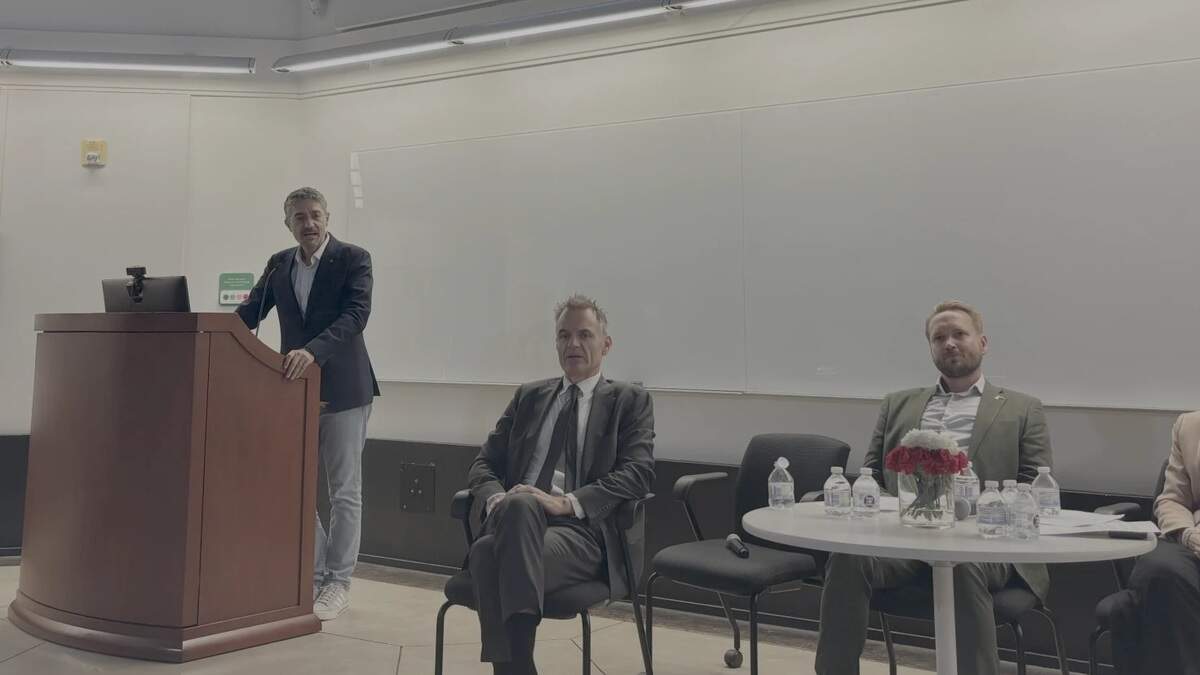
The University of Miami on Friday afternoon hosted the Embassy of Denmark for a panel on waterfront development and urban design. The event aimed to bring together Danish and Miami perspectives on climate adaptation and flood protection.
About 50 people filtered into the Perez Architecture Center for the event, many holding plates of danishes and boxes of Royal Dansk Danish butter cookies laid on tables by the entrance. A mix of students and community members listened to speakers, including Danish Ambassador Jesper Moller Sorensen.
Denmark hopes to foster a closer relationship with Florida, Sorensen said, because the two are strongholds in life sciences and maritime industries. Both, he added, are coastal areas being confronted with urban-development challenges.
“I actually think that we can do a lot more together, Florida and Denmark,” Sorensen said. “That’s essentially why we are here; we are on a little bit of a fact-finding mission.”
Both Florida and Denmark are facing rising sea levels due a warmer global climate, which causes glaciers to melt and seawater to expand. In southeastern Florida, sea levels rose nearly 4 inches from 2000 to 2017, according to one 2019. Meanwhile in Europe, temperatures are increasing at twice the global average rate, leading to more flooding.
READ MORE: Sea levels are rising faster. Here’s what South Florida can expect
Copenhagen, Denmark’s capital city, has implemented a “Cloudburst Management Plan,” which aims to invest $1.3 billion in public-works projects to reduce the effects of flooding. It was implemented in 2012, one year after a devastating storm struck the region.
At the University of Miami, the Rosenstiel School of Marine, Atmospheric, and Earth Science is spearheading sea-rise research and has even offered an undergraduate course devoted to the topic.
During Friday’s panel, Juan Mullerat, the principal of urban planner Plusurbia Design, gave an overview of two waterfront projects that he’s tackling on Watson Island and the shoreline of Virginia Key.
“We have a real love affair with water, but … we also have a lot of challenges because of water,” Mullerat said. “And nothing tells you more how much of a love affair we have with water than by the way that we build.”
About 40% of the world, he pointed out, lives along coasts. But even people who live in inland Miami will see effects from sea rise. Rising waters and flooding, he said, will push people inward, affecting affordability throughout the region.
Read more Danish experts and UM partner to share solutions to tackle rising sea levels
The area, Mullerat said, must adapt to the challenge. On a community level, that could mean creating more open spaces between the waterfront and development, replacing the asphalt that borders places like Virginia Key with mangroves and walking paths.
“It’s not the war against cars,” he said. “It’s the war against waterfronts that are not providing the types of uses that we really, really want to see in a city that prides itself for leading beaches.”
Sea rise could lose Southeast Floridians more than $4.2 billion in property value by 2040, according to a business-focused study conducted in 2020. That would affect jobs and cause drops in sales, property and tourism taxes.
Through 2070, South Florida could see $2 of benefits for every $1 invested in community adaptations, like seawall construction and beach nourishment.
Gardner Berry, a 19-year-old University of Miami architecture freshman, said he has already seen the effects of rising sea levels in the city. He recalled one period of heavy rain when Port Everglades shut down, causing a gas shortage. About one-third of the state’s fuel comes through the port.
His own desire to build a more sustainable future played a large role in his decision to study architecture, particularly at the University of Miami, he said.
“I would struggle to think of another school that is so exposed to these challenges and offers a better place to learn about them,” Berry said.
Another panel attendee, retiree Yeraldine Ordonez, said she felt inspired to attend the talk because of her fond memories of Denmark from a visit in 2018. She fell in love with the country’s infrastructure, she said, and dreams that Miami will one day incorporate similar features.
Ordonez has seen “sunny-day flooding” — temporary coastal flooding caused by high tides, which happens without rain or storms — increase during her time living in South Florida.
“We are developing, but we’re not keeping up with the infrastructure,” she said. “So we’re not doing the water and sewer infrastructure, but we are demanding more of the infrastructure that is already failing us.”
Read more Pat White’s No. 5 jersey retired by West Virginia
This report was produced by Miami Herald news partner WLRN Public Media.








Post Comment