Deception and Bloody Marys: How a Cuban spy in Miami became ‘devoted’ to anti-Castro militant
For decades the Cuban government denounced plots by one of its arch-enemies, the radical anti-Castro militant Luis Posada Carriles, whom both Washington and Havana suspected of masterminding the 1976 bombing of a Cubana Airlines jetliner that killed 73 people and was behind several attempts to assassinate Fidel Castro.
Read more Deception and Bloody Marys: How a Cuban spy in Miami became ‘devoted’ to anti-Castro militant
As it happens, Posada’s caretaker during his last years in Miami — the person who took him to doctor’s appointments and events, the same who had secretly harbored him in Central America for over a year in his own apartment— is a Cuban-American man and Kendall resident whom the U.S. government identified this week as a longtime spy for Cuba. Immigration and Customs Enforcement deported him last month.
Fernando Armando Valdes Perez, 61, “was friends with everyone; he fixed everything,” said Santiago Alvarez, a wealthy Miami developer with a long history of anti-Castro activities who was Posada’s benefactor.
“Fernando was bold, a charismatic guy — built to be liked by everyone; he was almost too perfect,” said Orlando Gonzalez, another close friend of Posada’s and director of Rescate Jurídico, a Hialeah-based organization supporting political prisoners in Cuba.
Valdes was a Cuban intelligence asset tasked with infiltrating Cuban exile organizations since at least the 1990s, according to ICE. The agency said Valdes, who has lived in Kendall for years, was arrested in July at Miami International Airport in a joint operation with U.S. Customs and Border Protection and the FBI. He was deported to Guatemala on Aug. 7 for not disclosing to immigration authorities his ties to Cuban intelligence.
According to Gonzalez, Posada, the Cuban government’s arch-enemy, and Valdes, the spy Cuba sent to keep tabs on him, became inseparable, at first in Central America, then for years in Miami, where Valdes had a home in west Kendall.
“Fernando was his representative, his rock; he took him everywhere, as if he were a nurse. He handled his medications—he was the devoted son,” Gonzalez said. “You had to ask him for an appointment to see Luis.”
Valdes’ deportation, announced earlier this week, put the spotlight again on how close the Cuban government has kept an eye on some of its more notorious opponents in Miami’s Cuban exile community. While living in South Florida, Valdes even donated to the campaigns of Cuban-American politicians known for their strong positions against Cuba’s communist government.
A polarizing figure
Posada was one of the most controversial figures among a group of Cuban exiles who, soon after Castro took power in 1959, opposed him and resorted to violence. He was also a paid CIA informant who reported on his fellow anti-Castro militants.
He was branded as a terrorist by the Cuban government and praised as a hero by some Cuban exiles because he participated in many failed efforts to topple Castro, including the 1961 Bay of Pigs invasion. Cuba and Venezuela both believed he had been behind the 1976 airline bombing and, in Cuba’s case, for a hotel bombing in 1997 that killed an Italian tourist. He escaped in 1985 after spending nine years in a Venezuelan prison while the jetliner case wound through the courts.
All of that made him a top priority target for Cuban intelligence services.
Posada’s associates said they cannot say exactly how his friendship with Valdes began, but the three point to Posada’s stay in a Panama prison after he and three other associates had been arrested, accused of plotting to kill Fidel Castro during a summit in that country in 2000.
Valdes started visiting the imprisoned men in Panama, usually unannounced, and more frequently than Posada’s other close associates – among them Miami anti-Castro activist Ernesto Abreu and Gonzalez, the founder of the group that supports political prisoners. They wondered why someone with no clear past connection to the imprisoned men started visiting them so often and how he could afford the expenses, including the food he was frequently buying to take to the men.
“He showed up, out of the blue, saying he wanted to help. He would show up at the prison and walk around like he owned the place,” said Abreu. Gonzalez said he raised the issue with the men imprisoned, including Posada, but was mostly dismissed.
One time, both Abreu and Gonzalez recalled that Valdes encouraged Posada to escape from prison, stating that he had cut a perimeter fence and could provide a weapon. Another time, he took Gonzalez to an unplanned meeting in El Salvador with men who claimed to be military and were “happy” to provide weapons for his anti-Castro activities, which Gonzalez said he felt was a setup.
‘Sleeping with the enemy’
There were also unexplained coincidences and suspicious behavior, like the night Abreu and others were in a hotel in Central America and Valdes allegedly went out in the wee hours to run. Abreu said he followed him and saw him trying to make a call on a public phone. When confronted, Valdes said he was trying to call his wife. Or the time Gonzalez was in Valdes’ apartment in Guatemala and saw him running on the street, also past midnight. When asked, Valdes said he was just coming from his office and had gone to see if Alvarez had sent him a message.
The next morning, Gonzalez found what he thought was a better explanation: Valdes’ apartment was just two blocks from the Cuban consulate in Guatemala.
When Panamanian President Mireya Moscoso pardoned Posada and released him from prison in August 2004, Gonzalez flew him to Honduras, on a plane chartered by Alvarez. But Alvarez said the group heard the Cuban government had hired paramilitary men to kill Posada, so he had to leave Honduras. He spent more than a year in hiding in Guatemala — hosted by Valdes.
All that time, Posada was living 200 yards away from the Cuban consulate in Guatemala City home of the man the U.S. says was a Cuban spy.
Read more 10 notable stats from No. 7 Miami Hurricanes’ season-opening rout of Stanford
“Sleeping with the enemy, that’s what it was,” Abreu said.
“Fernando was highly skilled at winning Posada over—to the point where Posada didn’t want to part ways with him,” he added. “In Guatemala, he would make him breakfast; at 11:00 a.m. he’d make him a Bloody Mary, and by one in the afternoon, he’d give him his Scotch.”
The Santrina trip
Because of Abreu and Gonzalez’s doubts, Alvarez said he had instructed Abreu not to bring Valdes with Posada from Guatemala to Mexico, where Alvarez was planning to pick him up in a shrimp boat he owned named the Santrina.
“I was getting a boat ready—the Santrina—to bring him over here [to Miami] because his life was in danger,” said Alvarez. “But Luis flatly refused to let Fernando Valdes stay behind in Guatemala; he said that if Valdes didn’t come, he wouldn’t go either. Along the way, Abreu became convinced that he was a state security agent.”
At the time, the purpose of the Santrina’s trip to Mexico remained a mystery. Both Alvarez and Abreu pleaded guilty in 2006 to obstruction of justice for refusing to testify about the trip to an El Paso grand jury investigating Posada’s later illegal entry into the United States.
But Fidel Castro publicly insisted that the mission of the Santrina trip was to ultimately sneak Posada into Florida. In hindsight, it is likely the Cuban leader had first-hand information about Posada’s movements.
Following the news of Valdes’ arrest and deportation, Posada’s friends had many questions, including why Valdes was not charged with espionage or acting as a foreign agent of Cuba and what it took federal investigators so long to act.
Federal prosecutors usually do not use espionage charges to convict foreign agents spying on exile groups, but instead charge them with other crimes like conspiracy or acting as an agent of a foreign government. Such charges, however, are subject to a 5-year statute of limitations. Trials also risk exposing confidential information during court proceedings.
Gonzalez said he told the FBI about his suspicions when he was detained at the airport in Miami on his way back from a trip to El Salvador around 2006. He said the federal investigators asked him about the identity of the Cuban government official he met, which he interpreted as confirmation that Valdes was a Cuban intelligence agent.
‘I could have killed Luis’
Gonzalez, the founder of the Hialeah roup that supports political prisoners, said he alerted his friends about Valdes, though some remained in contact with him. He also said he confronted Valdes during a hospital visit to Posada and told him he had relayed his suspicions to the FBI.
Gonzalez said Valdes told him that if he were really a Cuban spy, “I could have killed Luis — I could have killed you.’
Gonzalez said he responded: “You couldn’t have done anything, because you’re a soldier. You simply follow orders. And you’ve carried out your orders perfectly. You’ve infiltrated every exile entity and organization here. You operate at the level of congressmen; you’re friends with senators—that’s your job. You weren’t sent to kill anyone.’”
Valdes contributed $2,900 to U.S. Rep. Maria Elvira Salazar’s re-election campaign in 2022 and $1,000 in 2024 using a company registered to his name, Sr Valdes Cigars, according to a Federal Election Commission contributions database. He also donated to U.S. Rep. Mario Diaz-Balart’s re-election campaign, $1,000 in 2018 and $2,000 in 2024. Both Cuban-American Republicans from Miami are two of the most vocal critics of the communist government in Havana.
The Miami Herald contacted Valdes by phone and email with no response. The Herald visited Valdes’ quiet neighborhood of single-family homes off Southwest 86th Street in west Kendall on Thursday morning.
Several cars were parked on the red driveway of his $650,000 three-bedroom home and the curtains were shuttered. Above the front door, within a small portico entrance, was a sign that said “Home sweet home.” But no one answered the front door, nor did the neighbors, except for one woman who said she knew nothing about his deportation.
Posada was never convicted of terrorism. He was acquitted of the immigration fraud charges in 2011.
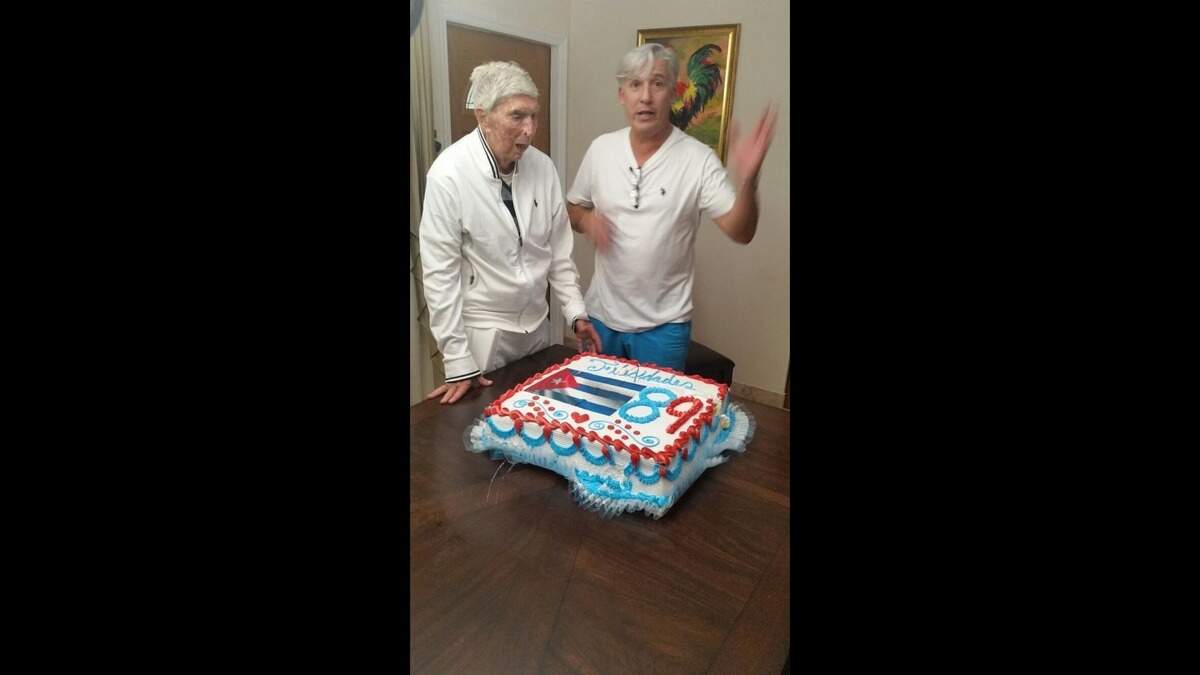
He died in 2018 at age 90 in a hospital in Broward. In a blurred photo from his last birthday party, he is seen in front of a giant cake with the number 89 drawn in blue and red frosting.
Read more Here is the high school football scoreboard for South Florida – Week 3
Only one person stood next to him: Valdes.
Miami Herald staff writer Syra Ortiz-Blanes contributed to this report.
This story was originally published September 5, 2026 at 5:30 AM.





Post Comment