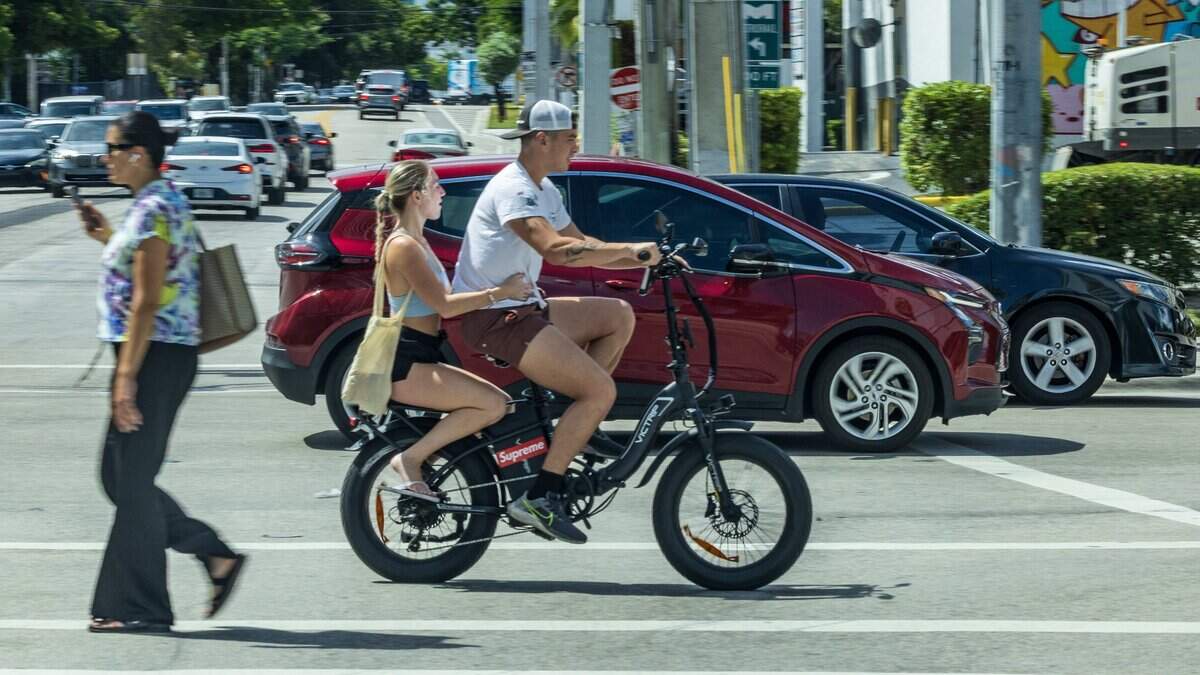
E-bike injuries in South Florida are on the rise — and cities are cracking down
Cody Scott escapes the big city by riding his e-bike in the Everglades. Or sometime he’ll “just cruise around” downtown Miami. The 34-year-old even uses it commute to and from work “if traffic’s super bad.”
Read more Plan to protect Miami-Dade from storms: $4.5 billion to elevate thousands of homes
But about a month ago, Scott was hurt in a hit-and-run while riding his e-bike near his house.
E-bike accidents are on the rise across South Florida, and hospitals are seeing more injuries. And more cities are cracking down on the electric bicycles and scooters.
“People are not wanting to see them in their cities. Which now being here in Miami, I kind of see why,” Scott said
E-bikes are popular among commuters and students. But as more people buy them and hit the road, hospitals are seeing more riders as patients.
Memorial Healthcare System in South Broward has seen a 178% increase in injuries from 2024 to 2025 related to micromobility devices — small vehicles powered by a low-speed electric motor, including e-bikes — “with the trend continuing into 2026.”
Malvina Duncan, a registered nurse and injury prevention coordinator with Nicklaus Children’s Hospital near South Miami, said there’s been a staggering increase in micromobility trauma in recent years.
In 2021, there were six severe injuries in the trauma registry at the children’s hospital related to e-bike and e-scooter accidents. By 2025, 37 were reported, marking an increase of over 500%, said Duncan, who is also the Miami-Dade coordinator for SAFE KIDS, a nonprofit aimed at reducing preventable injuries in children, such as traffic injuries and drownings.
And the trend continues, as the children’s hospital has registered 46 micromobility-related injuries in the first five months of this year.
And it’s not only smaller kids who are at risk. The University of Miami banned all micromobility devices starting in August, aiming for a safer campus, the school said in a notification to students and employees.
The university also mentioned concerns about pedestrian safety, accessibility, emergency access and risks associated with lithium-ion batteries as reasons for the ban.
Following bike laws is important
Cody Scott says he understands why cities are restricting e-bike use after living in Miami “because it’s crazy.”
He says that some e-bike riders “don’t have any sense — they’re riding crazy. They’re riding without helmets. They’re not paying attention to cars or pedestrians. Accidents are happening.”
About four weeks ago, Scott was involved in a crash while riding his e-bike to the grocery store, about a half mile from his house. He fractured his leg, elbow and wrist and severely sprained his ankle.
“The car hit me out of nowhere. I was in the bike lane, doing everything I was supposed to do,” Scott said. “The car swerved, hit me and took off.”
As more cities make rules restricting the use of e-bikes, Scott says that it’s important to “abide by bike laws,” wear a helmet, be aware of speed limits and “stop blowing through lights.”
He said many careless kids on e-bikes, popping wheelies and cruising in the middle of the street, “are ruining it for a lot of people that are actually trying to do the right thing and use them in the proper way respectfully.”
He said parents need to be “instilling guidance into their kids,” and that laws should ban riding for kids under 18.
E-bike injuries
The speed these devices can reach worsens the type of trauma seen in an accident, said Duncan of Nicklaus Children’s Hospital.
“We’re seeing head traumas. We’re seeing facial traumas,” Duncan said. “Obviously broken bones, and internal organ injuries as well. Unlike regular pedal bikes, e-bikes are able to go way faster, so everything is exaggerated.”
In Florida, e-bikes are defined as a bicycle or tricycle with fully operable pedals, a seat or saddle and an electric motor of less than 750 watts.
Different types of e-bikes can go from 20 to 28 mph. According to Leoguar Electric Bikes, a company that sells e-bikes, commuters can go 4 to 10 mph faster on e-bikes than pedal bikes, and when used on hills, 8 to 11 mph faster.
Read more E-bike injuries in South Florida are on the rise — and cities are cracking down
And when two or more people ride a micromobility device designed for a single rider, the injuries can be far worse.
“We’ll get a trauma, and it’ll be two kids coming in, and you would think it was a collision between them, but it’s not,” Duncan said. “It’s that both of them were riding on the same scooter.”
According to the National Highway Traffic Safety Administration, the increased speeds that e-bikes can reach make it “possible for drivers to misjudge the speed of a person on an e-bike.” This can lead to an increase in vehicle collisions with micromobility devices.
The PPM Bike and Walk Alliance, which advocates for safer pedestrian and biker environments, reported that “e-bike riding injuries are three times more likely to involve a crash with a pedestrian,” showing that those just walking around e-bikes are also at risk.
What state law says
Florida law treats e-bikes and pedal bicycles the same. Under state legislation, micromobility devices are not viewed as a motor vehicle, and you don’t need a driver’s license to ride them. They don’t need to be registered, either.
The state says e-bikes are subject to pedal bicycle laws, prohibiting more than one person from riding an e-bike that is designed for a single rider. Florida also requires riders under 16 to wear helmets and says the devices must have lights in the front and rear.
The law leaves room for local governments to make their own e-bike rules on where people can or can’t ride them.
“Florida is quite a bit behind on the legislation for it,” said Julio Blanco, neighborhood resource officer with the Miami Beach Police Department. “Basically, their latest approach is ‘Well, we’re going to let the cities come up with their own regulation.’
“What may be totally prohibited in one city may not be prohibited at all in another,” Blanco said. “And then comes the confusion.”
Said Eugene Rider, the vice president of the Florida Bicycle Association: “Miami-Dade, as a county, doesn’t have one uniform rule book about where and how e-bikes can be operated, and a rider can go across multiple municipality boundaries, and the rules change as you go from one place to another. That makes it difficult for people to understand.”
It’s difficult to accurately report incidents
The National Highway Traffic Safety Administration says that tracking the data around micromobility accidents is difficult because “underreporting may be common.”
“Specifically, incident and crash reporting is seldom specific enough to indicate these bike types, with e-bike crashes often recorded as bicycle crashes, and e-scooters often recorded as pedestrian crashes,” the NHTSA website says. “While understanding related to e-scooter safety is growing, many municipalities are not systematically tracking injuries of people riding e-scooters”
Tanya Bhatt, a Miami Beach city commissioner and member of the Public Safety and Neighborhood Quality of Life Committee, said that “the statistics haven’t even caught up to the incidents.”
“The data doesn’t even begin to cover the actual number of incidents, unless it’s some kind of catastrophic, horrific accident where somebody’s transported to the hospital,” Bhatt said. “It’s something that’s really critically important that we get right, because if we don’t, people die, and we’ve seen that happen.”
Parents have to be aware of e-bike risks
When it comes to parents buying their children e-bikes, education is key.
“I don’t think parents understand how dangerous they are and how their kids are using them,” Bhatt said.
Rider, vice president of the Florida Bicycle Association, recommends if a parent buys their child an e-bike for something like commuting to and from school, they must ride the route themselves, at the time of day their child would, and ask themselves two key questions: Is my child ready for this route, and is this route ready for my child?
“This is not something that was meant to be a toy,” Duncan said. “This was meant to be a micromobility device that’s going to help a person get from here to there.”
What are the city laws in Miami-Dade?
Here is a look at what cities are doing to restrict the use of e-bikes:
Sunny Isles Beach
In July, the Sunny Isles Beach City Commission approved a new ordinance for e-bikes.
- Riders must be 16-years-old or older with a government issued ID
- Riding e-bikes on city sidewalks is banned
- Fines for a first offense are $250. Every subsequent offense has a $500 fine. Citations began on August 16.
Aventura
Aventura passed an ordinance in January.
- Micromobility devices are allowed on streets, bike lanes, sidewalks and shared pathways.
- On sidewalks and paths, there is a 10 mph speed limit, and riders must yield to pedestrians and disengage their electric motor, using only pedal power.
- Riders are not allowed to use their e-bike or e-scooter on Biscayne Boulevard, though, and the fine for doing so is $100.
Pinecrest
- Micromobility devices are limited to a 15 mph speed limit on shared pathways, including Kendall Linear Park, and 10 mph on sidewalks.
- Any rider under age 16 operating a class two e-bike must first complete a free safety training.
- First-offense fines for violations are $250, and repeat offenses are $500.
Doral
Last year, Doral passed it’s e-bike ordinance.
- Riders 15-years-old and older can operate micromobility devices with a valid ID or learner’s permit.
- E-bikes are allowed on streets, sidewalks and bike paths.
- There is a 16 mph speed limit on sidewalks
Bal Harbour
Bal Harbour passed an ordinance in March for e-bikes.
- Micromobility devices are prohibited on the Beach Path, the Jetty and Cut Walk and the 102nd Street Beach Access Path south of Oceana.
- Violations will result in a $50 fine.
Key Biscayne
- The Village of Key Biscayne strictly prohibits all micromobility devices on streets, highways, sidewalks, bicycle paths, multiuse paths and trails, beaches and dunes unless otherwise authorized.
- Initial violations can result in a $250 fine, and subsequent violations can result in a $500 fine and impoundment.
- Crandon Boulevard is treated a bit differently, and class one e-bikes are permitted in the bicycle lanes.
Miami Beach
Miami Beach has enacted local laws governing micromobility use.
- E-bikes, e-scooters and e-skateboards are banned on the Beachwalk, sidewalks, Collins Park, the Promenade, South Pointe Park, the Baywalk and Lincoln Road.
- Blanco, the Miami Beach police officer, says e-bikes are allowed in all green bike lanes, “and even in the green bike lanes, they’re limited to a safe speed of about 8 mph.”
- Blanco notes that the police department has gone to schools throughout the city to educate students on the local laws surrounding micromobility devices, even providing the children with helmets, but he says more oversight is desperately needed at the state level to reduce the large number of e-bike-related injuries South Florida hospitals are seeing.
“We’re also willing to have conversations with the lawmakers to explain,” Blanco said. “That this cannot be kicked further down the road.”
“Before you can drive a jet ski, you have to do a boater safety course,” Blanco said. “It gives somebody some basic rules and guidance as to how to operate a jet ski on the water. We need to do the same thing for micromobility.”
Read more ICE sends second deportation flight to Haiti in a week. There are kids aboard
This story was originally published August 27, 2026 at 1:16 PM.











Post Comment