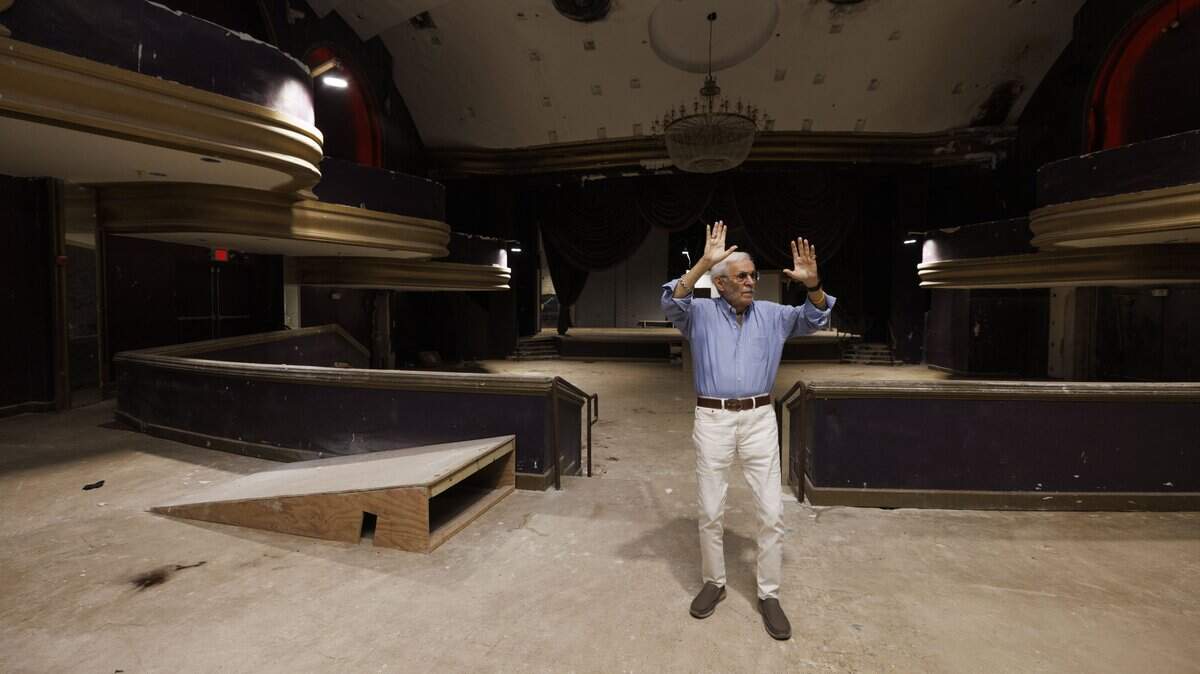
It wasn’t always the Playboy theater. A Miami Beach leader returns, remembers
On the last night of crooner Harry Belafonte’s weeklong run in Miami Beach in 1967, at the height of his fame, the stage crew and hotel general manager played a prank.
Read more This taco spot that started in Miami Beach has closed its Coral Gables location
The theater, designed by a New Yorker with a sense of humor, had a split stage — each side could rise independently.
Grammy winner Belafonte was about to perform, standing at center stage. The crew started to raise one side and Belafonte’s left leg began to elevate. The sold-out crowd gasped, then went silent. Belafonte was one of the biggest stars in show business.
The stagehands finally lowered the elevated side of the stage, ended their mischief, and Belafonte began singing.
The entertainer kept his composure, and then laughed about it all.
“He didn’t blink an eye,” one of the chief pranksters recalled. When Belafonte’s show ended, and he came off the stage, he was laughing.
Miami Beach today may be filled with newcomers, cranes and construction, deals and demolitions. But there’s still a connection to the past.
Stuart Blumberg remembers. He lived it.
A one-time Playboy building enters the real estate market
The news that the old theater is for sale brought back a lifetime of memories for Blumberg, an 89-year-old Miami Beach High grad who rose from bellboy to become a prominent leader for decades in the region’s hospitality industry. He doesn’t want people to forget what this city was like.
The former Playboy Theater was once part of the Playboy Plaza Hotel, now the Castle Beach at 5445 Collins Ave.
The venue was a popular spot for live entertainment in the 1970s and beyond. The video of Gloria Estefan’s 2011 hit “Hotel Nacional” was shot there. The theater boasts about 26,000 square feet across three levels. The Castle was converted to private condos in the 1990s, but the theater is independently owned.
Yet Blumberg said that before the venue became the Playboy Theater, it had another life.
He should know: He was the hotel’s first general manager. That hotel began as the Hilton Plaza and opened in 1967.
“The theater was called The Great Room designed by our entertainment director, Jackie Gleason,” he said.
Yes, that Jackie Gleason.
Gleason was one of the world’s top comedians and entertainers from the 1950s through the 1970s. He played Minnesota Fats in the 1961 film “The Hustler” starring Paul Newman, starred as Ralph Kramden in “The Honeymooners,” the 1950s television series, and hosted a weekly variety show from the Miami Beach Auditorium.
He remembered lines without rehearsing and even produced and sang. His nickname? The Great One.
Blumberg was a star in his own right, for decades, one of the most prominent names in the South Florida hotel and tourism business. He founded the Greater Miami and the Beaches Hotel Association and led it for 20 years. He started the Greater Miami Convention and Visitors Bureau and helped build the Adrienne Arsht Center for the Performing Arts.
Blumberg recently agreed to head over to the old theater and share his memories of the place.
A nostalgic Miami Beach visit
On a weekday morning, Blumberg drove by himself to the former theater from North Bay Village, where he lives with his wife, Marlene.
When he arrived in the place that meant so much to him, no one at the hotel recognized him, neither employees nor guests. Kids and families ran around the lobby. Some children lay on the floor. The carpet was ragged. The hotel long ago was converted into condos, losing any exclusiveness or elegance it once had.
Blumberg maintained a stoic face but was experiencing a range of emotions. He was initially a bit depressed to see the lobby’s deterioration. Still, he was glad to be back.
“A lot of memories,” he said wistfully.
He revealed that he hadn’t been back in 55 years. “I never walked back in until today,” he said.
Blumberg walked around, then cut through the lobby. He pointed to where Jackie Gleason had an office, designed for him, and to where the fine dining area was, adjacent to the theater.
Neither Gleason’s office nor the dining room remain, but each evokes an era not seen since. A revolving stage with Freddy Martin’s orchestra had regaled guests. Every day featured music and dancing. That, too, is long gone.
A lot of memories.
Stuart Blumberg,
Former manager
Each server wore a tuxedo. Female guests donned elegant dresses while men wore ties and jackets. Those were the bare minimum requirements to get in. This was an era long before people paraded through hotels in flip-flops, yoga pants and workout bras.
Gleason often showed up at the hotel unannounced, and he’d go to his office, Blumberg recalled. Then, “he’d take me and go into the dining room, pick up a lady and start dancing with her,” said the former general manager. “They’d go gaga over him.”
“This was the place to be,” surrounded by the era’s top celebrities, Blumberg said.
Long before anyone knew who Blumberg was, he was enjoying a brush with the stars and living his best life.
“I thought I’d died and went to heaven,” he said. “This place was paradise.”
Elegant Miami Beach
The Hilton Plaza Hotel, opened in December 1967 and would be the last hotel in Miami Beach built from the ground up until the Loews made its debut 31 years later.
During that era, South Florida hotels had fancy, elegant nightclubs. The Hilton Plaza competed with the Fontainebleau just down the street and the Diplomat in Hollywood for the top entertainers of the day.
Frank Sinatra, Tiny Tim and the Smothers Brothers were regulars at the Fontainebleau. The Supremes, Diana Ross and Eddie Fisher performed at the nearby Eden Roc. The Beatles’ second TV appearance in the U.S., on the Ed Sullivan Show, was taped at the Deauville. Next door, the Carillon put on elaborate shows, posting a sign to enter the lobby: “Jackets and ties required after 7 p.m.”
As this golden era was forming on the Beach, a young Blumberg worked at another hotel in downtown Miami. But a personality conflict with the boss made him start looking for other jobs. He’d regularly drive past the new hotel under construction on his way to work.
One day on his way home, he dropped off his resume. Within a few months and before 1967 ended, he was hired as the Hilton Plaza’s first general manager. He was 30 years old.
As young as he was, Blumberg had some experience in hotels. He broke in as a bellhop in 1956 at the Americana in Bal Harbour, the Tisch family’s first hotel in the Miami area.
“That’s where I got my real training,” he said.
He was friends with Bob Tisch until his death in 2005, and son Jonathan Tisch, who said last year he’ll be retiring.
“You live long enough and everything comes full circle,” Blumberg said, laughing.
Jackie Gleason died in 1987 at his home in Lauderhill at 71. His acerbic wit helped make “The Jackie Gleason Show” a television hit from the mid-1950s through 1974. By the time the Hilton Plaza opened, he had already moved to South Florida. He continued his weekly TV show from Miami Beach in what is now The Fillmore, near Lincoln Road.
Then he was brought in to help design the Hilton Plaza’s nightclub and theater, initially named The Great Room, an ode to Gleason’s nickname. His influence is seen on several elements even today.
He helped build the first physical stage for performers. He designed it like a theater and studio at the same time, Blumberg said during his recent visit.
The split stage was Gleason’s idea. The comedian was also in charge of booking entertainers, directly or through his agency at the time, the influential William Morris.
He handpicked Harry Belafonte to be the first act, Blumberg said.
The entertainer and civil rights activist who served in the U.S. Navy during World War II had popularized Calypso in the U.S.
“The women of that time went nuts for him,” recalled Blumberg.
He did the customary two shows a night, 9 p.m. and midnight. The last night was when Belafonte unexpectedly found himself on stage with his left leg elevated.
“We decided to have some fun with him,” said Blumberg.
That was just the beginning of the fun. Jack Benny, Connie Francis and Woody Allen also came to town.
“Every major star played these rooms,” said Blumberg.
By 1967, Benny was already a legend. He didn’t need to, but committed to two shows a night for a week. But after his first performance on his first day the comedian told Blumberg, “I’m not going to do a second show.” It had become too tiring for him. Singer Vikki Carr took over for the midnight show.
Then he did something stunning for that time, in Blumberg’s view. He said “take half of my money back.” That gesture made a strong impression on the young hotel general manager.
“He was such a wonderful man,” Blumberg said, and the two became friends. The general manager visited him in California in later years.
Inside the theater
To enter the theater, Blumberg walked past a long, draped hallway and many cobwebs.
He entered what’s now the back half of the theater. That part was new to him. Moving his head in half-circles, he said “there was nothing here” back in the early days.
The original Great Room, the theater and nightclub, could seat about 600 he recalled. The space he was now visiting could seat at least two to three times that.
Read more A look at the rare IMAX projector behind record ticket sales for ‘The Odyssey’
But he could recognize some things. His hands pointed to the arches high above. Box seats were still there as was the balcony, which Gleason had built. The walls still showed evidence of the original blue velvet. Blumberg loved touching that while visiting.
The stage curtains were a different color and the split stage was no longer there.
Blumberg’s memory was holding up better than some parts of the theater were.
But his memories weren’t always warm. Young Stu Blumberg’s job wasn’t always fun or funny.
‘I want to kill the MF’
Singer Connie Francis got booked at The Great Room at the height of her career. She arrived with a list of 20 typed demands. Many were easy to meet, like hot tea at the piano. Singers didn’t want their voices to get hoarse over the long night or week.
She also asked that the air conditioning in the hall be turned off when she performed. But that was trickier in South Florida.
“I’ve got 600 people in the audience. I can’t do that,” Blumberg remembered telling her.
She responded: “If you don’t turn off the air, I’m not going on.”
The young general manager’s solution? They shut off the air before Francis got on stage. But once she started singing, they turned it back on. By then, it was too late for her to complain. She couldn’t stop singing.
After completing the first show, Francis came offstage furious. “I want to kill the MF” who turned on the AC, Blumberg vividly remembers her saying. Her manager hurled his hands onto Blumberg’s chest. But the hotel general manager kept telling them, “I have a job to do.”
He did the same thing all seven nights she performed, drawing her anger each night.
“We didn’t have a friendly relationship,” he said of the star, who moved to Parkland in Broward County and died last year.
Still, Blumberg also got to pick up actor Cary Grant. He booked a limo and driver and rode out to the Fort Lauderdale airport, onto the tarmac and right up to Grant’s private plane. And they hit it off.
“He was bigger than life,” said Blumberg, and they talked about their families and kids.
Woody Allen also performed at The Great Room in its first year. In the 1960s, before his famous filmmaker days, he was a leading stand-up comedian.
While in town, Allen spent all day holed up in his hotel suite writing scripts for future films. But between the two shows, “he used to go into the fine dining room and I used to sit with him,” recalled Blumberg.
Every night, Allen ordered the same thing: stone crabs, tomato juice and cheesecake. But he never touched the cheesecake.
Finally, after seven nights, the general manager worked up the nerve to say, “Woody, can I ask you a question? Why haven’t you touched the cheesecake?” Allen slammed his hand into the cheesecake while yelling, “I thought you’d never ask me!”
Blumberg said, “His humor went over people’s heads.”
What’s the future of The Great Room?
Looking at the former Great Room today, it’s uncertain what the future holds. During his visit, Blumberg was trying to make sense of whether it had one.
Its most vivid life may be long gone, but should it be preserved — the rich history and the nostalgia?
Visiting the place is one thing. But what next?
Blumberg said his visit was in part “a reality check.” It made him realize “I have outlived everybody from that time.”
He also deeply misses what he and the city once had.
“Miami Beach was the place that every major entertainer had to play,” said Blumberg.
Could that be resurrected after the theater is sold?
Some original elements of The Great Room, like the balcony, remain. The lights are still there. The stage got larger. But a lot of work would be needed to bring it back to the glory years.
Still, The Great Room as Blumberg knew it is gone.
“That room will never be the same again. It will have no history to it,” he said. “Going into that space made me realize you can’t go back again.”
Blumberg and preservation
One might imagine that a man nearing 90 and who was a prominent leader in hospitality has grappled with the issue of historic preservation. That was evident during and after the visit as he sought to reconcile his nostalgia with his more nuanced and pragmatic views.
When he was head of the hotel group, Blumberg opposed historical preservation on Lincoln Road to 23rd Street because he felt the Miami Beach Convention Center needed hotels next door to take off.
He says today, “I lost [that fight] but I’ve proven to be right.” That’s because a new Grand Hyatt is rising adjacent to the convention center and is scheduled to open in 2027. The center has lost a lot of business each year due to not having a connected hotel, tourism experts have said.
Then there’s the perpetual debate over The Fillmore Miami Beach at the Jackie Gleason Theater, the performing arts venue. While it remains there, Blumberg has previously supported letting it come down due to its deteriorating condition. He promised to keep Gleason’s name alive. The venue is where “The Jackie Gleason Show” was taped in the 1960s. In 2022, the city allocated $29 million in bonds to renovate it. It continues to hold weekly events.
So, what about The Great Room?
Despite the lifetime of memories he produced, Gleason only stayed with the Hilton Plaza Hotel for one year. Then, in 1970, Playboy bought the building. Then it became a Hyatt House hotel.
In 1974, a Miami Beach hotelier named Harold Konover bought it and reamed it the Konover. In 1987, months before he died, Konover sold it to New York developer Abraham Hirschfeld, who renamed the building Castle Premier. Hischfeld preserved the theater but renamed it Hirschfeld Theater, for Broadway caricaturist Al Hirschfeld. The venue hosted productions of “Phantom of the Opera,” “Evita“ and “42nd Street.”
The entire building was later renamed the Castle Hotel. In 2021, New York City-based Top Rock Holding, a real estate firm, acquired the theater and has owned it since.
The theater remains on the market for about $6.5 million, said Daniel Shimhayiv, vice president of the company. That’s down from the original price of $8 million when it first listed in 2025.
The day Blumberg visited, he tried to encourage the sellers while being realistic.
He suggested a couple of names to the real estate broker. He asked about different ways the space could be used.
“Can you operate a business on it?” he inquired, meaning independent of the condo units in the building.
Yes, was the answer.
Happy to hear that, Blumberg then rolled off some ideas. A community theater, art school, a studio for young artists, or art gallery. He asked if the stage goes all the way to the back wall.
Told yes, he enthusiastically replied, “You’ve doubled the space!” He showed where the original one Gleason built had ended.
Blumberg asked if you could enter this space from the main lobby and got a positive answer. He was happy to hear that. “That’d make it ideal for an art gallery,” he said, or a studio to record music videos.
The former general manager would be among the first to say the old theater needed a major infusion of money and a lot of work to raise the curtain again.
With all the new money flowing into South Florida real estate, can the theater attract a buyer and recapture the magic?
Even with the star power of Jackie Gleason, the theater got lucky in its first year.
Blumberg and Gleason had booked a duo, Dan Rowan and Dick Martin, to do 10 shows, one week’s worth, in March 1968. The performers signed contracts one year earlier when few had heard of them.
Meanwhile, unknown to Blumberg or Gleason, the two debuted a pilot show on television in September 1967. ” It immediately caught fire and by 1968, the weekly “Laugh-In” was a huge hit, launching the fame of Goldie Hawn and Lily Tomlin. And Rowan and Martin became famous, too.
Yet, when it came to The Great Room, the two kept their word. They honored their contact, and in March 1968 did 10 shows.
“The place was packed,” recounted Blumberg. “They were the big rage at the time.”
The Great Room was the only venue that could land the duo, recalled the former general manager.
“Nobody else could get near them,” recalled Blumberg with pride, referring to the many other clubs and hotels trying to book them. He still has a lot of pride.
Read more ICE deports Venezuelan official accused of torture. He lived in South Florida
“We were fortunate.”
This story was originally published August 27, 2026 at 5:00 AM.











Post Comment