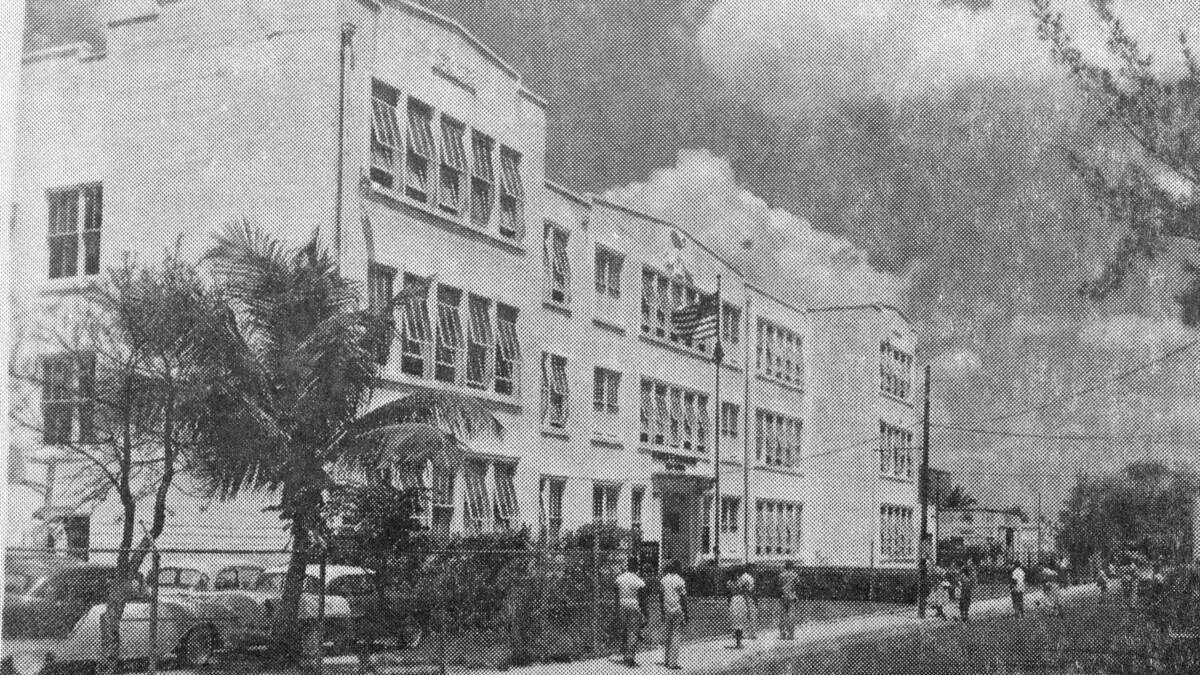
Booker T. Washington Senior High is turning 100. I couldn’t be prouder | Opinion
The other day I attended a planning meeting for Booker T. Washington High School’s centennial celebration.
Read more City orders Miami condo to ‘cease immediately’ all illegal vacation rentals
Attending the meeting were members of the school’s alumni association, led by president Roberta Daniels. We met with principal Anthony Simon III, who wants to make Booker T.’s 100th birthday the biggest Overtown celebration since the first students marched into the school in February 1927. (The festivities will be in February.)
I graduated from Booker T. Washington Junior/Senior High School, now known as Booker T. Washington Senior High, in 1956. While the school’s founding date is 1926, students didn’t start attending classes until February 1927 due to the Great Miami Hurricane of 1926, which hit in September, damaging the newly built school at 1200 NW Sixth Ave.
To me, and every other graduate of BTW (as we fondly referred to the school), our relationship with her is personal, a love story.
My love affair with BTW started when I was in the third grade, attending Frederick Douglass Primary School. Third-graders, back then, got out of school at 3 p.m., just like the “big” kids attending BTW several blocks north of Douglass. I remember slowing my walk after school so I could fall in step with the big kids coming down the street from BTW.
Momma knew how much I dreamed of attending the school. My dream came true when I entered the seventh grade in 1950, along with many of my elementary school friends. I am a proud BTW graduate. My graduation day was June 9, 1956, 70 years ago this year. Four years later, in 1960, Miami historian Dorothy J. Fields graduated.
Booker T. Washington Junior/Senior High School was more than just a school to the Coloreds (as we were called back then). It was, as a line from the school song says, “…our source of inspiration.” It was a community treasure, the center of Overtown, known then by whites as Colored Town or the Central Negro District.
The school provided not only a beautiful venue for our graduations, but thanks to a progressive principal named Charles L. Williams, who was educated in the arts in addition to education, the school served as a community theater. We saw live shows like “Carmen Jones,” just like New York’s Broadway.
The school was also a concert hall and a convention center where Colored church denominations met when they came to the Magic City and where all-night gospel sing-alongs were held.
The school served the community in other ways, too. During the 1940s, weekly voter registration rallies were held in the auditorium. Coloreds from throughout the county gathered to hear speakers who told them of the importance of their vote. In an era of segregation and racial discord, the school was a safe place for Coloreds and whites to engage in interracial discussions.
And from its classrooms, leaders from every profession would emerge. The school that almost didn’t happen — more on that later — became the pride of the community. So much so, it was dubbed Booker T. Washington University.
Booker T. Washington Junior/Senior High school was founded in 1926, during the height of the Jim Crow era. The dream of having a bona fide high school for Coloreds in Miami was finally coming true. No longer would families have to send their high-school age children to relatives who lived out of state just to obtain a diploma. The highest education level a Black student could attain in Miami in the roaring 1920s was the eighth grade.
So, imagine the excitement when the word got out that Miami would, indeed, have its own Colored high school. While whites saw the school as a threat, Colored folks saw it as something that would benefit their children and their children’s children.
Read more One of few remaining green spaces in Brickell could disappear. What’s planned?
Explosion at school during Jim Crow era
But there was trouble on the horizon. As the three-story school building was being constructed at Northwest Sixth Avenue and 12th Street, just blocks away from white businesses, including the Regal Beer Brewery, some whites thought the cream-colored, three-storied building was not only too good for Coloreds, but too close to white neighborhoods.
Sometime during the early-morning hours of June 25, 1926, as workers gathered, an explosion occurred, demolishing the school’s newly erected walls and injuring eight people. The next day, the Miami News published a story about the alleged “dynamiting” of the school, which the newspaper erroneously referred to as the George Washington School for Coloreds.
The Colored community came together and organized “watches” around the clock, so the school building could be completed. But it was also hurricane season in Miami. The school was nearly completed when the fierce winds of the Great Miami Hurricane of 1926, a Category 4 storm, almost demolished the structure. The marching-in date was moved from September 1926 to February 1927, almost 31 years after Miami became a city in 1896.
Over the decades, the school, named after the founding principal and first president of what would become Tuskegee University, weathered many changes. The construction of Interstate 95 in the ‘60s ripped Overtown apart, scattering Black pioneer families and businesses.
Still, students sang: “…Washington’s walls are fairer than the skies. Her spirit blooms in every sort of clim…”
In 1967, as Black schools and Black teachers took on the brunt of school desegregation, BTW became a middle school.
The school that had produced many of South Florida’s Black professionals, including Joe Lang Kershaw, class of 1930 and Florida’s first Black legislator since Reconstruction; M. Athalie Range, the first Black woman to hold a Miami commission seat and a 1934 graduate; and Garth C. Reeves Sr., class of 1936 and publisher of The Miami Times, was no longer dubbed Booker T. Washington University. It was relegated to being a middle school. Worse yet, there were rumors the school was slated to be closed for good.
In 1981, the “Ole Washington spirit” was cranked up with the Save Booker T. rally, drawing the support of BTW alumni from across the country who fought for the school to reopen as a high school with the same name. In 1999, the new school opened. The first graduation was in 2002; I was there.
“Booker T. Washington Senior High school is a stalwart institution of teaching and learning for past and present academic excellence,” said Daniels, the alumni association president. “For nearly a century, it continues to embrace a lifelong commitment to improving the quality of education and life for its students as well as society. And, today, it is still a beacon of light and hope.”
More about the centennial celebration
The centennial celebration will kick off Feb. 6, the first Saturday in February. The event will include a parade with marching bands, floats and drill teams, said Daniels, the alumni association president. The weekend will also include a Centennial Gala and an Alumni Weekend that will include a church service and a Centennial Journal.
To place an ad in the journal or to place a message honoring former graduates in the journal, contact Daniels at 305-450-2812 or Ralph Williams at 305-926-6195.
Read more Fort Lauderdale dredging project paused after damage to endangered corals





Post Comment