Voting begins for Miami Marine Stadium, even-year elections. What to know
Voters across the state will be casting ballots in the August primary election for major races, from U.S. Senate to Florida governor. But residents in the city of Miami will also be deciding on two ballot referendums that seek to switch the city to an even-year election cycle and to approve an operator for Miami Marine Stadium.
Read more Parents sue, claim wrong-way detectors on Florida’s Turnpike missed son’s killer
Early voting runs Aug. 3-16. Early voters can go to in Miami-Dade County. Due to its limited capacity, Miami City Hall will not be used as an early voting site for this election.
To receive a vote-by-mail ballot, voters must request one no later than 5 p.m. on Aug. 6.
Election Day is Aug. 18. Voters casting ballots on Election Day must go to their assigned precinct.
Here’s what to know about the two referendums appearing on the August primary ballot for city of Miami voters.
Referendum 1: Even-year elections
Miami voters experienced whiplash last year when, in a matter of weeks, the November 2025 election was postponed to November 2026 — and then rescheduled back to 2025.
Last summer, the City Commission passed an ordinance that switched the city from odd- to even-year elections, postponing the November 2025 election to 2026 and giving the elected officials at the time an extra year in office — even those who were term-limited.
The ordinance was promptly challenged. The courts found that changing the election date requires voter approval.
So now, more than a year later, and after hitting several snags along the way, the election-date change proposal has finally landed on the ballot, labeled Miami Referendum 1.
“My biggest fear was that it would never make it to voters,” Commissioner Damian Pardo, who has championed the proposal, told the Miami Herald.
If the referendum passes, Miami will join the vast majority of Miami-Dade cities that hold elections in even years. Voters in Coral Gables recently approved the same change.
When the Miami commission approved the unlawful ordinance last summer, the change went into effect immediately.
But the version posed to voters this year would take much longer — with the city’s first even-year election happening in 2034.
Here’s a breakdown of how the charter amendment would work:
- The next elections for mayor and city commissioner would take place as currently scheduled: in 2027 for Districts 1, 2 and 4; and 2029 for mayor and Districts 3 and 5. The winners of those races would be elected to a typical four-year term.
- The following election cycle would occur four years later, as usual: in 2031 for Districts 1, 2 and 4; and 2033 for mayor and Districts 3 and 5.
- The winners of the 2031 and 2033 races would be elected to one-time three-year terms. Those shortened terms would count as full terms as it relates to term limits.
- As a result of the one-time three-year terms, the city would sync up with the even-year election cycle for those seats in 2034 and 2036, respectively.
- From that point forward, elections would take place in even years, and terms would resume being four years each.
Proponents of even-year elections have argued that syncing up with the national election cycle will decrease election costs while boosting voter participation, since many people are disengaged during odd years or unaware that elections are taking place at all. The city’s voter turnout for the 2025 election, for example, was about 22%.
Read more We will lose so much when our Haitian nurses, chefs, artists won’t be here | Opinion
Opponents, on the other hand, say even-year elections make it more difficult for grassroots candidates to break through the noise of presidential and gubernatorial elections, giving incumbents even more of an advantage. In even-year elections, opponents say, candidates in local races are buried at the bottom of a crowded ballot.
Whether Miami voters agree with Pardo — and the extent to which last year’s legal debacle left a sour taste in their mouths — will be determined Aug. 18.
Referendum 2: Miami Marine Stadium
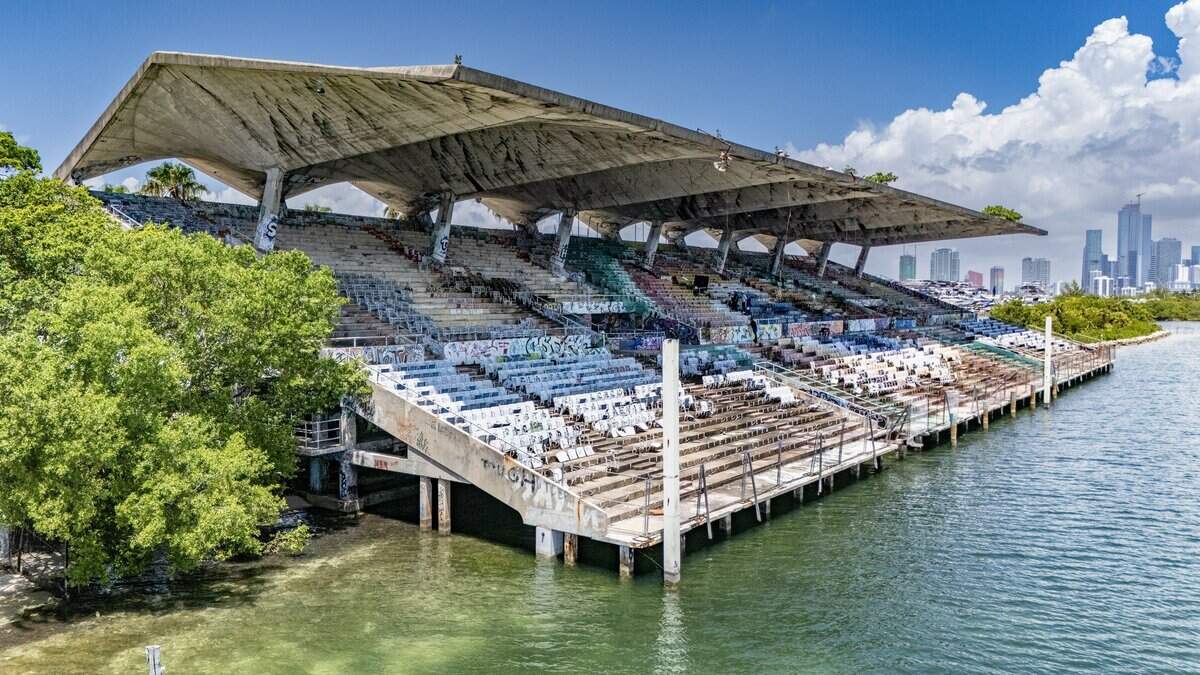
For more than 30 years, an architecturally renowned stadium on the water that hosted music icons like Jimmy Buffett and Ray Charles has sat abandoned and been left to deteriorate.
But the city of Miami has found a management partner that it believes can help revive the historic Miami Marine Stadium, making it into a world-class destination that will attract visitors from around the globe.
Before it can move forward, however, the city needs permission from voters. Miami Referendum 2 is asking Miami residents to allow the city to enter into a management agreement with Global Spectrum, a subsidiary of Oak View Group, one of the country’s largest operators of sports and entertainment venues.
“I think the stadium will be as symbolic to Miami as the Sydney Opera House is to Sydney, Australia, or the Golden Gate Bridge is to San Francisco,” Don Worth, co-founder of Restore Miami Marine Stadium, told the Herald. “ … In my mind, it’s the trifecta: The architecture gives it the ‘wow.’ The history gives it its soul; it’s got a rich history. The visceral experience you get when you walk in there — that’s what knocks everybody out.”
The proposal involves building a long-promised flex park, operated by Oak View Group, that would convert the stadium’s vast parking lot into a water-oriented public recreational facility that could also be used for special events.
“So while they’re putting together more concrete plans for operating the stadium itself, they will run the flex park,” Worth said.
The referendum stipulates that Oak View Group would pay the city a total capital investment of up to $10 million for restoration of the stadium. The operator would get a $400,000 annual base fee, as well as incentive fees equal to 7% of gross revenues and food and beverage sales, and 15% of revenue from sponsorships and premium seating, according to the underlying city legislation.
Worth said the total restoration cost has not yet been determined but that there are several non-city funding sources available to pay for the restoration, including the sale of historic tax credits, as well as naming rights.
“There are significant revenue streams in this,” Worth said.
Pardo, who sponsored the legislation to send the Marine Stadium development to the ballot, told the Herald that a few years down the road, the city can look at issuing a revenue bond to cover the restoration costs.
Under the proposed agreement, Oak View Group would receive a 10-year management contract, with three options for renewal. The city would receive a large cut of revenue from events and sponsorships while paying Oak View Group a monthly management fee.
Read more Broward food company recalls powder after a customer’s medical issue
The referendum includes the following financial terms:
- City receives 93% of gross sales of all events after deducting a $33,333 monthly management fee
- City receives 85% of sponsorship revenues
- Up to a 40-year term
- Global Spectrum to pay the city up to $10,000,000 toward the restoration of Historic Marine Stadium









Post Comment