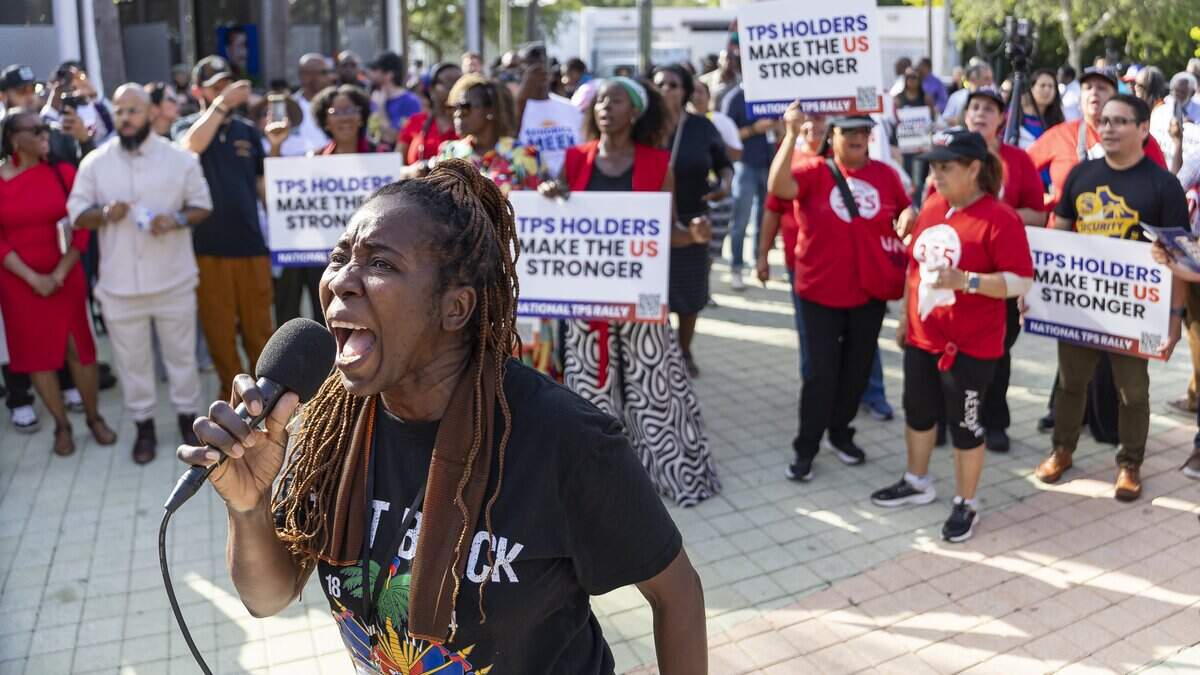
‘I’m just so lost:’ Haitians face impossible choices as TPS nears the end
One is entering her final year of college and hopes to attend medical school to become a cardiothoracic surgeon. The other was preparing to begin a registered-nursing program after working for the past year as a licensed practical nurse.
Read more Secret Service agent charged in UM frat hazing case. Here’s what to know
Both are Haitian. Both have been living in the United States under Temporary Protected Status. And both now see the futures they had envisioned slipping from their grasp.
As the federal humanitarian program nears its end, hundreds of thousands of Haitians who had been shielded from deportations because of their homeland’s turmoil are confronting impossible choices: return voluntarily to a country gripped by gang violence, kidnappings, a collapsed health system and widespread hunger, or remain in the U.S. and risk detention and deportation.
For friends Viki and Sandy, who asked to be identified only by their nicknames because of their vulnerable immigration status, there is no easy answer.
“I’ve been in a constant state of ‘I don’t know,’ ” said Sandy, 21, who lives in Miami. “This is very stressful.”
Awaiting judge’s order
Since the U.S. Supreme Court cleared the way in June for the Trump administration to terminate Haiti’s TPS designation after 16 years, many Haitians have been living in a state of uncertainty.
The anxiety has intensified as employers remove Haitian workers from schedules or terminate them amid the shifting announcements about when the protections, driver’s licenses and work authorizations will expire.
“Until the court gives a date, we don’t yet have a date,” Guerline Jozef, the executive director of the Haitian Bridge Alliance, said referring to U.S. District Court Judge Ana C. Reyes in Washington, D.C. Reyes has issued a stay on the termination of TPS, originally scheduled by the Trump administration to end on July 1, then July 10 and then on July 24, until a federal appeals court in Washington, D.C. ruled last week that nothing could happen before Monday.
While work permits expired, according to one of the lawyers in the original lawsuit, Judge Reyes has not signaled when she will lift the stay. “We know that the court system will have to adhere to the Supreme Court, but we don’t know when that will take effect,” Jozef said.
In February Reyes blocked the administration from revoking TPS for more than 300,000 Haitians, finding it likely that the administration’s decision was motivated by “hostility to nonwhite immigrants.” After an appeal court upheld her decision, the administration asked the Supreme Court to weigh in. The high court’s conservative majority allowed the administration to proceed, ruling that, the way Congress wrote the law, judges do not have the power to review the Homeland Security secretary’s decision on ending TPS.
In their suit in Washington before Reyes, the Haitian plaintiffs argued that the Department of Homeland Security had failed to consult with the State Department on conditions in Haiti before taking its decision, and that the decision was based on President Donald Trump’s racial and national animus toward Haitians. The Supreme Court said the Haitians were likely to lose their discrimination claim. Even so, lawyers said their case continues seeking a permanent order against the end of TPS based on race discrimination.
While the justices left the door open to constitutional challenges to the decision to end TPS, their majority decision has upended the lives of thousands who have spent years building families, careers and businesses in the U.S.
Arrived days apart
Viki and Sandy were still in high school when they arrived in Florida three days apart after the July 7, 2021, assassination of Haitian President Jovenel Moïse. At first, it was supposed to be a short summer visit with family in the U.S. But it became permanent after an earthquake struck Haiti and gangs tightened their grip on major roads, neighborhoods and hospitals amid a political vacuum.
The girls enrolled in public schools – Sandy in Miami-Dade County, and Viki in Orlando. They learned English, graduated and received scholarships to attend community college.
“Right now, the only thing I’ve put in my mind is I have to finish school,” said Sandy, who earned an associate’s degree in biology. “Even if I have to take a gap year, or two gap years for medical school, I have to finish this fourth year.”
As she mapped out her fall semester, she found herself wondering: “What am I going to do if I can’t leave my house?”
She ultimately scheduled her classes to only two days a week in hopes of limiting her exposure on the street to immigration agents.
Surge in deportations
The Trump administration has warned Haiti that once TPS ends, it plans to increase deportation flights to two planeloads a week carrying about 250 Haitians. Over the weekend, Haitian communities around the U.S. reported an increased presence of Immigration and Customs Enforcement agents, said Jozef, who was fielding calls as late as Sunday evening.
“We’re hearing from people across the country,” she said. “People are afraid. They are confused. They are traumatized because there are no clear guidelines.”
Sandy, who has seen the posts about immigration arrests and detentions on social media said she’s scared ICE will arrest her.
Read more ‘Crazy.’ County officials who brokered PortMiami fuel deal shocked mayor nixed it
“It’s one of the things that terrifies me the most,” she said.
‘It’s very hard’
Viki, 20, was supposed to start her registered-nursing program on July 6.
“A week before that,” she said, “they told us your TPS is done.”
Hoping something would change, she waited. When nothing happened, she called her private university on July 1 and withdrew from the accelerated program that would have allowed her to become a registered nurse in as little as 16 months.
“I told them I wasn’t going to be able to start,” Viki said.
She had already made two installment payments on her tuition payments. After deducting a nonrefundable registration fee, the school refunded her $2,962, she said.
“I was set to start,” said Viki, who was working as a home health aide. “I did all I needed to do. I took the test and passed the test with flying colors to enter that school and then the same week I am supposed to start is the same week they also told me ‘you’ve lost your job.’ ”
Because her work permit is tied to her TPS status, her employer stopped assigning her shifts caring for ventilator-dependent patients, including children.
“When we first got the news that TPS was ending, they started looking for nurses to cover the shifts I was supposed to do,” Viki said.
The changing dates over when TPS for Haitians will terminate has left employers and employees uncertain over when work authorizations actually end. Some companies issued terminations soon after the Supreme Court ruling. Others, like Viki’s employers, have been taking a day-by-day approach.
“I basically lost two weeks of work,” she said. “It’s very hard.”
Immigration issues
The mothers of both women are also in the U.S. with TPS. Each family had pending family petitions to receive green cards that got mired in delays, missed deadlines, poor legal advice and, in the case of Viki, she said abuse from the relative who sponsored her mother.
Sandy said her family relied on someone who wasn’t a lawyer to help them with the petition filed by her U.S. citizen stepdad in 2019 on behalf of her mom.
“That person that was helping us didn’t really do their job right, and they did not really explain everything to us,” said Sandy, who has a 17-year-old sister who is also on TPS. “Right now we do have a lawyer. Hopefully we will be able to do something.”
Viki said she is trying to see if she can get a green card under the Violence Against Women Act. The federal law allows individuals who have suffered abuse from close relatives of U.S. citizens and lawful permanent residents to file for status on their own.
Viki, who takes anxiety medication, said the uncertainty over TPS has been weighing on for more than a year.
“Last year I found myself crying every month,” she said. “This year, I’m just so lost. It’s kind of like you just give up. The only thing I had the strength to do was find a lawyer.”
Two weeks ago, she and her family met with a lawyer, and she is hoping the abuse her mom endured will be enough for her to finally get her green card.
“They told us that based on the story, they will analyze it and see if we’re eligible for it,” she said.
Jozef and other advocates say while they have not given up on litigation, they are urging Haitians “to prepare for the worst.”
Regardless of the date when TPS protections finally end, families should gather important documents, identified trusted caregivers and seek advice from reputable attorneys and organizations, she said.
Sandy and Viki, who are hoping their immigration attorneys can help, say the lack of clarity over when they will lose their benefits is beyond stressful. They worry about themselves and their mothers.
“She’s very stressed,” Viki said of her mom, a former journalist in Haiti. “If she actually loses her job, she’s not gonna be able to pay for her apartment anymore. … I just feel lost, scared because I don’t know what the future holds for me.”
Sandy, whose mother depends on public transportation to get to her job as a cashier and a certified nursing assistant, also doesn’t know what she and her family will do.
Read more Miami condo turned into party central by Airbnb takeover. Here’s what to know
“This is very stressful,” she said. “Am I gonna be able to go to work tomorrow?”








Post Comment