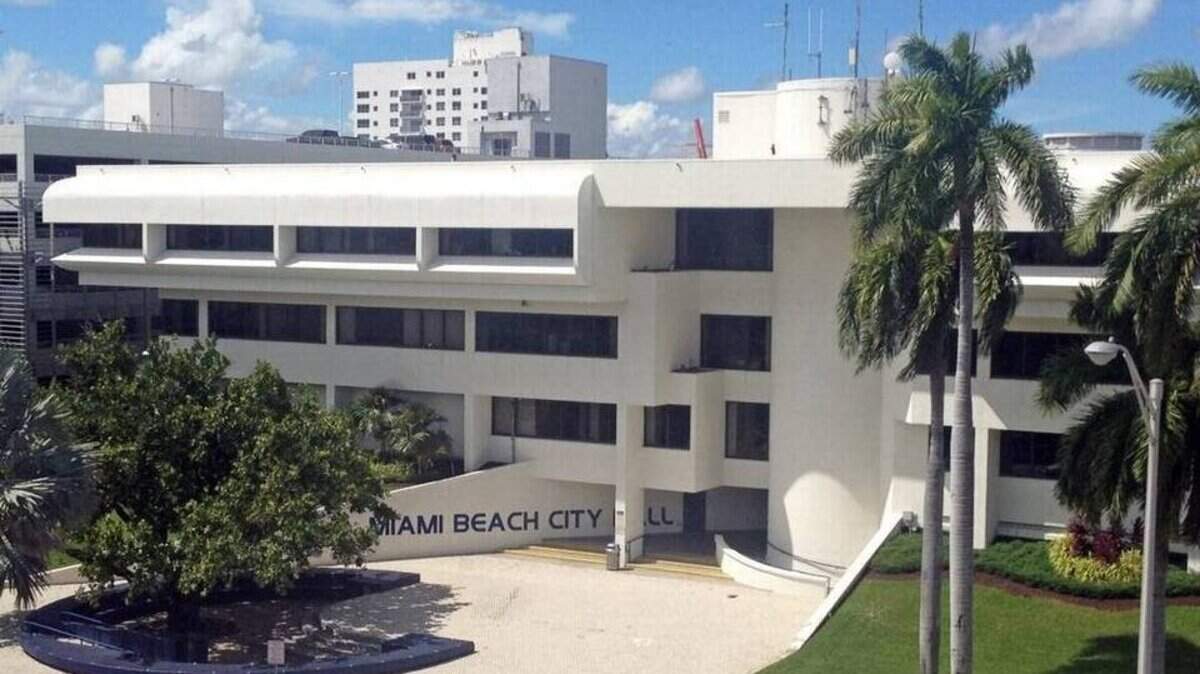
How will Miami Beach pay to fix flooding, old pipes? Higher water bills are coming
Miami Beach officials approved a plan Wednesday to fund hundreds of millions of dollars in “mission-critical” infrastructure projects — but declined to fund hundreds of millions more.
Read more Free school lunches to end for thousands of Miami-Dade students. Here’s what to know
City leaders have been talking for more than a year about how to address enormous infrastructure needs — including to replace old pipes and prevent neighborhoods from flooding in the face of sea-level rise — while also trying to limit cost increases for residents.
At Wednesday’s City Commission meeting, elected officials spent hours debating whether to raise water and sewer rates, place a general obligation bond in front of voters in November, or pursue a combination of the two.
Ultimately, they voted to fund approximately $450 million in projects by increasing water and sewer rates for residents but declined to put a general obligation bond on the ballot. The rate increases will need two more votes later this year to take effect.
Commissioners called on the city administration to cut — at least for now — another $340 million in projects that are deemed to be less urgent.
The administration had not yet determined Wednesday which initiatives would be removed from the city’s plans. Public Works Director John Norris said he would aim to cut projects that are lower on a ranked list of priorities, meaning they aren’t scheduled to begin until as late as 2035.
Commissioner Joseph Magazine, who proposed the approach, said it would allow the city to move forward with “mission-critical” projects over the next five years, then revisit other projects down the road.
“We can cross that bridge when we get closer to it,” Magazine said. “We send a message to our residents that we are really only doing the things that are more mission-critical.”
Mayor Steven Meiner agreed.
“We are funding the projects that we want to get done in the next four, five, six years,” Meiner said.
To raise the $450 million, city officials said the typical single-family homeowner using 5,000 gallons of water per month would see their combined monthly water and sewer bill go from about $106 currently to about $113 this year, and increase annually until reaching $150 in 2031.
READ MORE: Can Miami Beach fix pipes and stop flooding without raising costs for residents?
Read more Unsafe croquetas and empanadas plus dirty equipment cited at a Vecky Bakery
Other options rejected
The vote Wednesday was 5-2 to approve the rate increases, with Commissioners Laura Dominguez and David Suarez opposed. Five votes were required to lift a moratorium on water and sewer rate hikes that the commission had passed in May amid backlash from residents concerned about the rising cost of living in Miami Beach.
Before that vote on Wednesday, the commission rejected multiple proposals that would have put general obligation bonds on the ballot, meaning the city would have sought resident approval to borrow money by issuing bonds and paid them off over time by raising property taxes.
A vote on whether to hold a referendum on a $789 million general obligation bond to cover all the city’s infrastructure needs failed, 5-2, with Suarez and Commissioner Alex Fernandez in favor. Miami Beach voters previously approved $159 million in G.O. bonds for arts and culture projects in 2022 and $439 million in G.O. bonds for public safety, infrastructure and parks projects in 2018.
Suarez advocated for the G.O. bond approach, noting that the money would have been raised through property taxes that place a greater share of the burden on wealthier homeowners than lower-income residents. Water and sewer bills, on the other hand, are assessed at a flat rate based on usage.
Earlier Wednesday, commissioners also voted down a hybrid option, 4-3, to put a $340 million G.O. bond for stormwater projects on the ballot and raise an additional $450 million through water and sewer rate hikes. Dominguez and Commissioners Tanya Katzoff Bhatt and Monica Matteo-Salinas voted in favor of that option.
Miami Beach is pursuing major anti-flooding projects in neighborhoods around the city, some of which have faced significant delays or been put on hold. Projects along the First Street corridor and in North Beach are next on the list, while a multiphased project in the West Avenue neighborhood has been ongoing for almost a decade.
Norris, the public works director, and other city officials have previously warned about the risks of delaying critical infrastructure projects, saying the city should advance them and ensure that massive infrastructure failures, like the catastrophic sewage spills in Fort Lauderdale in 2020, are avoided.
“I am not comfortable deferring this any longer,” Katzoff Bhatt said at Wednesday’s meeting.
Magazine made the case that, realistically, some of the projects in the city’s current capital improvement plan won’t break ground for many years — and, therefore, don’t need funding right now.
“That is the best way to save money for our residents,” Magazine said.
The rate increases aren’t official yet; they require formal approval from the City Commission in the form of an ordinance. An initial vote is expected in September, followed by a final vote in October.
Read more Billionaire CEO spends $36M on Palm Beach County estate: ‘Manalapan is booming’








Post Comment