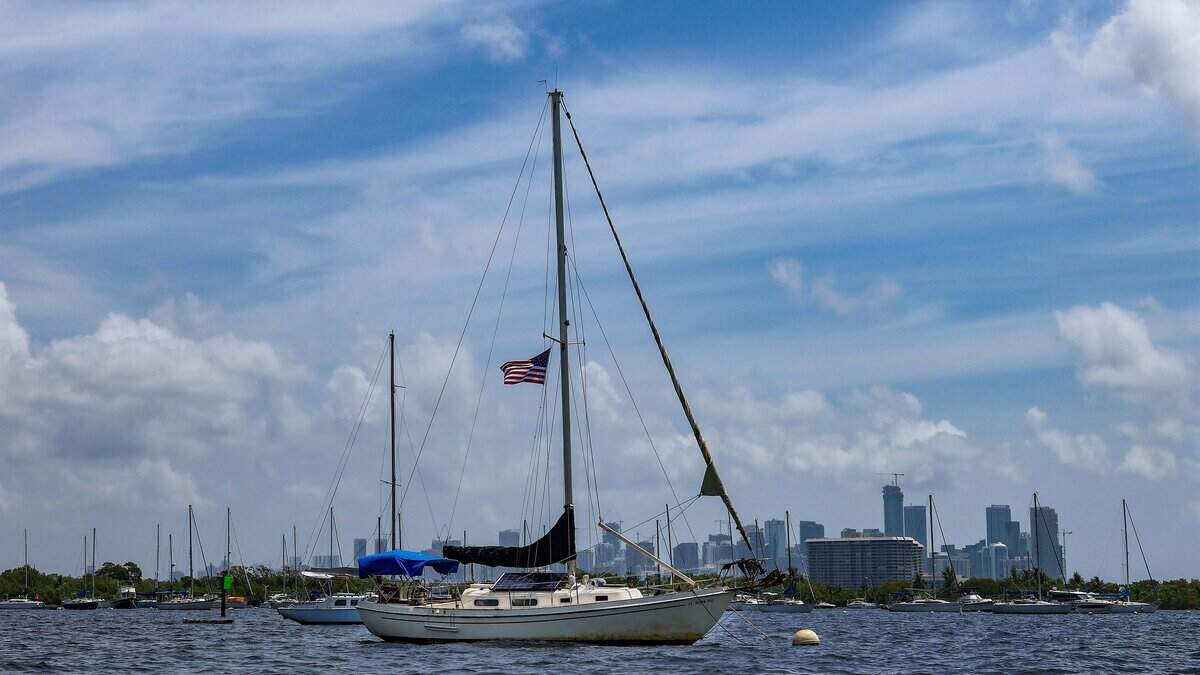
The clock is ticking for Miami-Dade liveaboards as anchoring crackdown advances
The clock is ticking for Miami-Dade’s liveaboard community as county leaders consider new restrictions that could limit how long people can keep their boats anchored in one place.
Read more Miami Herald, media partners to host forum with candidates for District 24
The county’s Recreation, Tourism and Resiliency Committee voted Tuesday to advance legislation that would limit how long boats can remain anchored in one location, while raising concerns about its impact on people who live aboard their vessels.
The measure, sponsored by County Commissioner Vicki Lopez, would prohibit vessels from anchoring in the same location for more than 30 days within a six-month period unless they are in a designated mooring field or participating in permitted marine construction or maintenance activities.
By a 3-1 vote, county commissioners who serve on the committee advanced the legislation to be heard by the full 13-member Board of County Commissioners in October but asked the county administration to bring more information on how many people live aboard boats and whether enough marina and mooring spaces exist. Some were concerned the proposal could leave residents homeless.
“You have my pledge to work with the administration and the city of Miami to find out exactly the number of people who are living on the water who never move their vessel,” said Lopez. “This is not about derelict boats. We have a derelict statute, and we have a derelict ordinance. This is about people that choose to live on the water and never move.”
Lopez said the proposal is intended to address environmental and navigational concerns caused by long-term anchoring while encouraging boaters to use marinas and managed mooring fields. Boaters who violate the ordinance would face a $500 fine for a first offense, with penalties increasing for repeat violations to as much as $2,500.
The measure would bring Miami-Dade County in line with a 2025 Florida law allowing large counties and municipalities to enforce a 30-day overnight anchoring limit. Similar restrictions have already been adopted by Miami Beach, Miami Beach and the city of Fort Pierce.
Lopez says a countywide approach would create a more consistent system for boaters and enforcement agencies rather than requiring residents to follow different rules across different areas.
“All it does is align it with state statute,” she said.
Supporters of the ordinance argued that long-term anchoring has contributed to damage in Biscayne Bay, including harm to seagrass beds, dumping of waste, and increased risks from abandoned or damaged boats.
John Ricisak, who works for the Miami-Dade Department of Environmental Resources Management, or DERM, said enforcing environmental violations on anchored vessels can be challenging because many problems, including illegal sewage discharges, occur when officials are not present.
“A lot of this stuff occurs at night, during which time we do not have people on the water, and it’s not observable,” said Ricisak. “So in terms of things like sewage disposal, in particular, it is very easy to circumvent the regulations.”
But Commissioner Raquel Regalado — who strongly opposed the measure and was the sole dissenting vote — said environmental concerns should be addressed directly rather than through a broad anchoring restriction.
“If someone is pumping sewage into the water — if someone is leaking oil — that is all actionable,” said Regalado. “This does not address that. This is a different thing. This is about excluding liveaboards. Full stop.”
Regalado, who represents portions of Coral Gables, Key Biscayne and South Miami, also asked in the meeting if her district could be exempted from the ordinance.
Read more Take a look at this new private undersea habitat in the Florida Keys
“My district doesn’t want this. They don’t agree with it,” she said. “We are literally in my district waiting 20, 25 years to dock a boat. This is a way of life in Coconut Grove. It really is.”
Commissioner Roberto Gonzalez said he wanted more information before supporting a measure that could significantly affect boat residents.
“I just need more information,” Gonzalez said. “I just philosophically disagree that we should turn our full force of the county’s weight against individuals who are living on board. … I just feel like I’m standing in a courtroom arguing a case without any evidence to support my case.”
Liveaboard boaters and marine business owners who attended the meeting argued that the county lacks enough available slips and mooring spaces to accommodate people who would need them if the rule passed.
Danielle Chandler told commissioners she had kept her 60-foot sailboat at the same dock for more than a decade before the property was sold in May and the new owners stopped renting wet slips. She said she has struggled to find another location because her vessel is too large for some facilities, including the Dinner Key mooring field, while many marinas are full.
“If this rule passes, in a matter of weeks, I will have gone from a decade of having a secure dock to having no lawful options to remain in this county at all,” Chandler said.
David Furer said the proposal could also affect his wind-powered ecotourism business, Sail Ahead Miami, which operates small sailboats that take visitors through Biscayne Bay while removing trash from the water.
He said his 18-foot sailboats are too small to qualify for marina slips under current requirements, leaving anchoring as the only practical option for his business.
“My business has a negative carbon footprint,” said Furer. “Now I wake up to the fact that you guys want to, with this law, drive me out of what I do and kill an important part of my livelihood and something very unique.”
Many public marinas currently have limited availability. Pelican Harbor Marina and Regatta Harbour reported no wet slips available, while Crandon Park Marina’s wait list extends several years, depending on vessel size. Matheson Hammock Marina has hundreds of applicants waiting for popular slips, with some applications dating back more than a decade. Herbert Hoover Marina expects only a small number of wet slips to become available soon.
Managed mooring fields are also tight on availability, and they have capacity limits and vessel-size restrictions.
The proposed anchoring restrictions will be heard by the County Commission on Oct. 20.
Read more Miami-Dade public schools top financial officer to leave for Barry University











Post Comment