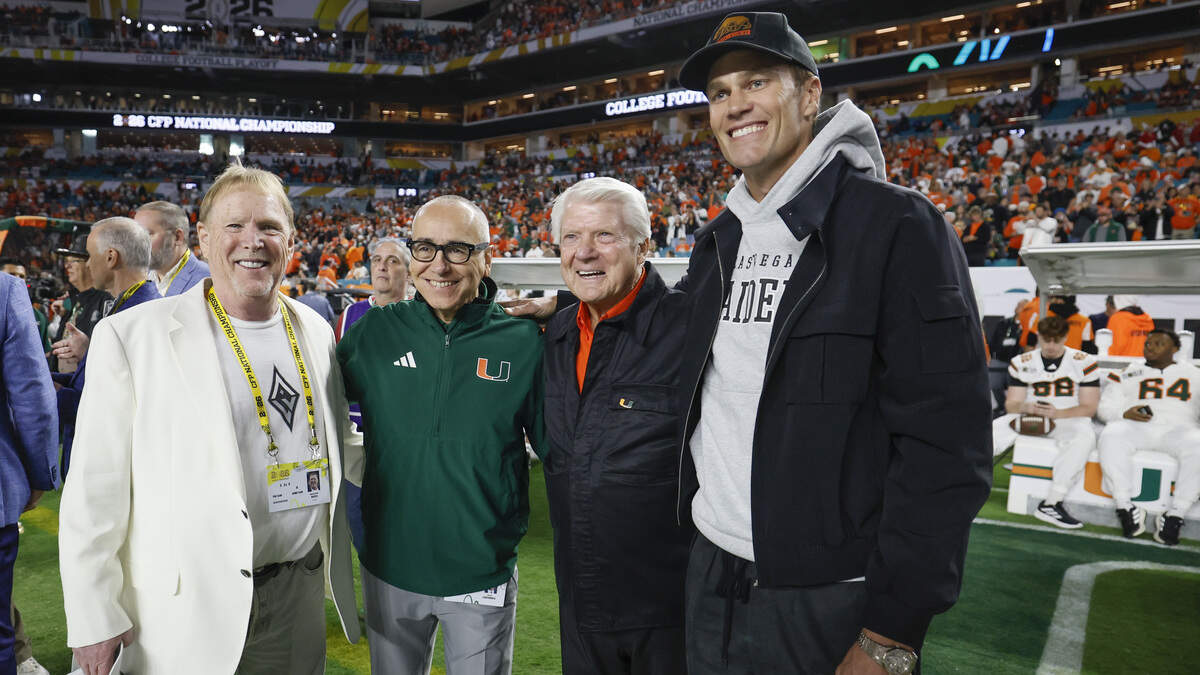
Could Hurricanes break away from ACC? Miami’s president doesn’t rule it out
University of Miami president Joe Echevarria understands where the Atlantic Coast Conference stands in the grand scheme of college athletics. The Southeastern Conference and Big Ten are running things, especially in the moneymaker of college football. Everyone else, even fellow Power 4 conferences in the ACC and Big 12, are essentially just along for the ride.
Read more Six things becoming clear about the Dolphins’ defensive personnel at the bye
It’s why he might have an uncomfortable move to make in the not-so-distant future in order to do what’s in the Hurricanes’ best interests moving forward.
“We are proud members of the ACC. If the economics were even, we wouldn’t be having any of these conversations,” Echevarria said in an interview with Yahoo Sports. “Thing is, we sit in the second tier. It’s a reason we don’t get a vote on the 24-team playoff and the Big Ten and SEC do.”
Does that mean Echevarria and the University of Miami are willing to jump ship from the ACC to better position Miami for the long-term if push came to shove? It sounds like Echevarria isn’t against it, even with the hurdles that might come with it.
Evidence of this came earlier this month, when Tomahawk Nation reported that four ACC schools — Miami, Florida State, North Carolina and Clemson — sent a letter to House of Representatives speaker Mike Johnson asking for two changes one provision of the Protect College Sports Act, a bill working its way through Congress that would have massive ramifications on college sports.
The changes: Expand the conference membership cap it hopes to place from 20 teams to 22 and remove the requirement that a team has to operate as an independent for three years before joining a new conference.
The ACC’s current media rights deal runs through 2036. Schools who choose to leave the ACC before that have to pay a hefty exit fee. That fee is currently $147 million if a team exits this academic year. That number drops slightly each year until it eventually goes down to $75 million after the 2029-30 academic year through the end of the media rights deal — an agreement that came following a legal settlement between the conference, FSU and Clemson in the summer of 2025 after the two schools filed a lawsuit regarding the conference’s grant of rights.
Echevarria wants Miami, which reached the College Football Playoff National Championship Game last season, is No. 1 in the latest AP poll and enters Saturday’s game against Pittsburgh a perfect 6-0 (4-0 in ACC play), to be as best positioned for continued success as possible.
“You cannot lock us into a conference,” he said to Yahoo, adding “the fact is that we won about every game you could win last year and maxed out in revenue in our current [ACC] sharing model. And we made the same amount of money as other institutions [in the Big Ten and SEC] whose football programs operate at different levels of investment and performance.”
If needed, would UM survive a three-season run as an independent? The Hurricanes functioned as an independent from its football team’s inception in 1936 until it joined the Big East in 1991 and then eventually the ACC in 2004. Miami won three of its five national championships as an independent (1983, 1987, 1989).
Read more Gavin Newsom’s ‘rocking chair test’: Will he commute California’s 500+ death sentences?
But times are different now. Top teams are spending tens of millions of dollars to put together football rosters alone in the name, image and likeness era. Money from conference media rights deals plays a significant part in a team’s budget.
Both the Big Ten and SEC averaged payouts more than $70 million last year to each of their member schools in media revenue. The ACC distributed between $38 million and $46 million to each of its schools, while the Big 12 distributed between $38 million and $42 million to each of its schools.
Yahoo reported that media entities like Amazon have been explored as possible TV partners by schools considering going independent.
The Hurricanes, meanwhile, will get an internal boost next season no matter what with the start of their new apparel deal with Nike, which is set to pay Miami slightly more than $20 million annually (up from the $6.5 million they’re currently getting from Adidas).
While in the ACC or as an independent, the Hurricanes will also reap the benefits of long playoff runs. While the Big Ten, Big 12 and SEC split payouts for team representation in the College Football Playoff across all of its league members, the ACC passes all the payout directly to the school(s) participating. Miami, as a result, kept all $20 million it received for getting to the title game ($4 million each for the making the field and getting to the quarterfinal, $6 million each for advancing to the semifinals and the title game) plus $3 million per round for operations and travel.
Independents, like Notre Dame, get the payouts directly as well but making the field would likely be tougher since scheduling restrictions could play a factor. Every power conference requires teams to play nine league games, limiting the options for out-of-conference scheduling.
“If we have to go independent, I like our chances because we are a national brand,” Echevarria said. “I wouldn’t like to do that because scheduling [other sports] is really tough. It’s great for football but what about track, volleyball and the golf team?”
As for which of the two big conferences Echevarria sees being the best fit for Miami should the situation present itself?
“As an AAU [Association of American Universities] research institution, we line up with the Big Ten’s profile,” Echevarria said. “We have an exceptionally strong profile that compares favorably with leading research institutions across the country. On the geography idea, we line up better with the SEC.”
Read more Birdwatcher dies of injuries suffered during attack at boat ramp, NC sheriff says









Post Comment