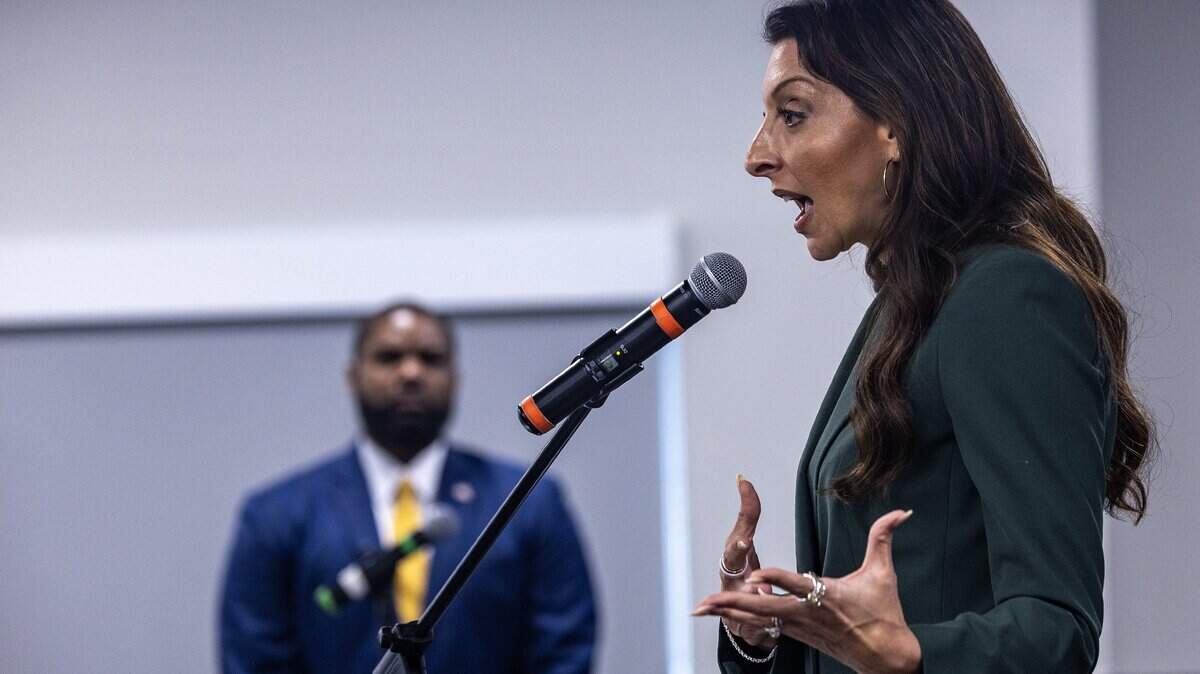
How Byron and Erika Donalds’ wealth hinges on millions in state education dollars
Five state-funded charter schools have paid more than $30 million over the last four years to two private companies run by Erika Donalds, whose husband is Florida’s Republican candidate for governor, according to a Herald/Times analysis of tax filings and state audits.
Read more Cuba-born woman loses U.S. citizenship over multimillion-dollar Miami casino fraud
Now, one of those companies is set to receive its largest payout yet. Her virtual reality curriculum company OptimaEd LLC is on track to charge the online school Optima Classical Academy $15.7 million in service fees for the 2026 and 2027 school year, show.
Once the taxpayer money lands in the coffers of Donalds’ businesses, how it’s used and how much executives are paid is not publicly reported. But Byron Donalds’ federal financial disclosures show that the majority of the couple’s collective wealth comes from his wife’s companies — and the public dollars they rely on.
If he wins, for the first time, Florida could have a leader whose family wealth is tied to the flow of taxpayer funds to the private charter school management industry. That means, as governor, decisions he makes about public education funding could have a direct impact on his family’s bottom line.
Under Florida law, charter schools can only be operated by nonprofit organizations or public entities, not by for-profit companies. But they can contract with private companies, like the ones Erika Donalds runs.
In the case of OptimaEd, all of the taxpayer money the nonprofit running Optima Classical Academy receives — including $9.7 million from the governor-approved state budget, $4 million in local property taxes and $2 million from a Collier County school funding referendum — goes straight to Donalds’ for-profit company.
Critics say these kinds of comprehensive management contracts are a regulatory loophole circumventing the public oversight of taxpayer funds, but Florida has shown little interest in requiring more transparency from these private companies.
“Having people connected to or in positions of power to regulate these things who are benefiting from them not being regulated, in my view, is problematic,” said Bruce Baker, an education professor at the University of Miami.
Erika Donalds has promised that as governor, her husband will pave the way for an “economy of education” where “profit is not going to be a bad word.”
Her own profit from running private charter school management companies is not publicly reported. The roughly $30 million paid out already, and expected $16 million this school year, represents overall revenue to Erika Donalds’ organizations — not her personal profit margins.
But Byron Donalds’ federal financial disclosures reveal that the largest share of their collective wealth is thanks to her companies’ growth.
He valued his personal assets between $141,000 and $805,000 in 2020, and at $510,000 or less ever since, according to those reports, in which lawmakers report their assets in ranges. Meanwhile, Erika Donalds’ assets expanded their net worth significantly — growing alongside her companies’ contracts with taxpayer-funded charter schools.
Their total reported wealth peaked somewhere between $2.1 million and $11 million in 2023, when companies she owned had management contracts with five publicly funded charter schools across Florida, according to federal financial disclosures.
Ethics questions abound
Ethics experts who spoke to the Herald/Times said the Donalds’ reliance on state per-student funding — approved by the Legislature as part of its budget process, which requires the governor’s signature — could present an ethical conflict for the congressman should he win election on Nov. 3.
“I could see political controversy after controversy arising from this situation because, for Erika, it appears to be her lifelong ambition to promote charter schools and Byron Donalds will be subject to a conflict of interest code,” said Craig Holman, a governmental ethics lobbyist for the consumer watchdog group Public Citizen.
Florida’s ethics code only applies to the governor and not their spouse (something Holman thinks should change), but it could still require Donalds to recuse himself from certain executive actions related to charter schools.
Byron Donalds’ gubernatorial campaign declined to make Erika Donalds available for an interview, but they provided lengthy statements from both the candidate and his spouse.
Byron Donalds said that, as governor, he will follow all applicable ethics laws.
“If elected, I will follow legal guidance and comply with all ethics requirements, including recusal,” he said. “My decisions will prioritize the law and Floridians’ best interests, with an education agenda focused on academic excellence and expanding opportunities.”
Miami attorney Brian Tannebaum, who specializes in ethics cases, said recusal for a singular executive like the governor is not always a clear-cut solution. And the public perception of where the line is around personal profit from political office has changed drastically under the administration of Donald Trump, who’s grown his own wealth by the billions during his second term in office, he said.
To avoid the appearance of impropriety when governing public education dollars, “should he say, ‘I’ve spoken to my wife, she doesn’t want any of this money?’ I mean, sure, in a perfect world, those are the things that should happen,” Tannebaum said. “But I just think more and more people are willing to look the other way even when it’s clear that there’s an issue.”
Erika Donalds said she has no plans to slow down any of her businesses if her husband wins statewide office. She noted that her companies are paid by the charter schools through management contracts, so it’s not the state of Florida directly writing checks to her companies.
Read more Five massacres later, Haiti is still waiting for justice for Kenscoff victims | Opinion
“I plan to continue my business and foundation leadership roles. My businesses do not contract with the State of Florida, and that will not change if Byron is elected governor,” she said. “Families need more educational options, and I intend to keep building, helping schools succeed, and expanding opportunities for students.”
Baker, the charter school expert at UM, said the Donalds are far from the biggest profiteers from the flow of public education dollars to private companies — but having a state governor so closely tied to that industry is likely unprecedented.
“I don’t know if any governor in particular has the same kind of personal wealth accumulated in that one space over which they then would have regulatory authority,” he said.
A shared vision for education
At times on the campaign trail, Byron Donalds’ pitch for the future of education has struck a different chord than that of his wife. While she runs a virtual reality curriculum company, his campaign promises to “bring back real books in the classroom instead of parking young kids in front of screens all day.”
But where both of their messages have been consistent is in their advocacy for more educational options for parents, and the continued expansion of Florida’s programs to send public education dollars to private companies to educate students.
Erika Donalds was a Collier County School Board member earning $38,000 from the state, and $160,000 as an accountant for a New York-based investment firm, when Byron Donalds entered the state Legislature in 2016, according to her state financial disclosures.
In 2019, she founded the nonprofit Optima Foundation, which received $8 million for management services from Florida charter schools between 2020 and 2024. Most of those years the nonprofit did not report paying Donalds a salary for her role as CEO, according to nonprofit filings. Only in 2021 did she earn $183,000, tax filings show.
By the time her husband entered Congress in 2021, she was becoming a national advocate for expanding the use of taxpayer funds beyond traditional public schools.
From 2021 through 2023, according to his financial disclosures, she was a salaried employee for a company called Educator Solutions that provides payroll and management services for charter schools. While she worked at that company, Educator Solutions received $14 million from the handful of charter schools that have also contracted with Donalds’ own companies.
By 2023, she was running her own two private charter school management companies: Optima Management Services and OptimaEd. The value of her stake in those two companies was somewhere between $2 million and $10 million that year, according to the congressman’s financial disclosure reports.
Byron Donalds contested that the reported value of his wife’s companies is a direct measure of the family’s wealth: “Erika built her own career, and her businesses’ reported ownership values shouldn’t be confused with personal income,” he said.
But the value of their collective assets that he reported to Congress shows that the majority of their wealth is tied to her charter school management companies. Her company’s relationships with some of those schools have shrunk over time, while the online school has expanded its payouts.
In mid-2023, two Jacksonville schools switched to a different “management team with appropriate experience, knowledge and skill to operate the School effectively and efficiently,” according to two of the schools’ annual that also blamed Donalds’ foundation for past auditing problems. Those two schools had paid Optima Management Services and OptimaEd $2.6 million between 2022 and 2023, according to their tax filings.
Another school, Naples Classical Academy, has been shrinking the management fees it pays to Optima Management Services from 12% of its revenue in 2024 to 1% this year as it “transitions to self-management,” state audit show. The school paid Donalds’ two companies $9.1 million between 2022 and 2025, their tax filings show.
Erika Donalds disputed the allegation that her nonprofit had mismanaged an audit at the Jacksonville schools and said the other schools’ partnerships with her foundation were always meant to be temporary.
A fourth school, Treasure Coast Classical Academy, cut ties with her nonprofit foundation and is suing the nonprofit over alleged breach of contract. The case is ongoing. That school had one contract with her private companies amounting to about $223,000.
Meanwhile, a fifth school has rapidly expanded its payouts to another one of Donalds’ education companies in recent years. The fully online school Optima Classical Academy paid Donalds’ virtual reality curriculum company OptimaEd LLC $10 million in service fees last year, and is planning to pay the company more than $15 million this school year, its budgets show.
If he wins office, Donalds said he plans to draw a clear distinction between his wife and himself as she continues to pursue expanding those businesses — even as they rely on contracts granting them taxpayer money.
“Erika is a successful entrepreneur with deep experience in education policy and school operations. I value her perspective, which she has earned through her own work,” he said. “There is only one governor.”
Read more Cuba-born woman loses U.S. citizenship over multimillion-dollar Miami casino fraud
This story was originally published October 22, 2026 at 5:15 AM.







Post Comment