Sprint Football, a Little-Known Version of America’s Favorite Sport, Is ‘Real Football.’ Just Smaller.
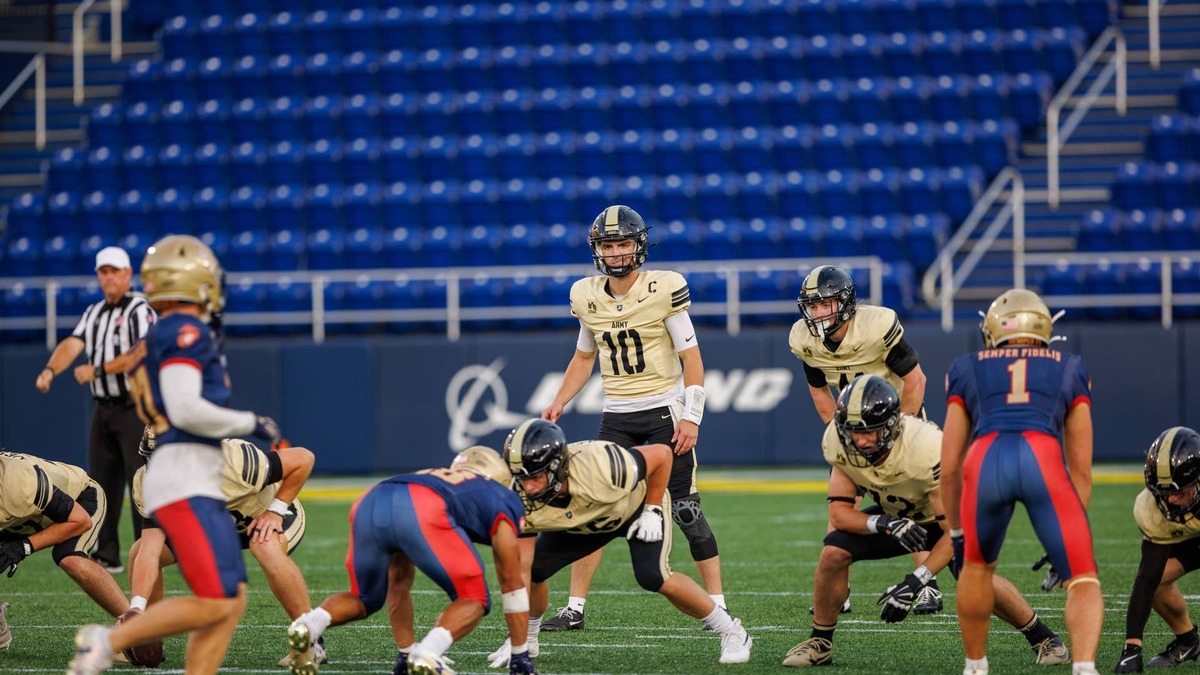
The game had the feel of Friday night lights. Fans filed into a sparsely populated stadium as the sun set on a September evening graced with ideal football-watching weather. Admittance was free. Alumni were in attendance. Family and friends scanned for jersey numbers and pointed out who they were there to support, waving to no avail.
Read more BC bids for first road win of season in encounter vs. Georgia Tech
The players warming up on the field are, well, slight. A hardened scout might not think many of them had a future in college football were it not for the fact that they were already playing college football. Technically. They are in college. And they are most certainly playing football. But this is not the FBS. Or the FCS. Or Division II, III or the NAIA, for that matter.
This is sprint football, which observes all the rules and regulations of NCAA football, save for the crucial caveat that players must weigh no more than 183 pounds. That’s what distinguishes this sport — which has been around for almost 100 years — from its counterparts, where beefy linemen may weigh twice as much as that strictly enforced weight limit.
“The question from those who are being told about sprint football is, ‘Is it 11-on-11? Is it seven-on-seven? What are the rules?’” Collegiate Sprint Football (CSFL) commissioner Dan Mara told Athlon Sports. “It’s football. They just have this weight limit. It’s real football.”
Sprint football, despite a lengthy history and recent growth, hasn’t gotten much traction. Fringe football leagues have struggled to catch on nationally even without the weight stipulation. And small, private schools in the Northeast — where the sport is almost exclusively played — are hardly the mecca for America’s favorite sport, which packs cathedrals with tens of thousands of fans on Saturdays, especially in the South and Midwest, and draws television audiences in the millions.
Sprint football is not about making money or attracting a legion of ardent fans. It’s about the opportunity for a few hundred teens and 20-somethings to compete on a uniquely level playing field. There are no frills, no scholarships and no notoriety. The general public, even in this football-crazed country, is “either loosely aware of it or don’t really know about it at all,” Mara said.
Sprint football is, in many ways, the embodiment of the phrase “for the love of the game” — an opportunity to put on pads one last time.
University of Pennsylvania president Thomas Sovereign Gates founded sprint football in 1934 to give smaller athletes a chance to play the sport. That guiding principle continues today.
“We provide an opportunity for some people who may not be able to — because of their size, etc. — be able to compete at an NCAA [Division] III, II, or I school,” Mara said.
The CSFL was first known as the Eastern 150-Pound Football League. As the weight limit changed to account for larger athletes, so did the league’s name. It was later known as the Eastern Lightweight Football League. And just before the turn of the century, it became the Collegiate Sprint Football League to capture the spirit and speed of this little-known sport.
Today, the CSFL site states that “NCAA Collegiate Football game rules shall be in effect.” The only exception is the weight limit and the stipulation that players must have body fat of 5% or greater. Games last four 15-minute quarters. And yes, it is 11-on-11. Rosters are capped at 70 players and coaching staffs are capped at eight, including the head coach.
There are 10 member schools with one more set to join next season. Some are well-known institutions, such as Cornell University and Penn, the last remaining charter member. Others, like Chestnut Hill College (located outside of Philadelphia), are relatively unknown.
The same can be said for the league’s players who go on to live normal lives with the fun fact that they played football in college — just not the kind most people think of or even know about. But the league counts President Jimmy Carter, Patriots owner Robert Kraft, Joseph “Beau” Biden III and rapper Hoodie Allen among its most famous alumni.
The CSFL is concentrated in the Northeast, almost exclusively at private institutions with small student bodies. Most — but not all — members do not sponsor football teams at any other level.
Army and Navy do, and they have combined to win 78 of the league’s 88 championships. In addition to Cornell, Penn and Chestnut Hill, they also compete with Caldwell University, D’Youville University, Mansfield University, Molloy University and St. Thomas Aquinas College.
The league has grown in recent years. Molloy joined in 2024, and D’Youville is in its inaugural season. Prospective new members must pay a $1,000 application fee to the league, share the reason for their interest and prove that they are compatible with the rest of the league. Annual dues for members are $2,600.
Mara was at D’Youville’s campus outside of Buffalo, New York, for the Saints’ inaugural game in September. He said university president Dr. Lorrie A. Clemo looked across the field and told him: “Thank God we did this.” At a school with fewer than 3,000 students, providing the opportunity for 70 of them to play football resonates on campus.
D’Youville’s addition was transformational for the CSFL because it introduced a rotational schedule. An eight-game schedule with 10 members meant that every member would no longer play one another each season, an indicator of growth for a sport still trying to break into the mainstream — even on campuses where it is offered.
New York Tech is also adding a team in 2027, marking the university’s return to competitive sports since they were suspended in 2020 during the pandemic.
“This is an exciting milestone for New York Tech Bears sports and an important opportunity for our students to continue playing the game they love,” university vice president Joseph Posillico said in a statement.
Mara said there have been discussions with other schools that are considering sponsoring sprint football and “there seems to be a significant amount of interest.”
“We want to grow it,” Mara said. “We think that there’s a market for it. We think there’s a benefit to it.”
A rival league — the Midwest Sprint Football League (MSFL) — popped up a few years ago. It’s a separate entity that operates by the same rules. After debuting with six teams in 2022, the MSFL peaked with as many as eight members. It has since lost steam. Just four teams are competing in the league this season and only two — Bellarmine University and Quincy University — are committed to playing in 2027 and beyond.
Sprint football has evolved as the CSFL’s membership has waxed and waned. The weight limit has risen. A championship game was added in 2017. And in 2020, the CSFL recognized the need for a commissioner after several decades of self-governance. It chose Mara, who is also the commissioner of the Division II Central Atlantic Collegiate Conference, as its leader.
Read more BC bids for first road win of season in encounter vs. Georgia Tech
Columbia, Harvard, Yale and Princeton — which went winless in 18 consecutive seasons, believed to be an organized football record — all once had sprint football teams. So did Michigan, Rutgers and Villanova.
Post University and Franklin Pierce University are past CSFL members that have since transitioned to Division II, where they now play “full-sized football.” Or, as one-time Mansfield coach Dan Davis called it, “the fat boy team.” The Mansfield Mounties dropped their Division II program in 2006, but they returned to the gridiron in 2008 with a sprint football team.
“I’d never heard of it, so it was astonishment at first. Is it football light?” then-president Maravene Loeschke told the Wall Street Journal at the time.
That struggle is representative of an issue the CSFL is still grappling with today.
“We’re always fighting for relevancy,” Navy coach Major Carter Reading said.
Reading has coached the team since 2024, and he played for the Midshipmen sprint football team from 2012-15. When he arrived on campus in Annapolis, Maryland, he thought that as a decent high school football player he might have a shot to make the FBS squad at try-outs.
“I was completely ignored, as many sprint football players were because we weren’t recruited,” Reading said. “We’re all walk-ons, and I was like, ‘Well, I want to play football. So let me go check out this sprint football.’”
Reading used to think the gap between the teams was closer than it actually is. Brendon Clements, a three-year starter at cornerback for what Reading called Navy’s “big-boy team,” shut down that idea when he starred on the sprint squad in 2016.
“When he played sprint, it was night and day,” Reading said. “He was such a phenomenal athlete.”
The Midshipmen sprint team enjoys some perks of competing at a school that also sponsors Division I football. Reading’s team gets to play games at Navy-Marine Corps Stadium, where the walls honor past Heisman Trophy winners and the 1929 national champions. Collaboration with coach Brian Newberry’s FBS team is not uncommon.
Army and Navy already attract high-caliber athletes, many of whom have backgrounds in high school football. And the weight limit is hardly an issue. Reading said his players relish the opportunity to dominate in the trenches in what is a mismatch of strength rather than size.
“The service academies attract the best of the best,” Mara said, “and the programs are not considered secondary at those schools.”
Even so, this Army-Navy game was not treated like the Army-Navy game. There was a flyover, but on this night, the more famous Black Knights and Midshipmen — the ones who play on a designated Saturday in December — are playing different teams, hundreds of miles away, their games well-attended and broadcast on ESPN, rather than YouTube.
“This is pretty good turnout,” a fan remarks, “for a sprint football game.”
They are among the 1,164 attendees who walked through the gates to see two of the CSFL’s top teams — and two of the great rivals in college sports — go at it. That game was actually better attended than the 2025 sprint football championship between Army and Navy, which the Midshipmen won in overtime. Most games draw a few hundred fans, if that.
2026 Sprint Football Army-Navy Uniform reveal⭐️🇺🇸 #beatarmy#gonavybeatarmy#navysprintfootballpic.twitter.com/zLoRepWESZ
— Navy Sprint Football (@NavySprintFB) September 7, 2026
“When you watch a sprint football game, at some point, you lose perspective on the fact that they’re all 183 pounds or less, and it just becomes football as you’re watching it,” Mara said. “Some kids are a little bigger, some kids are a little smaller — just like in a regular football game. And you really lose sight of the disparity between that and perhaps a Division II or Division 1 varsity football program, but it still is real football. And it’s great to watch.”
For the audience at Navy-Marine Corps Stadium, that’s more than enough. Fans still tailgate outside, scarf down hot dogs inside and show up decked out in their team colors — black and gold or blue and gold — to cheer.
The lineup card lists players ranging from 5-foot-6 to 6-foot-3. No weights are listed. If they’re playing, that means they made weight earlier in the week.
This game, which Army would win, has a bit of a backyard football feel to it. There are blocked kicks and broken plays, perhaps occupational hazards of not having 300-pound protectors up front. But it’s not like such plays are so strange in big-time college football, or even in the NFL.
And then, a fan stands up and screams, “That’s holding! That’s horrible!” Yep, this is real football alright.
Related: Inside the D.C. Defenders Beer Snake: Is the UFL’s Beloved Tradition an Endangered Species?
Related: Meet the Sickos Committee: Celebrating the Wild, Weird, Wacky Underbelly of College Football
Related: Tarleton State Keeps Beating FBS Teams. Will Texans Be Next to Transition?
Read more ‘It’s Not a One-Man Show’: Malachi Toney Has Been Elite, But the Others Remain As Important
Copyright 2026 The Arena Group, Inc. All Rights Reserved
This story was originally published October 21, 2026 at 7:30 AM.









Post Comment